Quiz · Easy
Earth's interior, plate boundaries, evidence for continental drift, the rock cycle, mineral hardness and earthquakes. Middle and high school earth science review.
Which of Earth's layers shown in the diagram is liquid?
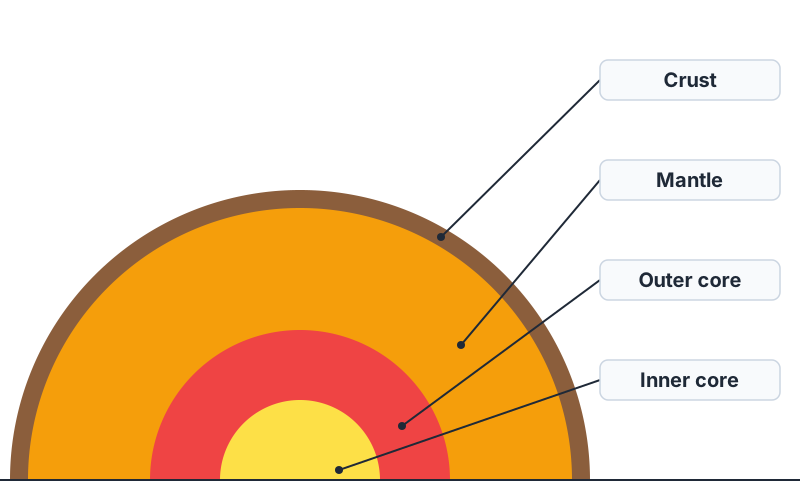
Outer core
Inner core
Mantle
Crust
The outer core is molten iron and nickel, and its flowing metal generates Earth's magnetic field. The mantle is solid rock that flows very slowly over millions of years, but it is not a liquid.
The inner core is hotter than the outer core, yet it is solid. Why?
It is made of a different, non-metal material
It is cooler than the outer core
It is surrounded by ice
The enormous pressure at the center keeps the iron solid
Pressure raises the melting point of iron. At Earth's center, the pressure is so great that iron stays solid even at temperatures similar to the Sun's surface.
Which layer makes up most of Earth's volume?
Crust
Outer core
Mantle
Inner core
The mantle is about 2,900 km thick and holds roughly 84% of Earth's volume. The crust is a thin skin, only about 5–70 km thick.
The lithosphere is made of:
The crust only
The crust plus the rigid uppermost mantle
The mantle and outer core
The soft, partly molten layer the plates move on
The lithosphere is the rigid outer shell broken into tectonic plates. Beneath it is the asthenosphere, a hotter, softer part of the upper mantle that flows slowly and lets the plates move.
An oceanic plate collides with a continental plate. What happens?
The continental plate subducts under the oceanic plate
The plates slide past each other with no volcanoes
The denser oceanic plate subducts, forming a deep trench and a volcanic mountain range
The plates pull apart and form a mid-ocean ridge
Oceanic crust (basalt) is denser than continental crust (granite), so it sinks. Melting above the sinking slab feeds volcanoes, as in the Andes. A mid-ocean ridge forms at divergent boundaries.
At a divergent boundary such as the Mid-Atlantic Ridge:
Plates move apart and new oceanic crust forms
Plates collide and crust is destroyed
Plates slide past each other horizontally
Continents collide to form high mountains
Magma rises into the gap and cools into new seafloor (seafloor spreading). The Atlantic widens by a few centimeters a year, about as fast as fingernails grow.
California's San Andreas Fault is an example of which type of plate boundary?
Divergent
Convergent oceanic-continental
Convergent continental-continental
Transform
At a transform boundary, plates grind past each other sideways. Crust is neither created nor destroyed, but stress builds and releases as earthquakes.
The Himalayas formed mainly because of:
Subduction of an oceanic plate under a continent
A hot spot under the Indian Ocean
Plates pulling apart
A collision between two continental plates
India crashed into Asia. Both are continental and too buoyant to subduct, so the crust crumpled and thickened into the world's highest mountains, which are still rising.
Which evidence did Alfred Wegener use to support continental drift?
Matching fossils, such as Mesosaurus, on continents now separated by oceans
Magnetic striping on the seafloor
GPS measurements of plate motion
Seismic waves passing through the core
Wegener cited matching fossils, rock formations and coastlines, plus glacial evidence in now-tropical places. Seafloor magnetic striping was discovered decades later and explained how the continents could move.
Which observation supports seafloor spreading?
The oldest ocean rocks are found at the ridges
Ocean crust is older than most continental crust
Seafloor rocks show no magnetic pattern
Rocks get older moving away from a mid-ocean ridge, with matching magnetic stripes on each side
New crust records Earth's magnetic field as it cools, and the field flips over time. The result is symmetric stripes on both sides of a ridge, with the youngest rock at the ridge itself.
Granite has large, visible crystals while basalt has tiny ones. Why?
Granite cooled quickly at the surface; basalt cooled slowly underground
Granite cooled slowly underground; basalt cooled quickly at the surface
Granite is sedimentary and basalt is metamorphic
Basalt was crushed by pressure
Slow cooling deep underground (intrusive igneous rock) gives crystals time to grow. Lava cooling fast at the surface (extrusive) forms small crystals or even glass, like obsidian.
In which type of rock are fossils most commonly found?
Igneous
Metamorphic
Sedimentary
All three equally
Sedimentary rocks such as limestone and shale form from layers of sediment that can bury organisms gently. The heat of igneous and metamorphic processes usually destroys fossils.
Limestone is exposed to heat and pressure deep underground. Which metamorphic rock forms?
Marble
Slate
Quartzite
Granite
Limestone becomes marble. Shale becomes slate, and sandstone becomes quartzite. Granite is an igneous rock.
A mineral scratches glass (hardness about 5.5) but is scratched by quartz (hardness 7). What is its approximate Mohs hardness?
4
8
6
10
It must be harder than 5.5 and softer than 7, so about 6, like orthoclase feldspar. On the Mohs scale, talc is 1 and diamond is 10.
Seismologists find that S waves do not pass through Earth's outer core. What does this show?
The outer core is solid iron
The outer core is liquid
The outer core is hollow
The mantle is liquid
S (shear) waves cannot travel through liquids, so they leave a shadow zone on the far side of Earth. P waves pass through both solids and liquids, though they bend at the core boundary.
What is the epicenter of an earthquake?
The point underground where the rupture starts
The place with the most damage
The point on the surface directly above where the rupture starts
The seismograph station that records it first
The rupture begins at the focus (hypocenter), underground. The epicenter is its projection on the surface. The worst damage often happens near the epicenter, but local soil also matters.
An earthquake of magnitude 6.0 compared with one of magnitude 5.0 has:
Exactly 2 times the energy
About 10 times the ground-motion amplitude and about 32 times the energy
About 10 times the energy and the same amplitude
1.2 times the amplitude
Magnitude scales are logarithmic. Each whole number step means 10 times the measured wave amplitude and roughly 32 times the energy released. Two steps is about 1,000 times the energy.
