Quiz · Medium
Atomic radius, ionization energy, electronegativity, electron affinity and ion size, with the reasons behind each trend. Uses the first three periods of the table.
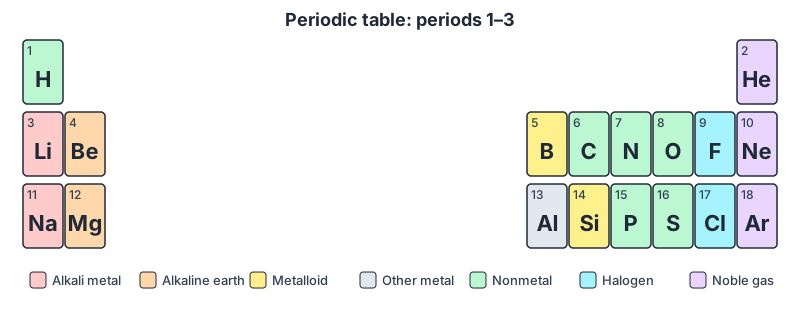
Using the table, which period 3 element has the largest atomic radius?
Cl
Ar
Na
Mg
Atomic radius decreases from left to right across a period because more protons pull on electrons in the same shell (higher effective nuclear charge). Sodium, at the far left, is largest.
Which element has the highest first ionization energy of all?
Ne
He
F
H
Ionization energy rises up a group and across a period, so it peaks at the top right: helium (about 2,372 kJ/mol). Its two electrons are very close to the nucleus with no shielding. Neon is high but lower than helium.
Which element is the most electronegative?
F
O
Cl
N
Fluorine has the highest Pauling electronegativity (3.98). Electronegativity increases toward the top right, excluding noble gases. Chlorine is lower because its valence electrons are in a larger, more shielded shell.
Moving down a group, first ionization energy generally:
Increases, because there are more protons
Decreases, because valence electrons are farther from the nucleus and more shielded
Stays the same, because the valence electron count is the same
Increases, because atoms get smaller
Each new period adds an electron shell, so the outer electron is farther away and more shielded and is easier to remove. More protons do not win because shielding grows too.
Compared with a neutral sodium atom, a Na+ ion is:
Smaller, because it lost its entire outer (3s) shell
Larger, because it has a positive charge
The same size, because the nucleus is unchanged
Larger, because the remaining electrons repel more
Na+ has lost its single 3s electron, leaving the [Ne] configuration with one fewer shell. Cations are always smaller than their parent atoms; anions are larger.
O²⁻, F⁻, Na+ and Mg²⁺ all have 10 electrons. Which is largest?
Mg²⁺
Na+
O²⁻
F⁻
In an isoelectronic series, the ion with the fewest protons holds the same electrons least tightly. O²⁻ has 8 protons and Mg²⁺ has 12, so O²⁻ is largest and Mg²⁺ smallest.
Which pair of elements from the table is most likely to form an ionic compound?
C and O
N and H
Ne and Ar
Na and Cl
Ionic bonds form between a metal with low ionization energy and a nonmetal with high electronegativity, here an alkali metal and a halogen. C and O and N and H are nonmetal pairs that share electrons (covalent bonds), and noble gases do not bond.
Which element is in group 2, period 3?
Be
Mg
Al
Ca
Period 3 is the third row and group 2 is the alkaline earth column, which gives magnesium. Beryllium is group 2 but period 2, and aluminum is in group 13.
An element's first four ionization energies are 738, 1451, 7733 and 10,543 kJ/mol. Which group is it most likely in?
Group 1
Group 13
Group 2
Group 16
The huge jump comes after the second electron, so the atom has two valence electrons. Removing a third means breaking into a full inner shell. These are magnesium's actual values.
Why is the first ionization energy of oxygen slightly LOWER than that of nitrogen?
Oxygen's fourth 2p electron is paired in an orbital, and the repulsion makes it easier to remove
Oxygen has fewer protons than nitrogen
Oxygen's outer electron is in a higher energy level
Nitrogen is a noble gas
Nitrogen has three unpaired 2p electrons (a stable half-filled set). Oxygen's extra electron has to pair up, and electron-electron repulsion lowers the energy needed to remove it.
Which element has the most metallic character?
Li
Cs
Al
Cl
Metallic character (how easily an atom loses electrons) increases down and to the left. Cesium sits low in group 1, so its single valence electron is lost very easily.
How many valence electrons does phosphorus (group 15) have?
3
15
5
2
For main-group elements, the valence electrons equal the last digit of the group number (13–18) or the group number itself (1–2). Phosphorus is 3s² 3p³, which is 5 valence electrons.
What is the ground-state electron configuration of chlorine (Z = 17)?
1s² 2s² 2p⁶ 3s² 3p⁵
1s² 2s² 2p⁶ 3s² 3p⁶
1s² 2s² 2p⁶ 3s¹ 3p⁶
1s² 2s² 2p⁵ 3s² 3p⁶
Fill in order 1s, 2s, 2p, 3s, 3p: 2 + 2 + 6 + 2 + 5 = 17 electrons. The 3p⁶ version has 18 electrons, which is argon or the Cl⁻ ion.
Why are noble gases so unreactive?
They have no electrons in their outer shell
They are radioactive
Their nuclei have no protons
They have a full valence shell, so gaining or losing electrons costs a lot of energy
A filled valence shell (an octet, or 2 for helium) gives high ionization energy and almost no tendency to gain electrons. That stability is what other elements reach by bonding.
Which element releases the MOST energy when it gains an electron (has the most negative electron affinity)?
F
O
Cl
Ne
Chlorine's electron affinity (about −349 kJ/mol) is more negative than fluorine's (about −328 kJ/mol). Fluorine is so small that the added electron feels strong repulsion from the crowded 2p subshell. It is a well-known exception to the trend.
Across a period from left to right, what happens to the effective nuclear charge felt by valence electrons?
It increases, because protons are added while inner-shell shielding stays about the same
It decreases, because more electrons shield the nucleus
It stays constant across the period
It increases, because a new shell is added with each element
Electrons added in the same shell shield each other poorly, so each extra proton increases the net pull. This one idea explains the trends in radius, ionization energy and electronegativity across a period.
Which element shown in the table is a metalloid?
Al
P
Si
S
Silicon (and boron) are metalloids, with properties between metals and nonmetals. Silicon's semiconductor behavior is why it is used in computer chips. Aluminum is a metal; phosphorus and sulfur are nonmetals.
