Quiz · Medium
Test yourself on organelles, membranes and transport, osmosis, and the cell cycle. Good review for high school biology and intro college bio exams.
In the animal cell shown, which labeled organelle makes most of the cell's ATP by aerobic respiration?
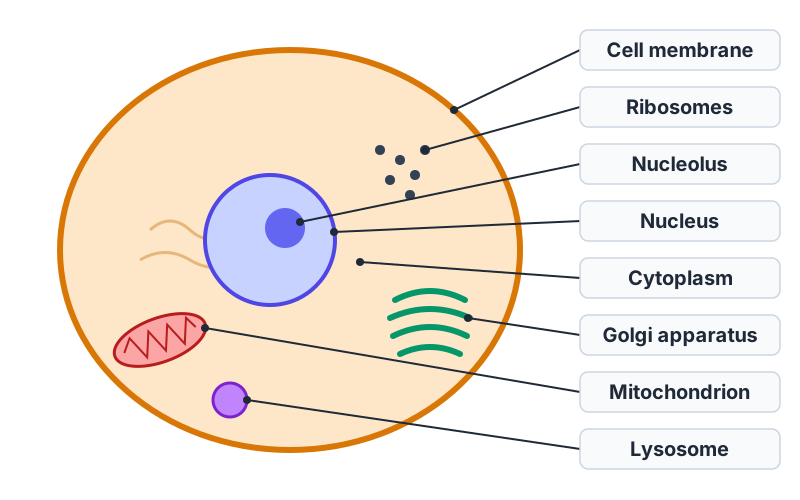
Golgi apparatus
Nucleolus
Mitochondrion
Lysosome
The mitochondrion runs the Krebs cycle and oxidative phosphorylation, which produce most of a cell's ATP. The Golgi apparatus modifies and packages proteins; it does not make energy.
Which labeled structure inside the nucleus is where ribosomal RNA is made and ribosome subunits are assembled?
Ribosomes
Nucleolus
Golgi apparatus
Cytoplasm
The nucleolus is a dense region of the nucleus that transcribes rRNA and assembles ribosome subunits. The finished subunits leave through nuclear pores and become the ribosomes you see in the cytoplasm.
Which structure is found in plant cells but NOT in animal cells?
Mitochondrion
Ribosome
Chloroplast
Golgi apparatus
Plant cells have chloroplasts (plus a cell wall and usually a large central vacuole). A common mistake is thinking plants have chloroplasts instead of mitochondria: plant cells have both, because they also do cellular respiration.
Which feature separates prokaryotic cells from eukaryotic cells?
Prokaryotes lack a membrane-bound nucleus
Prokaryotes lack ribosomes
Prokaryotes lack DNA
Prokaryotes lack a plasma membrane
Prokaryotes (bacteria and archaea) keep their DNA in a nucleoid region with no surrounding membrane. They still have DNA, a plasma membrane and ribosomes (smaller 70S ribosomes).
Which function belongs to the smooth endoplasmic reticulum?
Making proteins that will be secreted
Synthesizing lipids and detoxifying drugs
Sorting and tagging proteins for export
Digesting worn-out organelles
Smooth ER has no ribosomes; it makes lipids and steroids, stores calcium and detoxifies drugs (liver cells have lots of it). Making secreted proteins is the job of rough ER, whose ribosomes give it the rough look.
A cell's lysosomes stop working. Which process is most directly affected?
ATP production
Protein synthesis at ribosomes
DNA replication
Breaking down worn-out organelles and engulfed material
Lysosomes contain hydrolytic enzymes that digest old organelles, macromolecules and material taken in by endocytosis. Lysosomal storage diseases such as Tay-Sachs happen when one of these enzymes is missing.
According to the fluid mosaic model, what forms the basic bilayer of the plasma membrane?
Cholesterol
Glycoproteins
Phospholipids
Cellulose
Phospholipids arrange tails-in, heads-out to form the bilayer. Cholesterol sits between them to adjust fluidity, and proteins float in it like tiles in a mosaic. Cellulose is part of the plant cell wall, not the membrane.
A red blood cell is placed in a hypertonic salt solution. What happens?
Water enters the cell and it swells until it may burst
There is no net movement of water
Salt is pumped in until the cell bursts
Water leaves the cell and it shrinks (crenates)
Hypertonic means the outside has a higher solute concentration, so water moves out by osmosis and the cell shrivels. Swelling and bursting (lysis) happen in a hypotonic solution, the opposite case.
Which transport process uses ATP directly?
Diffusion of oxygen across the membrane
Osmosis of water through aquaporins
Facilitated diffusion of glucose through a carrier protein
The sodium-potassium pump moving ions against their gradients
Primary active transport such as the Na+/K+ pump hydrolyzes ATP to move ions against their concentration gradients. Facilitated diffusion uses a protein but no energy, because molecules move down their gradient.
For each ATP it hydrolyzes, the sodium-potassium pump moves:
2 Na+ out and 3 K+ in
3 Na+ out and 2 K+ in
3 Na+ in and 2 K+ out
1 Na+ out and 1 K+ in
The pump exports 3 sodium ions and imports 2 potassium ions per ATP. Because more positive charge leaves than enters, it helps keep the inside of the cell negative (the resting membrane potential).
A cube-shaped cell has sides of 2 µm. What is its surface-area-to-volume ratio?
1.5 : 1
6 : 1
3 : 1
1 : 3
Surface area = . Volume = . Ratio = 24 / 8 = 3 : 1. A 4 µm cube gives 96 / 64 = 1.5 : 1, which shows why bigger cells have relatively less membrane for exchange and why cells stay small.
During which phase of the cell cycle is DNA replicated?
S phase
G1 phase
G2 phase
Prophase
DNA is copied during the S (synthesis) phase of interphase. G1 is growth before replication and G2 is preparation for mitosis; by prophase the chromosomes have already been copied and are condensing.
Sister chromatids separate and move toward opposite poles during:
Metaphase
Anaphase
Telophase
Prophase
In anaphase the cohesin holding sister chromatids together is cut and spindle fibers pull them apart. In metaphase they are still joined and lined up at the cell's equator.
A human skin cell with 46 chromosomes divides by mitosis. How many chromosomes does each daughter cell have?
46
23
92
44
Mitosis produces two genetically identical diploid cells, each with the same 46 chromosomes as the parent. Halving to 23 happens only in meiosis, when gametes are made.
Crossing over between homologous chromosomes happens during:
Prophase II of meiosis
Prophase of mitosis
Anaphase I of meiosis
Prophase I of meiosis
Homologous chromosomes pair up (synapsis) and swap segments in prophase I. By meiosis II the homologs are already in separate cells, so there is no homolog to cross over with.
Which observation supports the endosymbiotic theory for the origin of mitochondria?
Mitochondria are found in all prokaryotes
Mitochondria have their own circular DNA, bacteria-like ribosomes and a double membrane
Mitochondria are built by the Golgi apparatus
Mitochondria cannot divide on their own
Mitochondria resemble free-living bacteria: circular DNA, small ribosomes, two membranes, and they divide by a fission-like process. Prokaryotes do not have mitochondria, which is part of why the idea is that an ancestral cell engulfed one.
What is the correct path of a protein that will be secreted from the cell?
Rough ER → Golgi apparatus → secretory vesicle → plasma membrane
Golgi apparatus → rough ER → lysosome → plasma membrane
Nucleus → smooth ER → mitochondrion → plasma membrane
Free ribosome → lysosome → Golgi apparatus → plasma membrane
Secreted proteins are made by ribosomes on the rough ER, travel in vesicles to the Golgi for modification and sorting, then leave in secretory vesicles that fuse with the plasma membrane (exocytosis).
Which part of the cytoskeleton forms the mitotic spindle?
Microtubules
Actin microfilaments
Intermediate filaments
Collagen fibers
Spindle fibers are microtubules that grow from the centrosomes and attach to kinetochores. Actin microfilaments form the cleavage furrow during cytokinesis in animal cells, which is a different step.
Viruses are considered living cells because they contain genetic material.
True
False
False. Viruses carry DNA or RNA but have no cytoplasm, ribosomes or metabolism, and they can reproduce only inside a host cell. Cell theory does not count them as cells.
