Quiz · Medium
How presidents and Congress are elected, with an electoral map, contingent elections, faithless electors and election administration.
How many electoral votes does a candidate need to win the presidency?
218
270
300
538
538 total electors (435 + 100 + 3 for DC), so a majority is 270. 218 is the majority of the House.
Which statement about the Electoral College is accurate?
Electors are chosen by Congress
Every state has the same number of electors
The winner of the national popular vote always wins
In 48 states and DC the statewide winner takes all electoral votes
Maine and Nebraska split their votes by district. The winner of the popular vote lost in 1876, 1888, 2000 and 2016.
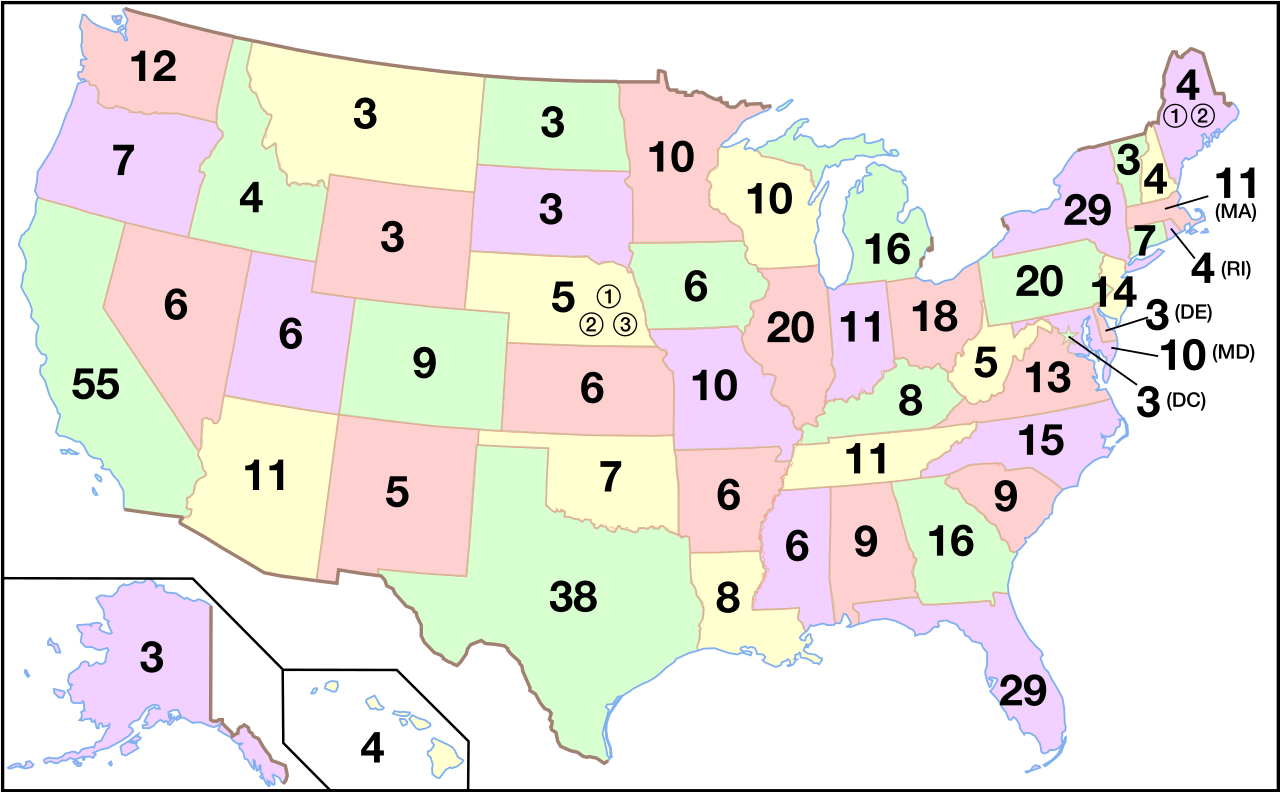
Looking at the map, which of these states had the most electoral votes (2012-2020 apportionment)?
California
Texas
New York
Florida
California had 55, Texas 38, New York and Florida 29 each on this map. Since 2024 California has 54 and Texas 40.
What is the main difference between an open primary and a closed primary?
Only party members vote in an open primary
Open primaries are held in the general election
In an open primary any registered voter may choose which party's primary to vote in
Closed primaries have no candidates
Closed primaries limit participation to registered party members; semi-closed ones also admit unaffiliated voters.
No presidential candidate gets 270 electoral votes. What happens under the 12th Amendment?
The Senate picks the president
The Supreme Court decides
The House picks the president from the top three, with one vote per state delegation
A new election is held within 30 days
The Senate chooses the vice president, one vote per senator.
Which election feature most helps incumbents in House races?
Name recognition, fundraising advantages and safe districts
Longer terms
Automatic ballot placement for all incumbents only
Exemption from campaign finance laws
Reelection rates in the House often exceed 90 percent for these reasons.
In a midterm election, the president's party usually:
Gains seats in the Senate only
Wins every seat
Is unaffected
Loses seats in Congress
Midterms often act as a referendum on the president, and the president's party typically loses House seats.
A state requires its electors to vote for the candidate who won the state's popular vote. The Supreme Court decided in Chiafalo v. Washington (2020) that this is:
Unconstitutional because electors must be free
Constitutional
Valid only for presidential electors in some states
Violating the 12th Amendment
States may bind electors to their pledges. 'Faithless' electors have never changed an election outcome.
What is a caucus?
A secret-ballot state election
A local party meeting where participants publicly show support for candidates
A convention of superdelegates
A runoff election
A primary is a state-run election by secret ballot; a caucus is a party meeting.
The National Popular Vote Interstate Compact takes effect when:
A majority of states join
Congress approves it by statute
States with at least 270 electoral votes have joined
A constitutional amendment is ratified
Joined states promise to give their electors to the national popular vote winner. It does not change the Constitution.
Which amendment gave Washington, D.C. electors in presidential elections?
The 23rd Amendment
The 24th Amendment
The 22nd Amendment
The 12th Amendment
DC has three electoral votes, as many as the least populous state.
What is a coattail effect?
A candidate's loss because of a vice president
A voter splitting a ticket
A party's platform change
A popular presidential candidate helps same-party candidates win lower offices
Coattails are weaker in recent decades as split-ticket voting has declined.
Which law followed the 2000 Florida recount and funded new voting equipment?
The National Voter Registration Act of 1993
The Voting Rights Act of 1965
The Help America Vote Act of 2002
The Hatch Act
HAVA also created the Election Assistance Commission and required provisional ballots.
The Electoral Count Reform Act (2022) made which change?
It abolished the Electoral College
It raised the threshold for objecting to a state's electors to one-fifth of each chamber and clarified the VP's role is ministerial
It required states to count ballots by hand
It gave the Supreme Court authority over electors
Congress counts electoral votes in a joint session on January 6.
Which of these is a function of a national party convention?
Counting electoral votes
Choosing members of the FEC
Certifying election results
Nominating candidates and adopting the party platform
State officials certify results; conventions are party events.
A voter is not on the registration list at the polling place and insists she registered. What can she usually do?
Cast a provisional ballot that is counted after verification
Vote only if she has a lawyer
Vote in the next election
Be turned away with no option
HAVA requires states to offer provisional ballots in federal elections.
A candidate wins 60 percent of the popular vote in one state and 49 percent in another, both winner-take-all. Which is true?
Both give the candidate all of the state's electoral votes if the other candidates have fewer votes
The 60 percent state gives more electoral votes per voter
The 49 percent state gives no electoral votes
Votes are split in proportion
Only a plurality is needed in nearly all states; Maine and Nebraska differ.
The Australian ballot refers to:
A ranked-choice ballot
A mail ballot
A government-printed secret ballot
A paper ballot counted by machine
US states adopted it in the late 19th century to curb vote buying and intimidation.
Super Tuesday is important because:
The general election is held
Many states hold primaries on the same day, awarding a large share of delegates
The electoral votes are counted
Congress certifies the results
It usually occurs in early March of the presidential election year.
The 20th Amendment sets the start of a president's term on:
March 4
November 8
December 15
January 20
March 4 was the date before 1937. Electors meet in December and Congress counts the votes on January 6.
Which situation is the best example of retrospective voting?
Voting for a party because of its promised future tax plan
Voting against the incumbent because the economy worsened during their term
Voting by family tradition
Voting for a celebrity
Retrospective voting judges past performance; prospective voting looks at promised future policies.
Which two states award some electoral votes by congressional district?
Texas and Florida
Vermont and Alaska
California and New York
Maine and Nebraska
They give two votes to the statewide winner and one per district. On the map, Maine's 4 and Nebraska's 5 are marked by circled numbers.
