Quiz · Medium
Test the JTB analysis and Gettier problems, theories of justification, Descartes, Locke, Hume and Kant, skepticism and perception.
According to the traditional analysis, knowledge is...
true belief
justified belief
belief caused by perception
justified true belief
True belief alone includes lucky guesses, and justified belief can be false. JTB is the analysis Gettier challenged.
In Gettier's case, Smith's belief about the man who will get the job is...
justified and false
justified and true but not knowledge
unjustified but true
true knowledge based on a false lemma
It is true by luck: it is true only because Smith himself gets the job and happens to have ten coins. It also rests on the false premise that Jones will get the job.
Henry sees a real barn in a county full of fake barns. Which concept best explains why he does not know?
His belief is false
Epistemic luck (his belief could easily have been false)
His belief is not justified at all
He lacks the concept of a barn
The case is a Gettier-style counterexample without a false premise. Henry's belief is true, but not safe.
Which theory says justification depends on the reliability of the process that produced the belief?
Coherentism
Internalist evidentialism
Infinitism
Reliabilism
Reliabilism is an externalist view associated with Goldman. Coherentism concerns fit among beliefs; infinitism concerns the structure of reasons.
Which of these positions is an answer to the epistemic regress problem that accepts basic beliefs?
Foundationalism
Coherentism
Infinitism
Skepticism
Foundationalists stop the regress at beliefs justified without inference. Coherentists accept mutual support, infinitists infinite chains.
'All bachelors are unmarried' is a standard example of which kind of statement?
Synthetic and a posteriori
Synthetic and a priori
Analytic and a priori
Analytic and a posteriori
It is true by meaning (analytic) and knowable without experience. Kant's synthetic a priori examples include mathematics and the causal principle.
Hume's problem of induction claims that...
inductive arguments are formally valid
experience can never provide evidence
causes are always observable
there is no non-circular justification for assuming the future will resemble the past
Arguing that induction works because it has worked relies on induction. It does not say experience gives no evidence; it says we cannot justify extrapolation by reason.
Which pair correctly matches thinker and view?
Locke: tabula rasa
Descartes: all ideas come from the senses
Leibniz: no innate ideas
Hume: there are innate ideas of causation
Locke held that the mind starts as a blank slate. Descartes and Leibniz defended innate ideas; Hume derived ideas from impressions.
What does Descartes' evil demon argument add to the dream argument?
It shows God does not exist
It proves the senses are reliable
It extends doubt to simple a priori truths such as arithmetic
It denies that I exist
Dreams cannot easily doubt that 2 + 3 = 5; a demon could. The cogito survives: even a deceived mind exists.
Kant's 'Copernican revolution' proposed that...
the sun does not move
objects as experienced conform to the mind's forms and categories
all knowledge is empirical
things in themselves are known directly
Just as Copernicus changed the viewpoint of astronomy, Kant changed the viewpoint of knowledge: the mind structures experience. Noumena stay unknowable.
In the Müller-Lyer illusion shown, the two horizontal lines have equal length. What is the main epistemological point?
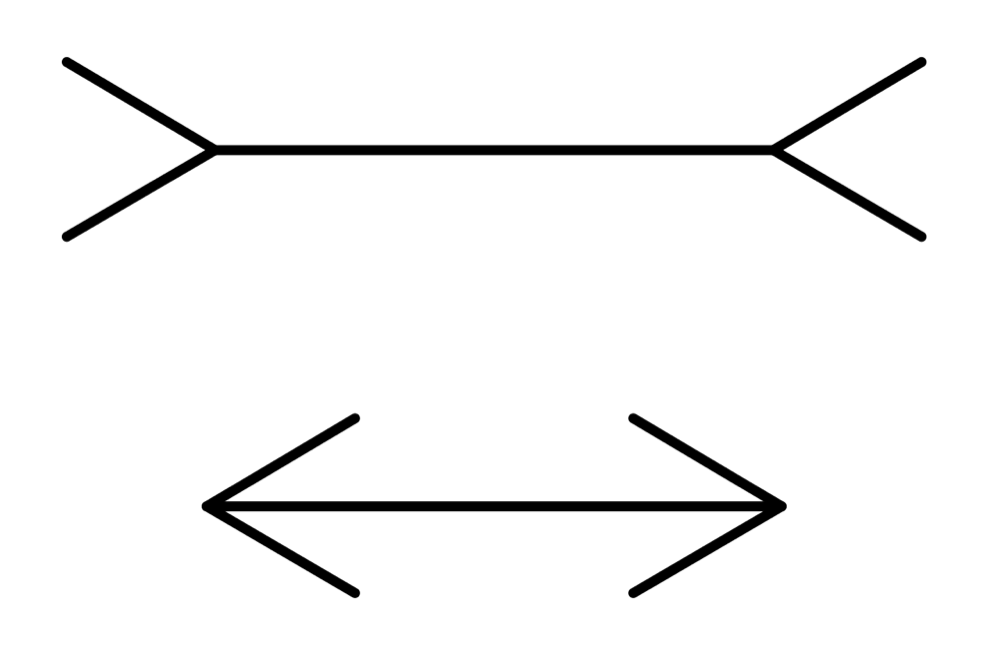
Appearances can mislead even when we know better
Direct realism is true
Perception is infallible when attention is focused
Visual experience gives no information about the world
The illusion persists even after measuring, so perception can differ systematically from reality. It does not show that perception always misleads; direct realism and illusion arguments are separate debates.
The 'Cartesian circle' is the objection that Descartes...
needs God to guarantee clear and distinct ideas, but uses them to prove God
doubts too much
infers existence from thinking
cannot define 'idea'
The circle is between the proof of God's existence and the guarantee of clear and distinct perception. It is not about the cogito.
Moore's response to skepticism about the external world is that...
the skeptic's argument is invalid
hands cannot be seen
he is more certain that he has hands than of any skeptical premise
we should suspend judgment
Moore turns the skeptical argument around: if the premises entail he does not know he has hands, so much the worse for the premises. The skeptic usually says Moore begs the question.
Which view says we perceive physical objects only by way of mental representations (ideas or sense-data)?
Direct realism
Indirect (representative) realism
Disjunctivism
Pyrrhonism
Locke's view. Direct realists deny any intermediary, and disjunctivism is a direct-realist alternative.
Nozick's response to skepticism denies...
that we have hands
that the brain-in-a-vat hypothesis is possible
that knowledge requires truth
the closure principle
Nozick's sensitivity condition lets us know we have hands but not that we are not envatted, so knowledge is not closed under known entailment.
Which of these is a coherentist claim?
Some beliefs are justified without support from others
Every belief has an infinite chain of reasons
A belief is justified if it coheres with the rest of one's beliefs
Justification depends only on causal history
Coherentism denies basic beliefs and holds that justification is holistic. The others describe foundationalism, infinitism and causal theories.
The duck-rabbit figure is used to illustrate...
that perception involves interpretation ('seeing-as')
that illusions are caused by faulty optics
that sense-data are not private
that other minds exist
The same lines are seen as a duck or a rabbit depending on interpretation, supporting the claim that observation is shaped by concepts. It is not an optical illusion in the Müller-Lyer sense.
According to Clifford, it is acceptable to believe on insufficient evidence if it is useful.
True
False
Clifford (1877) held that it is wrong always, everywhere and for anyone to believe on insufficient evidence. James took the opposite line for genuine options that evidence cannot settle.
Quine's 'Two Dogmas of Empiricism' attacked...
the existence of the external world
the cogito
Hume's fork only for ethics
the analytic/synthetic distinction and reductionism
Quine argued that the notion of analyticity is circular and that confirmation is holistic. Hume's fork depends on the analytic/synthetic distinction.
The lottery paradox shows a problem with...
the closure of knowledge under deduction in all cases
identifying justified belief with high probability
the idea that knowledge requires truth
coherentist theories only
Each ticket's loss is highly probable, but believing every ticket will lose contradicts the known fact that one wins. It also puts pressure on closure under conjunction.
Which statement about Pyrrhonian skepticism is correct?
It asserts that knowledge is impossible
It aims at suspension of judgment and tranquility
It was developed by Descartes
It rejects the use of reason in daily life
Pyrrhonists suspend judgment even on whether knowledge is possible, and follow appearances in practical life. Academic skeptics asserted that nothing can be known.
