Quiz · Hard
Multi-step exam-style questions on transformations, composition domains, inverses, asymptotes, difference quotients and log equations.
What is the slant asymptote of ?
y = 2x + 1
y = 2x + 5
y = 2x
y = 2
Divide: 2x² + 3x − 1 = (x + 1)(2x + 1) − 2. The quotient 2x + 1 is the asymptote. y = 2 would apply only if degrees were equal.
The blue graph is a transformation of y = |x|. Which equation matches it?
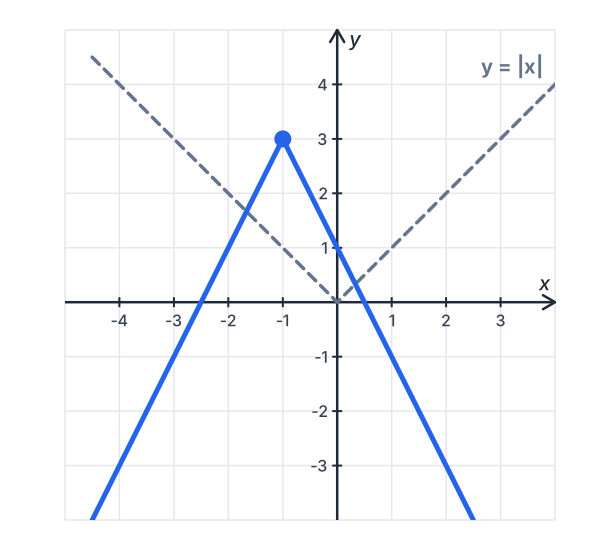
Vertex (−1, 3) gives |x + 1| + 3; the V opens down (negative a); each side has slope ±2, so |a| = 2.
The blue graph is a transformation of y = x². Which equation matches it?
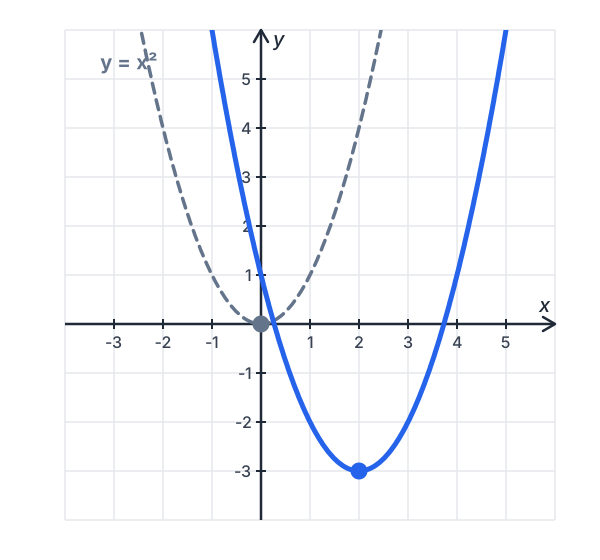
The vertex is (2, −3), so y = (x − 2)² − 3. (x + 2)² would put the vertex at x = −2.
How does compare with the graph of f?
Compress horizontally by 1/3, then shift left 6
Compress horizontally by 1/3, then shift left 2
Stretch horizontally by 3, then shift left 2
Shift left 6, then stretch vertically by 3
Factor first: f(3(x + 2)). That is a horizontal compression by 1/3 and a shift left 2. Shifting 6 ignores the factor of 3.
(−4, 6) is on the graph of y = f(x). Which point is on y = −½ f(x − 3) + 1?
(−1, −2)
(−7, −2)
(−1, 4)
(−1, −3)
New x: −4 + 3 = −1. New y: −½(6) + 1 = −2. Shifting x by −3 is the inside trap.
and . What is the domain of ?
[0, ∞)
[−2, 2]
(−∞, 4]
All real numbers
f(g(x)) = √(4 − x²) needs 4 − x² ≥ 0, so −2 ≤ x ≤ 2. [0, ∞) is the domain of f alone.
Find for .
x(y − 1) = y + 4 ⇒ xy − y = x + 4 ⇒ y = (x + 4)/(x − 1). This function is its own inverse. The reciprocal (x − 1)/(x + 4) is the trap.
Which describes the graph of ?
Vertical asymptotes x = 3 and x = −3
Hole at x = 3, vertical asymptote x = −3, horizontal asymptote y = 1
Hole at x = −3, vertical asymptote x = 3
Vertical asymptote x = −3, no horizontal asymptote
(x − 3)(x + 2)/((x − 3)(x + 3)): x − 3 cancels (hole at x = 3, at the point (3, 5/6)), x + 3 stays (asymptote x = −3). Equal degrees give y = 1/1 = 1.
Simplify the difference quotient of .
f(x + h) − f(x) = 4xh + 2h² − h. Dividing by h gives 4x + 2h − 1. 4x − 1 is the limit as h → 0, not the quotient.
Solve .
x = 2
x = ±2
x = −2
x = √2
(x + 1)(x − 1) = 3 ⇒ x² = 4 ⇒ x = ±2. x = −2 makes both log arguments negative, so only x = 2 works.
Which function is one-to-one on its whole domain?
x³ + 2 is strictly increasing, so it passes the horizontal line test. The other three repeat outputs.
Which describes the end behavior of ?
Up on both ends
Down on both ends
Rises left, falls right
Falls left, rises right
Even degree, negative leading coefficient: both ends go down. The 5x³ term does not control end behavior.
. What does the graph do at x = 2 and x = −1?
Crosses at both
Touches at x = 2, crosses at x = −1
Crosses at x = 2, touches at x = −1
Touches at both
Even multiplicity (2) at x = 2 means touch and turn; odd multiplicity (3) at x = −1 means cross (flattening as it goes through).
A sample of 200 g decays by the model , t in days. How long until 25 g remain?
16 days
24 days
32 days
64 days
25/200 = 1/8 = (0.5)³, so t/8 = 3 and t = 24. The half-life is 8 days: 200 → 100 → 50 → 25 takes three half-lives.
If and , what is ?
3x − 2
3x − 4
6x − 4
4x − 4
f(g(x)) = 2g(x) + 1 = 6x − 3, so g(x) = (6x − 4)/2 = 3x − 2.
For , which statement is true?
f has no inverse
Swapping x and y in y = 1/x gives x = 1/y, so y = 1/x: the function is its own inverse. Its graph is symmetric about y = x.
