Quiz · Medium
Foundational questions on geometric and p-series, the main convergence tests, absolute vs conditional convergence, power series and common Maclaurin series.
Which statement defines the convergence of ?
The terms approach 0
The sequence of partial sums has a finite limit
The terms are decreasing
The partial sums are all positive
A series converges exactly when its partial sums converge. Terms going to 0 is necessary but not sufficient (harmonic series).
Find .
a = 1, r = 2/5, sum = 1/(1 − 2/5) = 5/3. Choosing 5/2 mixes up the formula.
Which series diverges?
is a p-series with p = 1/2 ≤ 1. The others have p > 1 or are geometric with |r| < 1.
A student argues: , so converges. Where is the error?
does not actually approach 0
The nth-term test cannot prove convergence; diverges
The series is alternating
The terms must be negative for the test to work
If terms do not go to 0 the series diverges, but terms going to 0 proves nothing.
What does equal?
1
1/2
∞
π²/6
Telescoping: gives .
Which test is most natural for ?
Alternating series test
Integral test
p-series test
Ratio test
Factorial and exponentials simplify in the ratio . Here the ratio goes to ∞, so the series diverges.
What does the ratio test conclude when ?
The series converges
Nothing; the test is inconclusive
The series diverges
The series converges conditionally
Both and give L = 1 but behave differently.
Which series is conditionally convergent?
Alternating harmonic converges, but its absolute series (harmonic) diverges. The second is absolutely convergent, the third diverges, the fourth is absolutely convergent.
The alternating series test requires all of the following EXCEPT:
is (eventually) decreasing
is a geometric sequence
The terms need only be positive, decreasing and tend to 0, not geometric.
Using , the error after summing 4 terms is at most
The error is bounded by the first omitted term: . Using is the usual off-by-one slip.
If and diverges, then
converges
may do either
diverges
A bigger series than a divergent one must diverge. If instead diverged, could do anything.
Which comparison is valid for deciding ?
Compare with , since
Compare with , since it is larger
Compare with , since it is larger
No comparison is possible
To prove convergence, bound above by a convergent series. 1/n is larger but divergent, which proves nothing.
The radius of convergence of is
1/2
1
∞
2
It is geometric with ratio x/2, which converges when |x| < 2.
Which is the Maclaurin series of ?
Cosine is even, so only even powers, with alternating signs and factorials. The first option is sine.
The Maclaurin series for is centered at
0
1
π/2
x
Maclaurin means Taylor series centered at a = 0.
The interval of convergence of is
At x = 1 it is the harmonic series (diverges); at x = −1 it is the alternating harmonic series (converges).
Which function has the Maclaurin series ?
It is geometric with ratio −x. would have factorials in the denominators.
What is ?
∞
It is the series for at x = 1. Starting at n = 1 would give e − 1.
Differentiating a power series term by term changes
the radius of convergence
possibly the convergence at the endpoints, but not the radius
the center
nothing at all
R is preserved. For example converges at −1, but its derivative does not.
The partial-sum graph of (orange) compared with (blue) shows that
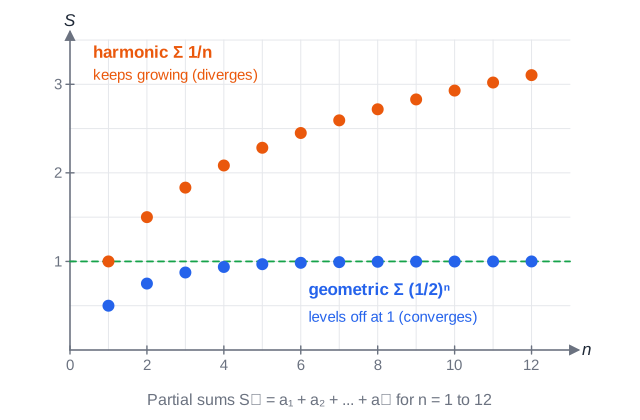
both sets of partial sums level off
the orange sums level off at 3
the blue sums level off but the orange sums keep growing
neither series has a limit
Geometric with r = 1/2 converges to 1; the harmonic series grows like ln n without bound.
Which test does the chart suggest for a series involving factorials and powers ?
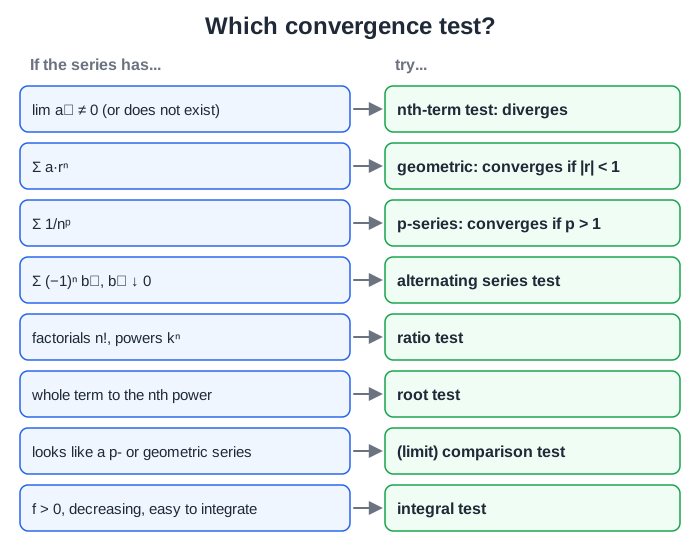
Root test
Integral test
Ratio test
Alternating series test
The chart pairs factorials and with the ratio test; the root test is for terms raised wholly to the nth power.
