Quiz · Hard
Fourteen questions on successive ionization energies, ion radii, exceptions to Aufbau, paramagnetism, lanthanide contraction and trend anomalies.
The first four ionization energies (kJ/mol) of an element are 738, 1450, 7730 and 10500. Which group is it in?
Group 13
Group 14
Group 2
Group 1
A huge jump after the second removal means two valence electrons: group 2 (this is magnesium).
Which species has the electron configuration [Ar] 3d⁵?
Fe³⁺
Fe²⁺
Mn
Cr³⁺
Fe is [Ar] 3d⁶ 4s². Losing three electrons (4s first, then one 3d) gives 3d⁵. Fe²⁺ is 3d⁶ and Cr³⁺ is 3d³.
Which of these has the largest radius?
Cl⁻
K⁺
Ca²⁺
S²⁻
All have 18 electrons. S²⁻ has the fewest protons (16), so the weakest pull, and the largest radius.
Why is the first ionization energy of oxygen lower than nitrogen's?
Oxygen is in a different period
Oxygen has a half-filled 2p subshell
Electron pair repulsion in a 2p orbital in oxygen
Oxygen has a larger nuclear charge
Nitrogen's 2p³ is half-filled and each electron is alone in an orbital; oxygen's 2p⁴ has a pair whose repulsion makes one electron easier to remove.
What is the electron configuration of Cu?
[Ar] 3d⁸ 4s²4p¹
[Ar] 3d¹⁰ 4s¹
[Ar] 3d⁹ 4s²
[Ar] 3d¹⁰ 4s²
A full 3d subshell is especially stable, so one 4s electron moves to the 3d subshell.
Which of these species is paramagnetic?
Zn²⁺
Ca²⁺
Cl⁻
Fe³⁺
Fe³⁺ is 3d⁵ with five unpaired electrons. Zn²⁺ (3d¹⁰), Ca²⁺ and Cl⁻ (noble gas cores) have only paired electrons.
Which statement about electronegativity is correct?
It increases down a group
It decreases across a period
It is highest for noble gases
It increases across a period and up a group
Greater effective nuclear charge and smaller radius attract bonding electrons more strongly. Noble gases are generally not assigned values.
Which oxide would be most basic?
Al₂O₃
SO₂
Na₂O
MgO
Metallic character decreases across a period. Na₂O is strongly basic, Al₂O₃ amphoteric and SO₂ acidic.
Why do the elements Zr and Hf have nearly identical atomic radii?
They are isotopes
Lanthanide contraction
Both are halogens
Both have the same atomic number
The poorly shielding 4f electrons added between them pull the 6th-period elements inward, canceling the usual increase in size down the group.
Which pair of elements is 'out of order' by atomic mass compared with atomic number?
Te and I
Na and Mg
Cl and Ar
O and F
Tellurium (127.6) has a larger mass than iodine (126.9), yet Te comes before I because Z = 52 < 53.
An element X forms a stable ion X³⁺ with the configuration [Ar]. What is X?
Scandium
Aluminum
Gallium
Argon
Sc is [Ar] 3d¹ 4s²; losing three electrons gives [Ar]. Al³⁺ is [Ne] and Ga³⁺ is [Ar]3d¹⁰.
Which is the correct order of increasing first ionization energy?
Si < Al < Mg < Na
Al < Na < Mg < Si
Na < Al < Mg < Si
Na < Mg < Al < Si
Ionization energy generally rises across period 3, but Al (3p¹) is lower than Mg (3s²) because the 3p electron is higher in energy and shielded by the 3s electrons: Na 496 < Al 578 < Mg 738 < Si 786 kJ/mol.
Which element is found at the intersection of period 4 and group 17 in the table?
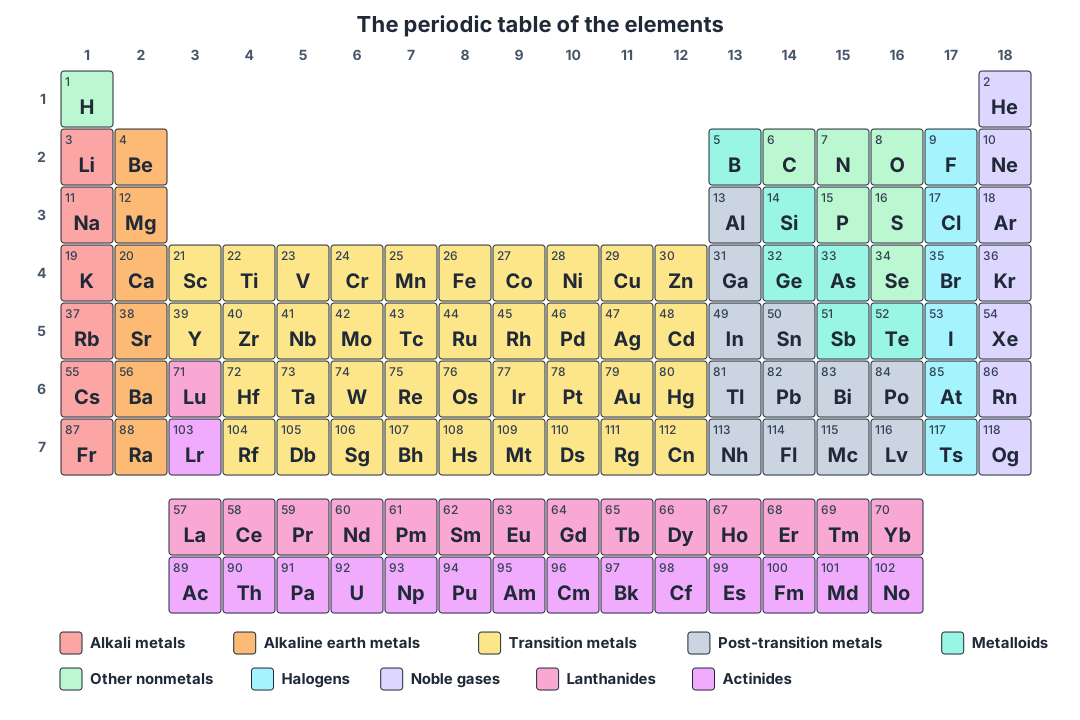
Selenium
Bromine
Chlorine
Iodine
Period 4 and group 17 is bromine (Z = 35). Cl is in period 3, I in period 5, and Se is in group 16.
True or false: hydrogen is an alkali metal because it is in group 1.
True
False
Hydrogen has one valence electron but is a nonmetallic gas; it is placed in group 1 for its configuration (1s¹) only.
