Quiz · Medium
Twenty questions on primary and secondary markets, orders, T-bills, short selling and margin, indices, the Federal Reserve, QE, the Taylor rule, banking regulation and yield curves.
A company sells newly issued shares to investors in an initial public offering. This takes place in the:
Secondary market
Primary market
Money market
Over-the-counter derivatives market
In the primary market the issuer sells new securities and receives the proceeds. Later trades between investors happen in the secondary market.
Which of these is a capital-market instrument rather than a money-market instrument?
A 10-year Treasury note
A 13-week Treasury bill
Commercial paper
A repurchase agreement
The money market covers debt maturing in one year or less. Notes and bonds are capital-market securities.
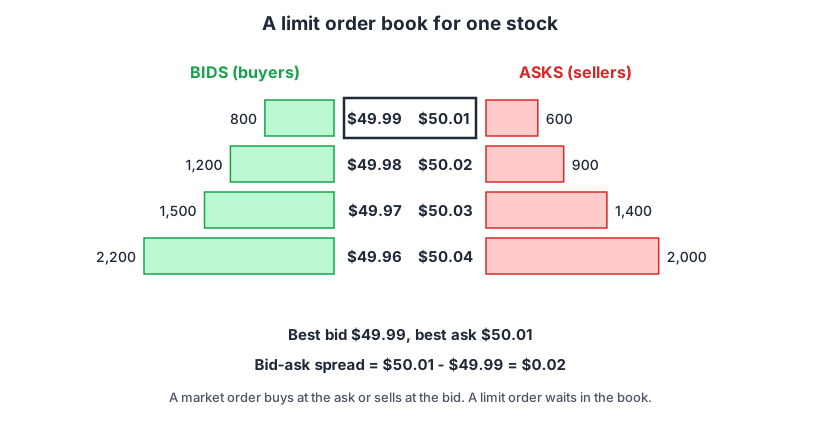
An investor places a market order to buy in the book shown. At what price does the order first trade?
$49.99, the best bid
$50.00, the midpoint
$50.04, the deepest ask
$50.01, the best ask
A market buy order takes the lowest available asking price. The spread of $0.02 is the cost of immediacy.
What does a limit order to buy guarantee?
Execution at the current price
Execution at the opening price
You pay no more than the limit price, but the order may not execute
The best price available all day
A limit order controls price at the cost of execution certainty. A market order does the opposite.
A 182-day T-bill with a $100 face value sells for $97.50. Its discount yield is closest to:
2.56%
4.95%
5.07%
2.50%
Discount yield = (100 - 97.5) / 100 x 360 / 182 = 4.95%. Bond-equivalent yield, which divides by price and uses 365 days, would be higher.
What is the maximum loss on a short sale of a stock?
Unlimited, because the price can rise without a ceiling
The initial sale proceeds
The margin deposit
The stock's original market value
A short seller must buy shares back at whatever price prevails. The maximum gain is the price falling to zero.
You short 100 shares at $80 and cover at $65. Ignoring costs, your profit is:
$1,300
$8,000
$6,500
$1,500
(80 - 65) x 100 = 1,500.
An investor buys 200 shares at $60 ($12,000), borrowing $6,000. With a 25% maintenance margin, a margin call occurs when the share price falls to about:
$45
$30
$40
$15
Equity / value = 25% gives V = 6,000 / 0.75 = 8,000, or $40 a share.
S&P 500 declines by 13% from the prior close in the middle of the trading day. Under US market-wide circuit breakers, what happens?
Trading continues without a pause
Trading halts for 15 minutes
Trading halts for the rest of the day
Trading halts for one hour
A 7% decline triggers a 15-minute halt, a 13% decline a second 15-minute halt, and a 20% decline closes the market for the day.
Which index is price-weighted?
The Dow Jones Industrial Average
S&P 500
Nasdaq Composite
Wilshire 5000
The DJIA's 30 stocks are weighted by share price, so a high-priced stock moves it more. The others are cap-weighted.
The Fed's dual mandate consists of:
Low interest rates and a strong dollar
Balanced budgets and low unemployment
Financial stability and full employment only
Maximum employment and stable prices
Congress set the goals of maximum employment, stable prices and moderate long-term rates. The Fed defines price stability as 2% inflation.
To tighten monetary policy, the Fed could:
Buy long-term Treasuries
Lower the discount rate
Raise the interest it pays on reserve balances and sell securities
Announce lower rate expectations
Higher administered rates and securities sales reduce reserves and push short-term rates up. The others ease policy.
Quantitative easing is best described as:
Raising reserve requirements
Large-scale purchases of longer-term securities by the central bank to lower long-term yields
Selling bonds to drain liquidity
Fixing the exchange rate
QE is used when short-term rates are near zero. The reverse, QT, shrinks the balance sheet.
Banks face a 20% reserve ratio. With the simple money multiplier, $2,000 of new reserves can support up to how much in deposits?
$10,000
$400
$2,500
$40,000
Multiplier = 1 / 0.20 = 5, so 2,000 x 5 = 10,000.
By the Taylor rule with r* = 2%, inflation 4%, target 2% and output gap 0, the recommended policy rate is:
6%
4%
9%
7%
i = 2 + 4 + 0.5 x (4 - 2) + 0.5 x 0 = 7%.
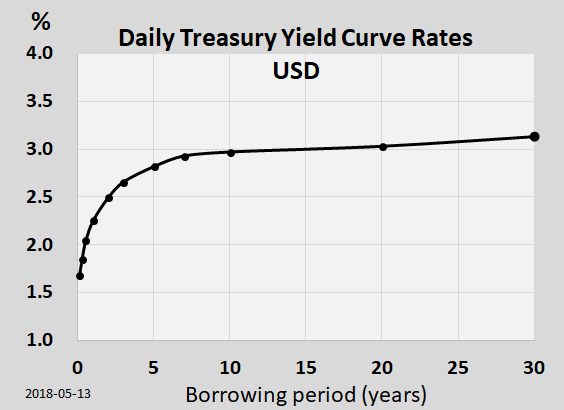
The yield curve shown is described as:
Inverted
Flat
Normal, with long-term yields above short-term yields
Humped, with a peak in the 5-year range
Yields rise with maturity. The slope is steepest at the short end and flattens beyond about 10 years.
Image: Ldecola, CC BY-SA 4.0, via Wikimedia Commons.
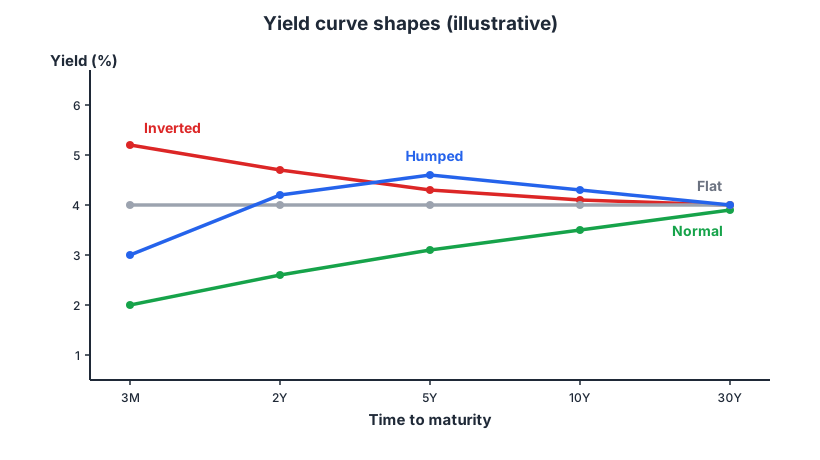
In the chart, the curve that slopes downward from 5.2% to 4.0% is:
Normal
Inverted
Flat
Humped
An inverted curve has short rates above long rates. It has often come before recessions.
Standard FDIC insurance covers deposits up to:
$250,000 per depositor, per insured bank, per ownership category
$100,000 per account
$1,000,000 per bank
All deposits
The limit was raised permanently to $250,000 in 2010.
Basel III requires a minimum common equity tier 1 (CET1) ratio of:
1.5%
10%
25%
4.5% of risk-weighted assets (plus buffers)
The 4.5% minimum is supplemented by a 2.5% capital conservation buffer and other surcharges.
The Secured Overnight Financing Rate (SOFR) replaced which benchmark for US dollar loans?
The prime rate
The federal funds rate
LIBOR
The 10-year Treasury yield
USD LIBOR panels ceased in June 2023. SOFR is based on overnight repo trades secured by Treasuries.
