Quiz · Hard
Sixteen scenario questions on biases, decision rules, adoption and loyalty that require applying concepts, not just recalling definitions.
A bank offers three savings plans: Basic at $10, Premium at $25 and Premium Plus at $27 with almost identical benefits to Premium. Most customers choose Premium Plus. Which bias is at work?
Anchoring only
Sunk cost fallacy
Decoy effect
Mere exposure
Premium is a decoy: slightly cheaper but clearly dominated by Premium Plus, making the latter look like a bargain. Anchoring is relevant but the key mechanism is the asymmetric dominance of the decoy.
A phone brand has an attitude score using . Battery: belief 8, evaluation 3; Camera: belief 6, evaluation 2. What is the score?
36
14
30
11
The score is 8×3 + 6×2 = 24 + 12 = 36. Adding beliefs (14) or evaluations (5) alone ignores the multiplication in the Fishbein model.
A shopper accepts a laptop only if it has at least 16 GB RAM, a 14-inch screen and a budget under $1,200; it is then picked at random among those that pass. Which decision rule is this?
Compensatory weighted sum
Lexicographic
Disjunctive
Conjunctive
Conjunctive rules set minimum cutoffs on every attribute and eliminate any option that fails one. A disjunctive rule would accept an option excelling on any single attribute.
A subscription site shows a pre-ticked 'auto-renew' box and most people leave it ticked. Which is the primary concept?
Reactance
Default effect
Reciprocity
Halo effect
People tend to stay with pre-selected options. Whether it is ethical or legal depends on disclosure and local consumer rules.
A free trial of a streaming service converts many users to paid, even though they would not have bought it unseen. The best behavioral explanation is:
Selective exposure
Endowment effect and loss aversion
Weber's law
Conspicuous consumption
After using something it feels 'ours', and giving it up feels like a loss. Weber's law is about detecting change; conspicuous consumption is status display.
A product gains 2.5% of its eventual market in its first year. Which group has most probably purchased it?
Early majority
Late majority
Laggards
Innovators
Innovators are the first 2.5% of adopters. They tolerate risk and complexity to try new things first.
A startup sells to early adopters but struggles to attract mainstream buyers. Moore's model says the problem is:
Failing to cross the chasm to the early majority
Overpricing
Too much advertising
Selective perception
The chasm lies between visionary early adopters and pragmatic early majority, who need references, a complete solution and proof.
A hotel thanks guests by email, offers a simple return policy and shows good reviews after booking. These actions mostly aim to reduce:
Stimulus discrimination
Perceived physical risk
Cognitive dissonance
Impulse buying
Reassurance after purchase reduces post-purchase doubt (dissonance).
Which pair of facts correctly describes high-involvement buying?
Little search, strong brand loyalty
Low risk, rapid choice
No search, peripheral cues
Extensive search, central-route processing
High involvement leads to careful evaluation (central route in the ELM). Low involvement uses peripheral cues and habit.
A price changes from $9.99 to $10.00. Why might demand drop disproportionately?
Halo effect
Left-digit effect
Social proof
Mere exposure
The left digit jumps from 9 to 10, so the price feels like a much bigger step than the one cent it really is.
Ads for a product emphasize 'don't miss out' and show a countdown. Which TWO principles are most directly used?
Authority and consistency
Reciprocity and liking
Scarcity and loss aversion
Social proof and halo
A deadline and limited stock create scarcity, and framing it as 'missing out' leans on loss aversion.
A shopper buys the same table salt every time without comparing brands. Which buying behavior is this?
Habitual buying
Complex buying
Dissonance-reducing
Variety-seeking
Low involvement with few perceived differences leads to habitual buying. Variety-seeking applies to low involvement with large brand differences (e.g. snacks).
An airline's loyalty program shows many customers repeat-buy but say they would switch for a lower fare. Which concept fits?
True loyalty
Brand attachment
Spurious loyalty
Reference group
Repeat purchase without positive attitude (habit or convenience) is spurious loyalty, easily broken by competitors.
Which statement about the hierarchy of effects (Lavidge and Steiner) is correct?
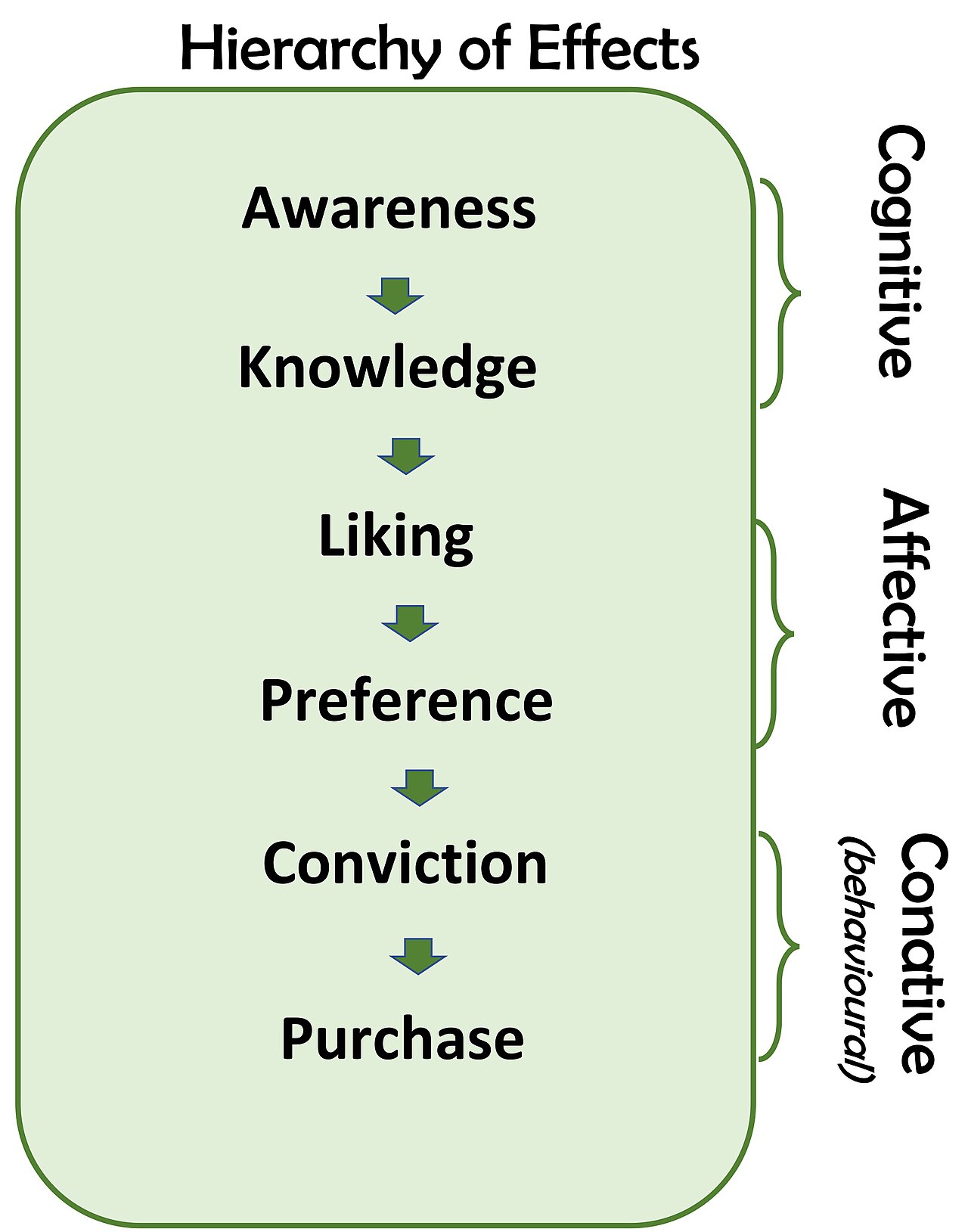
Liking and preference are affective stages
Purchase comes before liking
Knowledge is behavioral
It has only three steps
Liking and preference are affective; awareness and knowledge are cognitive; conviction and purchase are conative. It has six steps. Image: BronHiggs, CC BY-SA 4.0, via Wikimedia Commons.
A family's teenager suggests a holiday destination, the parents decide, one parent books and the whole family uses it. Which roles are present?
Opinion leader only
Only users
Gatekeeper only
Initiator/influencer, decider, buyer, users
The teenager is the initiator or influencer, parents decide and buy, and everyone is a user.
A study tracks users' eyes on a web page and finds no fixation on the right-hand banner. Which concept best explains it?
Subliminal persuasion
Banner blindness (selective attention)
Satisficing
Self-concept congruence
Users learn to ignore ad-like zones. It is selective attention, not subliminal processing.
