Quiz · Medium
Twenty questions on the spending and tax multipliers, closing output gaps, deficits vs debt, automatic stabilizers and crowding out, with debt, deficit and Laffer charts.
An income tax takes $1,000 from a $10,000 income and $25,000 from a $100,000 income. This tax is:
Regressive
Progressive
Proportional
Lump-sum
The average rate rises from 10% to 25% as income rises, so it is progressive.
MPC = 0.75. Taxes are cut by $20 billion. The maximum increase in GDP is:
$80 billion
$60 billion
$20 billion
$15 billion
Tax multiplier = −0.75/0.25 = −3, so a $20 billion cut raises GDP by $60 billion. $80 billion would be the spending multiplier (4) applied to the tax cut.
Which of the following is an automatic stabilizer?
Unemployment insurance payments
A stimulus bill passed by Congress
A cut in the federal funds rate
A one-time tax rebate announced by the President
Unemployment benefits rise automatically in a recession without new legislation. The other options are discretionary fiscal policy or monetary policy.
MPC = 0.8. Government spending rises by $20 billion. The maximum increase in GDP is:
$100 billion
$20 billion
$80 billion
$160 billion
Multiplier = 1/(1 − 0.8) = 5, so ΔGDP = 5 × 20 = $100 billion. $80 billion is the tax-multiplier answer (4 × 20).
There is a recessionary gap of $120 billion and the MPC is 0.75. How much must government spending rise to close it?
$90 billion
$120 billion
$30 billion
$40 billion
Multiplier is 4, so ΔG = 120/4 = $30 billion. Using the tax multiplier (3) would give $40 billion, which is the required tax cut.
Expansionary fiscal policy in a recessionary gap will, in the short run:
Lower real GDP and the price level
Raise real GDP and lower the price level
Raise the price level but leave real GDP unchanged
Raise real GDP and the price level, and lower unemployment
AD shifts right along the upward-sloping SRAS, so output and prices rise and unemployment falls.
Crowding out occurs when:
The central bank buys government bonds
Government borrowing raises interest rates and reduces private investment
Taxes are cut and consumer spending rises
Exports fall because the dollar weakens
Deficit financing competes for loanable funds, raising the real interest rate and reducing investment.
The government spends $3.5 trillion and collects $3.0 trillion in taxes in a year. Which statement is correct?
There is a $0.5 trillion surplus, which reduces the debt
The national debt is $0.5 trillion
There is a $0.5 trillion deficit, which adds to the national debt
The deficit equals the national debt
Deficit = spending − revenue = $0.5 trillion (a flow). It adds to the debt (the stock).
Which policy combination is contractionary?
Cutting government spending and raising income taxes
Raising spending and cutting taxes
Raising spending and raising taxes by equal amounts
Cutting taxes and cutting interest rates
Both reduce AD. Raising spending and cutting taxes are expansionary; a balanced increase is only mildly expansionary (multiplier 1).
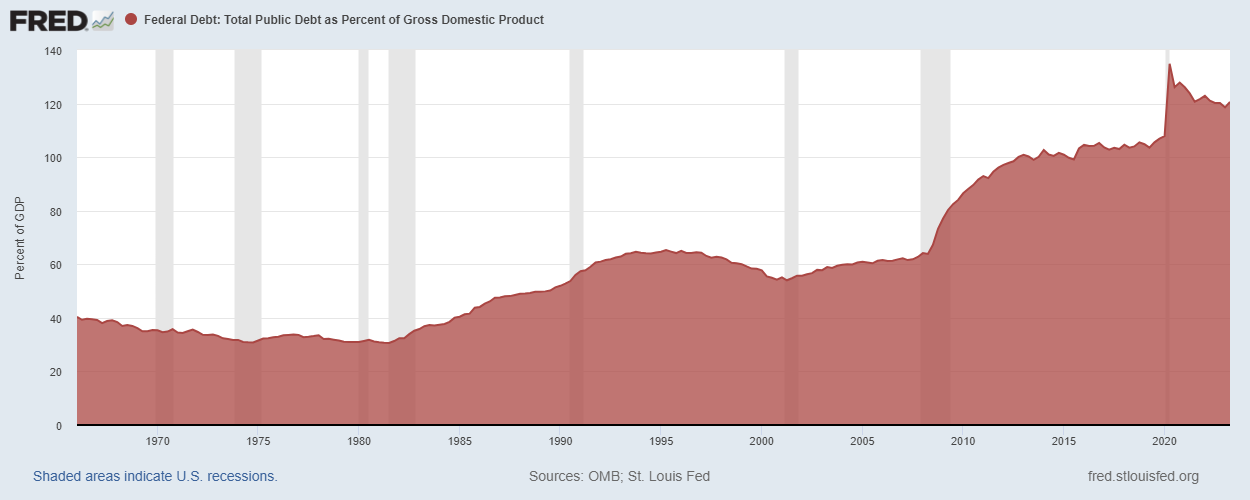
What caused the large jump in the debt-to-GDP ratio in 2020 shown in the chart?
A large budget surplus
The COVID recession cut GDP while relief laws raised borrowing
A fall in interest rates
The abolition of the debt ceiling
The recession reduced GDP and revenue, while the CARES Act and other laws increased spending and borrowing. Image: FRED, public domain.
The green bars in the chart (late 1990s) represent:
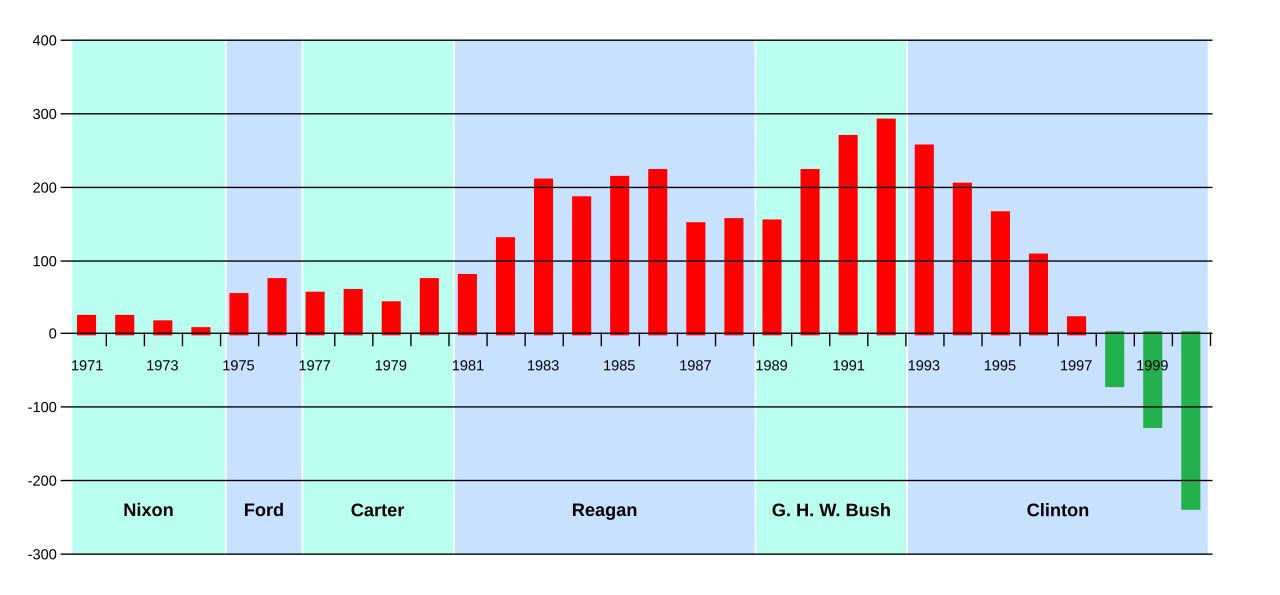
Budget surpluses
Higher spending than revenue
Debt held by foreigners
Interest payments
Red bars are deficits and green bars are surpluses; the US ran surpluses in the late 1990s. Image: Mupper-san, CC0.
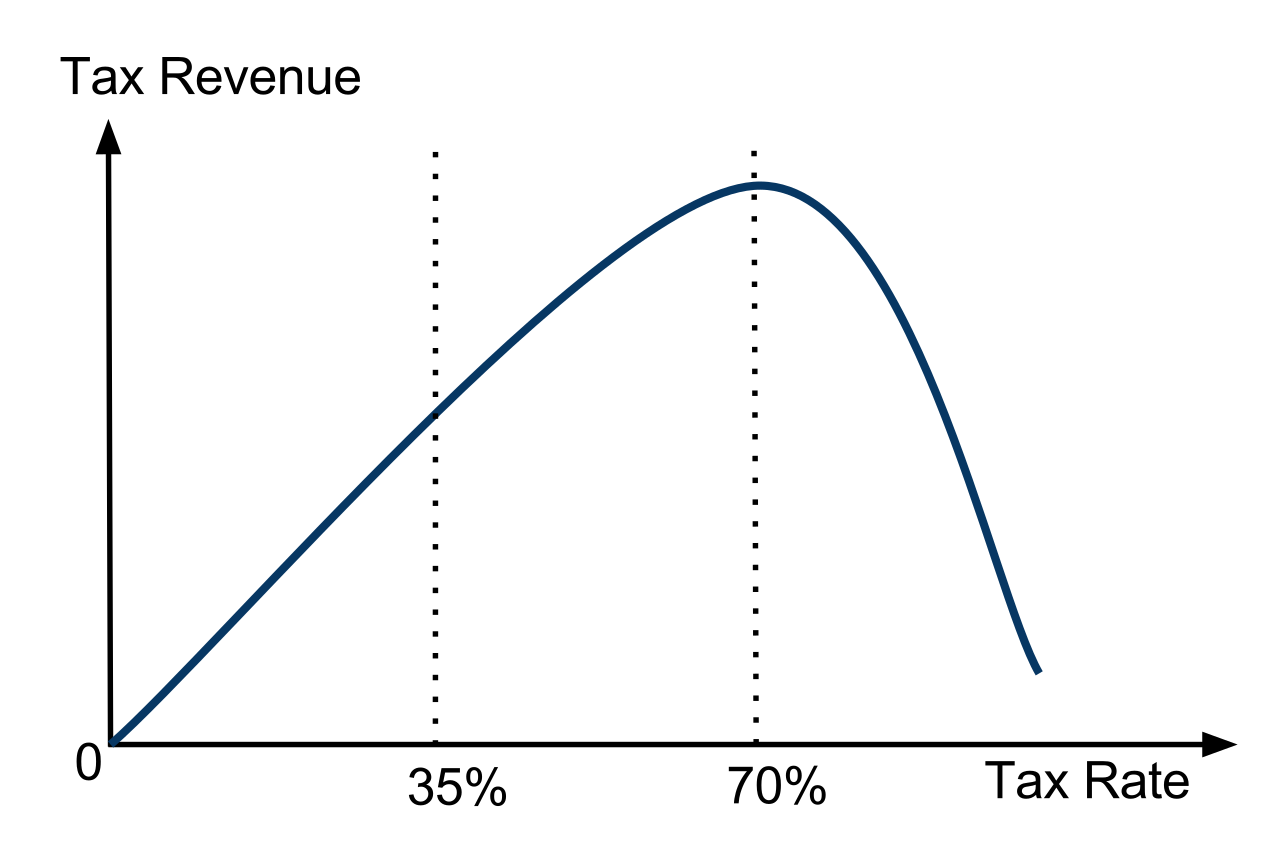
According to the Laffer curve, raising the tax rate above the revenue-maximizing rate:
Raises tax revenue
Reduces tax revenue
Has no effect on revenue
Eliminates deadweight loss
Beyond the peak, higher rates reduce the tax base enough that revenue falls. Image: Lawrencekhoo, CC0.
Which of these is a transfer payment?
Salaries of federal judges
Purchase of fighter jets
Social Security benefits
Spending on highway construction
Transfers are payments with no good or service in return. The others are government purchases (G).
Government spending and taxes both rise by $50 billion. With an MPC of 0.8, GDP rises by:
$250 billion
$200 billion
$0
$50 billion
The balanced budget multiplier is 1: +250 from spending and −200 from taxes net to +$50 billion.
Which lag is most associated with the legislative process in fiscal policy?
The decision (legislative) lag
The money supply lag
The inside lag of automatic stabilizers
The menu cost lag
Congress must pass laws, which takes time; automatic stabilizers have no such delay.
The part of the deficit that exists even at full employment is called:
The structural deficit
The cyclical deficit
The primary surplus
The trade deficit
The cyclical deficit comes from the business cycle; the structural deficit reflects tax and spending policy.
Why is the government spending multiplier larger in magnitude than the tax multiplier?
Taxes do not affect disposable income
Part of any tax change goes to saving, so first-round spending is smaller
Government spending is always larger than taxes
The tax multiplier ignores the MPC
Spending enters AD fully, while a tax cut changes spending only by MPC × the cut.
MPC = 0.5. What is the spending multiplier?
1
5
2
0.5
1/(1 − 0.5) = 2.
Who sets fiscal policy in the United States?
The Federal Reserve
The Supreme Court
The Treasury alone
Congress and the President
Fiscal laws (taxes, spending) require Congress to pass them and the President to sign them. The Fed sets monetary policy.
When unemployment rises in a recession, the budget deficit usually:
Rises because tax revenue falls and transfers rise
Falls because tax revenue rises
Stays the same by law
Becomes a surplus
Automatic stabilizers work through this effect: lower revenue and higher benefits.
True or False: The national debt and the budget deficit are the same thing.
True
False
False. The deficit is a one-year flow (spending minus revenue). The debt is the accumulated stock of past deficits net of surpluses.
