Quiz · Medium
Twenty-two questions on the road to secession, the major battles, emancipation and the end of the war.
What was Sherman's March to the Sea?
A march from Atlanta to Savannah destroying railroads and property
The march to Appomattox
The capture of Vicksburg
The Union retreat after Bull Run
Sherman used total war to break the South's resources and will to fight in late 1864.
What did the Missouri Compromise (1820) do?
Abolished slavery in the North
Allowed popular sovereignty in all territories
Admitted Missouri as a slave state and Maine as a free state, and banned slavery north of 36 degrees 30 minutes in the rest of the Louisiana Purchase
Created the Republican Party
The compromise kept the Senate balanced and drew a line across the Louisiana Purchase. Popular sovereignty came later, in 1850 and 1854.
Which law of 1854 repealed the Missouri Compromise's slavery restriction?
Compromise of 1850
Fugitive Slave Act
Wilmot Proviso
Kansas-Nebraska Act
Douglas's Kansas-Nebraska Act applied popular sovereignty to the territories north of 36 degrees 30 minutes. The Compromise of 1850 predated it; the Wilmot Proviso never became law.
Why did the Fugitive Slave Act of 1850 anger many Northerners?
It banned the slave trade
It required citizens to help return escaped slaves and denied accused fugitives a jury trial
It admitted California as a slave state
It ended popular sovereignty
The law made Northerners complicit in slavery and denied basic due process to people accused of being fugitives.
What did the Supreme Court decide in Dred Scott v. Sandford (1857)?
Congress could not ban slavery in the territories and Black people were not citizens
Black Americans could be citizens in free states
Slavery was illegal in Missouri
Fugitive slaves must be freed
Taney's opinion held that Scott was not a citizen and that the Missouri Compromise was unconstitutional. It inflamed the sectional conflict.
What happened at Harpers Ferry in 1859?
A Confederate victory
John Brown's raid on the federal arsenal
A Union naval battle
The first draft riot
Brown hoped to start a slave uprising, but he was captured and hanged. The raid deepened Southern fears of Northern radicalism.
Why did Southern states secede after the 1860 election?
Lincoln had promised to abolish slavery immediately in the South
Congress had banned cotton exports
Republican victory was seen as a threat to slavery's future and to Southern political power
The Supreme Court had ended slavery
Lincoln promised not to interfere with slavery where it existed but opposed its spread, which Southerners saw as a threat. He had not promised immediate abolition.
What event began the Civil War in April 1861?
The bombardment of Fort Sumter
The Battle of Bull Run
The Emancipation Proclamation
Lincoln's election
Confederates fired on the federal fort in Charleston Harbor on April 12, 1861. Bull Run came in July.
This map is a cartoon of the Anaconda Plan. What was the plan's main idea?
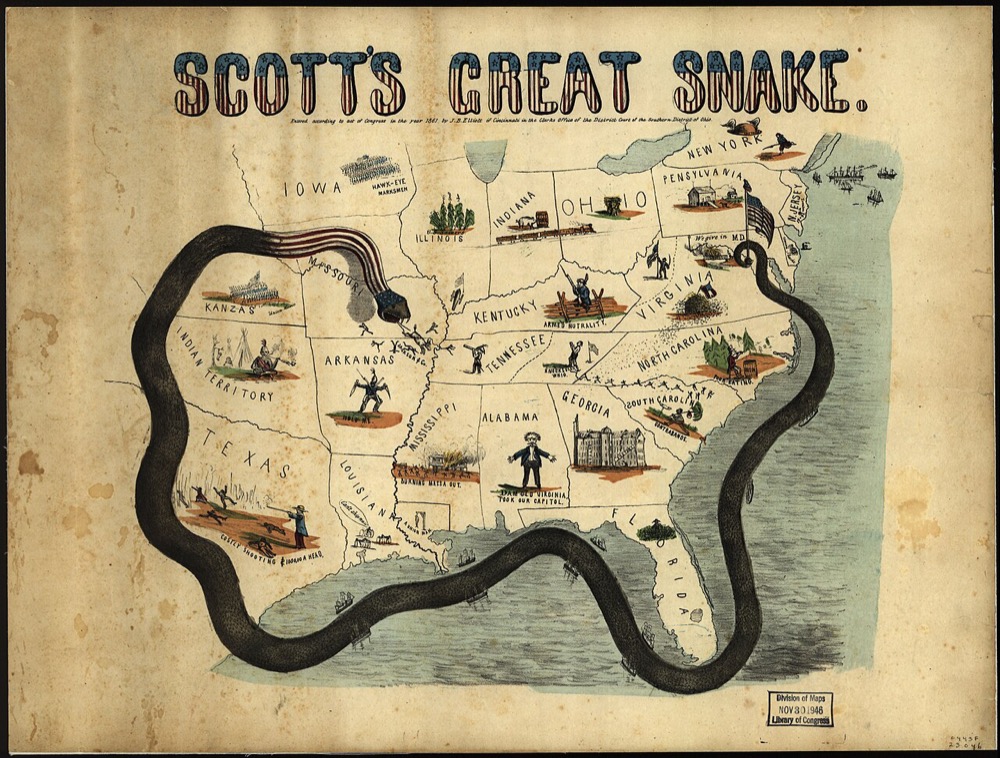
Quickly capture Richmond
Invade the South from Canada
Seek peace
Blockade Southern ports and control the Mississippi River
Winfield Scott proposed a slow squeeze of the Confederacy's economy. Critics wanted immediate offensives. Image: J. B. Elliott, public domain, via Library of Congress and Wikimedia Commons.
The Battle of Antietam (September 1862) was important because
it ended the war
Lee captured Washington
Grant won it
it was the bloodiest single day in American history and allowed Lincoln to issue the preliminary Emancipation Proclamation
About 23,000 casualties; Lee's invasion of the North was halted. Grant was not in command, and Lee did not reach Washington.
Which pair of Union victories in July 1863 marked a turning point?
Bull Run and Antietam
Fredericksburg and Chancellorsville
Gettysburg and Vicksburg
Shiloh and Atlanta
Gettysburg stopped Lee's invasion of the North, and Vicksburg gave the Union control of the Mississippi River.
What did the Emancipation Proclamation (January 1, 1863) do?
Declared slaves free in states in rebellion and allowed Black men to join the Union army
Freed all enslaved people in the United States
Ended slavery in the border states
Granted citizenship to freed people
The proclamation did not apply to the border states or Union-held areas. The 13th Amendment ended slavery nationwide.
What did the 54th Massachusetts Infantry demonstrate?
Britain would enter the war
Black soldiers could fight bravely as part of the Union Army
The draft was unpopular
Lee's army was weak
The regiment's assault on Fort Wagner in July 1863 showed Black soldiers' courage and aided recruiting.
The photograph below shows the aftermath of which battle?
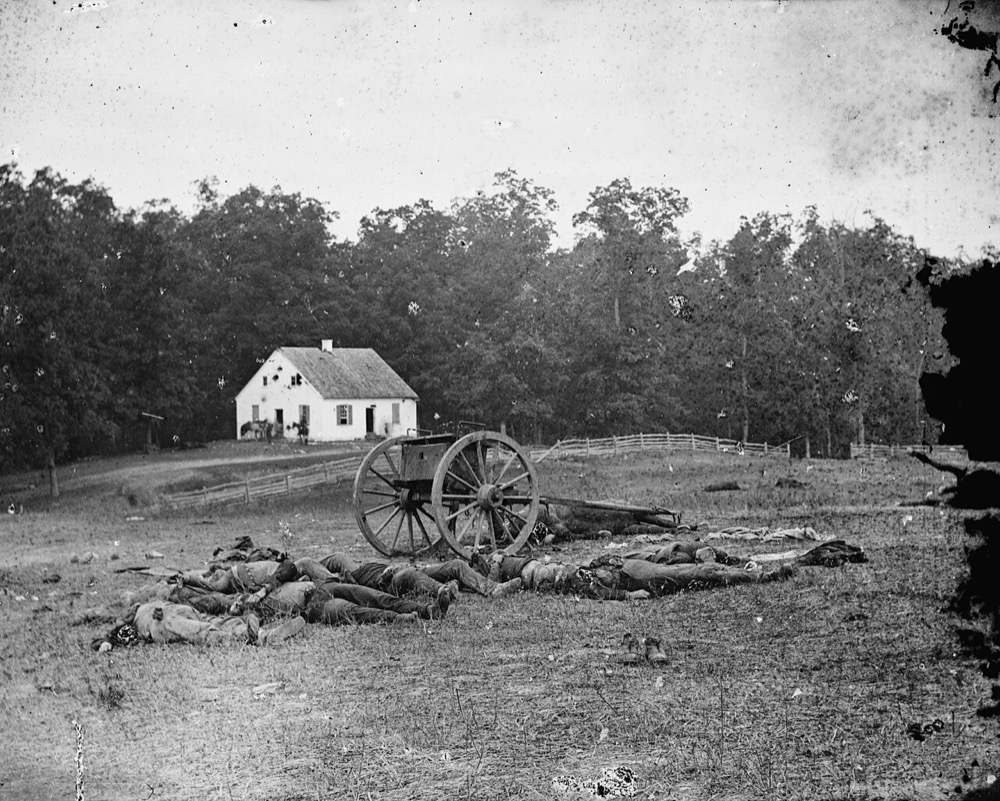
Bull Run
Shiloh
Appomattox
Antietam
Gardner's photographs of Antietam were displayed in New York in 1862 and shocked the public. Image: Alexander Gardner, public domain, via Library of Congress and Wikimedia Commons.
Why did the New York City Draft Riots (July 1863) occur?
Lincoln closed newspapers
Soldiers had not been paid
Workers resented being drafted while wealthier men could pay $300 or hire a substitute
Immigrants were excluded from the draft
The Enrollment Act allowed commutation and substitutes, and rioters also attacked Black residents.
How did the capture of Atlanta in September 1864 affect the election?
It ensured McClellan's victory
It helped Lincoln win reelection by raising Northern morale
It ended the war
It had no effect
Before Atlanta, Lincoln feared losing. Victory brought support, and he won 212 of 233 electoral votes.
The scene shown in this print took place at
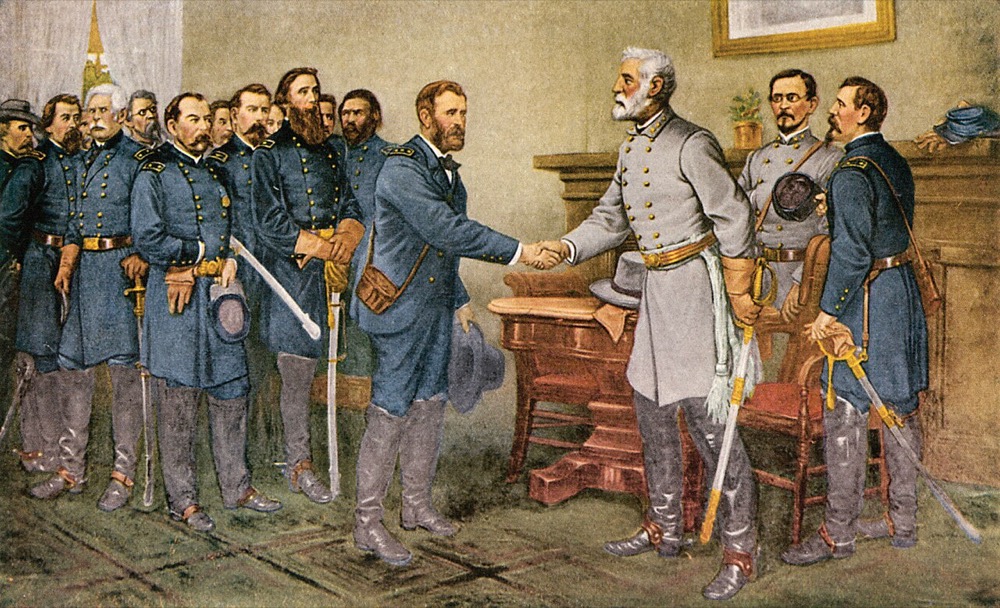
Gettysburg, Pennsylvania
Appomattox Court House, Virginia
Fort Sumter, South Carolina
Richmond, Virginia
Lee surrendered the Army of Northern Virginia to Grant there on April 9, 1865. Image: public domain, via Wikimedia Commons.
What did the Gettysburg Address emphasize?
The Union's victory at Vicksburg
Lincoln's plans for Reconstruction
A new birth of freedom and the ideal that all men are created equal
A call to end the draft
Lincoln redefined the war as a struggle for the nation's founding principles.
Which amendment, ratified in December 1865, abolished slavery?
12th
14th
15th
13th
The 13th Amendment abolished slavery except as punishment for a crime. The 14th (1868) and 15th (1870) dealt with citizenship and voting.
Which statement about the border states is correct?
Delaware, Maryland, Kentucky and Missouri were slave states that remained in the Union
They all seceded
They had no slavery
They joined the Confederacy after Fort Sumter
Lincoln worked to keep them loyal, which is why the Emancipation Proclamation excluded them.
Which advantage did the Union have over the Confederacy?
A larger population and industrial and rail capacity
Better generals at the start
Cotton exports
Fewer casualties
The Union had about twice the population and most of the factories and railroads. The Confederacy often had stronger early generalship.
What was the Homestead Act (1862)?
It created land-grant colleges
It gave settlers 160 acres of public land for farming
It issued greenbacks
It authorized a draft
Passed with Southern lawmakers absent. The Morrill Act created land-grant colleges and the Legal Tender Act issued greenbacks.
