Quiz · Hard
Harder comparison and cause-and-effect questions on colonial labor, government, religion and the road to imperial crisis.
Which development best explains why Chesapeake planters shifted toward enslaved labor in the late 1600s?
Fewer English servants were willing to come, and Bacon's Rebellion alarmed planters about a large class of landless freedmen
A decline in tobacco prices ended servant imports forever
Parliament banned indentured servitude in 1660
The Navigation Acts required slave labor
Rising wages in England reduced migration of servants, and Bacon's Rebellion (1676) made planters fear armed, landless freedmen. Parliament never banned indentured service, and no trade law required slavery.
Which comparison of Virginia and Massachusetts Bay is most accurate?
Both were founded mainly to practice religious dissent
Both restricted voting to church members
Virginia was founded for profit with dispersed settlement, while Massachusetts Bay was built around religious community and towns
Massachusetts relied on a cash-crop plantation economy
Virginia's investors sought profit and settlement spread along rivers. Massachusetts's Puritans sought a godly commonwealth organized into towns. Only Massachusetts restricted voting to church members, and not Virginia.
Which feature of the Massachusetts charter of 1691 marked a change from the original charter?
It created a hereditary aristocracy
It made voting depend on property rather than church membership
It banned Puritan preaching
It guaranteed slavery
After the Glorious Revolution, Massachusetts received a royal charter with a Crown-appointed governor and a property qualification for voting, which weakened Puritan control. It did not create nobility or ban preaching.
Which of the following is the best example of salutary neglect?
Passage of the Stamp Act in 1765
The creation of the Dominion of New England
Pontiac's Rebellion
Widespread colonial smuggling to avoid the Molasses Act with little punishment
Lax enforcement of trade laws left colonists with de facto autonomy. The Stamp Act and the Dominion were attempts at tighter control, the opposite of neglect.
What was the most significant long-term political consequence of salutary neglect?
The colonies became more loyal to Parliament
Colonial legislatures were abolished
Colonial assemblies gained power and habits of self-government
Britain won the French and Indian War faster
Assemblies controlled taxes and governors' salaries and expected to keep those powers. When Britain tightened control after 1763, colonists resisted.
The Half-Way Covenant (1662) reflected which trend in New England?
Declining church membership among the children of the founding generation
Increasing religious fervor among young people
Acceptance of Quaker beliefs
A move to separate church and state
Many in the second generation had not had conversion experiences, so churches allowed partial membership to baptized grandchildren. It shows fading zeal, not growth, and did not separate church from state.
Which statement about the Triangular Trade is the most accurate?
It was a single, tightly organized route all colonial merchants used
It involved no enslaved people
It was banned by the Navigation Acts
It describes a simplified model; actual trade included many routes linking Africa, the Caribbean, North America and Europe
Historians treat the triangle as a model; trade was more complex. Enslaved Africans were central to it, and the Navigation Acts regulated rather than banned it.
Which development did the French and Indian War most directly set in motion?
A policy of salutary neglect
British efforts to tax and control the colonies to pay war debts
French reconquest of Quebec
A Native American alliance with Britain
Britain's debt doubled during the war, and Parliament tried to raise revenue and tighten control in the colonies, which led to the Stamp Act crisis. Salutary neglect ended, not began.
This map shows British, French and disputed regions in 1754-60. Which conclusion is best supported?
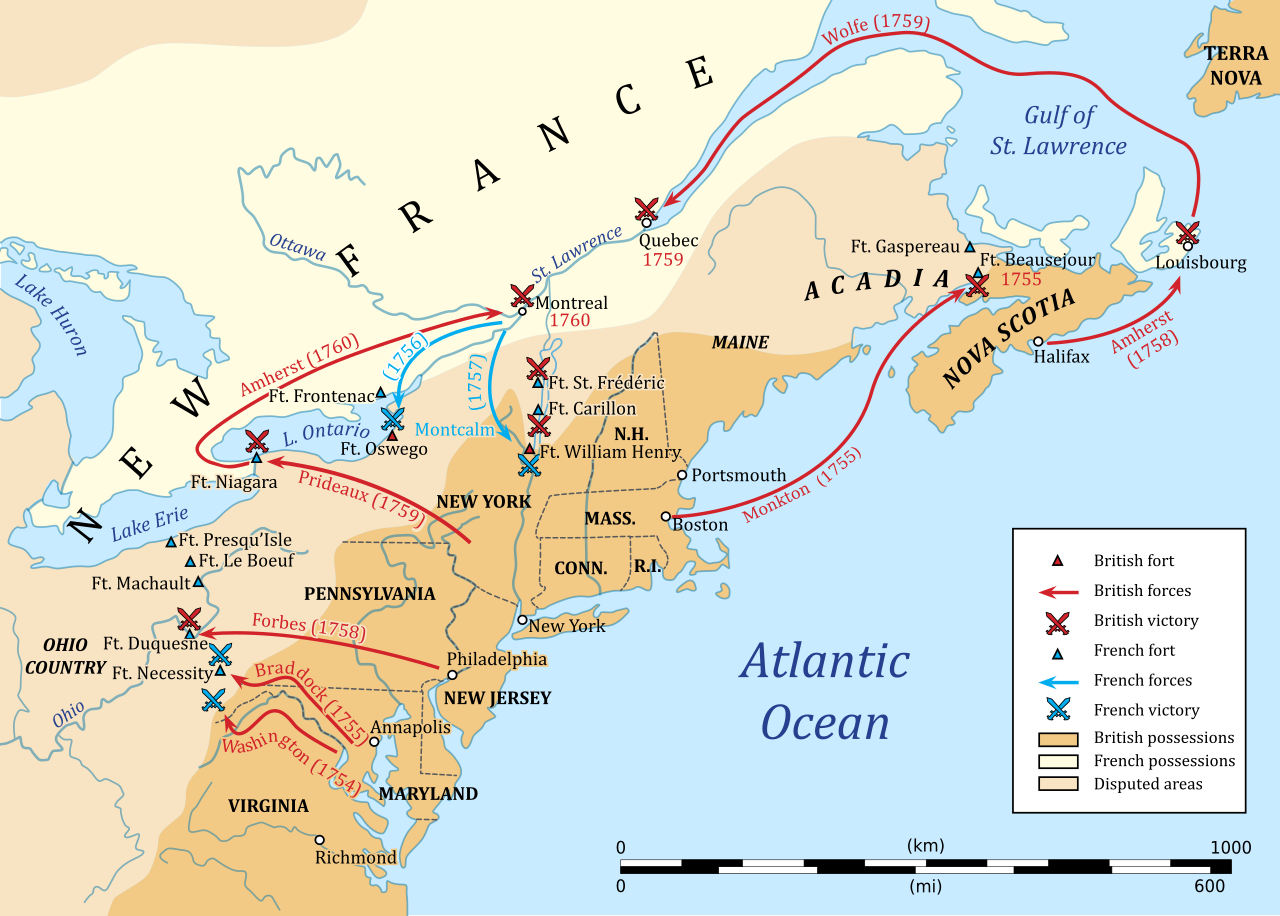
France held most of the Atlantic seaboard
Britain's colonies were concentrated along the Atlantic coast, with France controlling the St. Lawrence and Great Lakes
Spain controlled the Ohio Country
Britain and France shared Quebec
British possessions hug the coast; New France spans the St. Lawrence and Great Lakes; the Ohio Country is disputed. Spain does not appear in the area, and Quebec was French until 1759. Image: Hoodinski, CC BY-SA 3.0, via Wikimedia Commons.
Which pair of events best shows colonists' attempts to resist or reject centralized authority in the 1680s?
The Glorious Revolution in England and the overthrow of the Dominion of New England
The Great Awakening and the Stono Rebellion
Zenger's trial and the Albany Plan
The Navigation Act and the Molasses Act
Colonists in Boston arrested Andros in 1689 as news of the Glorious Revolution arrived; the Dominion collapsed. The other pairs belong to different decades.
Which feature distinguished Pennsylvania's early government from most other colonies?
Voting required church membership
It was ruled directly by the Crown from the start
Slavery was illegal from 1681
Religious toleration, a representative assembly and relatively fair dealings with Native nations under Penn
Penn's Frame of Government and Quaker values shaped early policy. The colony was proprietary, not royal, and slavery existed in Pennsylvania in the colonial period (abolition began in 1780).
Which long-term effect did the Great Awakening and the Enlightenment share?
Both increased deference to colonial elites
Both encouraged colonists to question traditional authority and think for themselves
Both ended slavery in the North
Both strengthened the Church of England
The Awakening emphasized personal religious experience over clergy; the Enlightenment emphasized reason and natural rights. Neither ended slavery or strengthened Anglican authority.
Which was a major cause of the 1763 Proclamation Line?
Anger over the Stamp Act
Spanish control of the Ohio Valley
Pontiac's Rebellion and the desire to avoid new frontier wars
The fall of Quebec
Britain sought to calm Native nations and avoid costly conflicts. The Stamp Act came in 1765, and Quebec fell in 1759.
Which colonial law best shows the development of hereditary, race-based slavery?
The 1649 Maryland Act of Toleration
Virginia's 1662 law making a child's legal status follow the mother's
The 1651 Navigation Act
The Mayflower Compact of 1620
The 1662 law meant children of enslaved women were enslaved for life, creating an inheritable system. The other documents concern religion, trade and self-government.
Which is the strongest argument that the Chesapeake and New England were different societies?
New England had a more balanced sex ratio and family-based settlement, while the early Chesapeake had many single male servants and high mortality
Chesapeake colonists were more religious
New England relied on plantation slavery
The Chesapeake had more town meetings
Puritans migrated in families and lived long lives, while early Chesapeake settlers were mostly young men who died young. Chesapeake plantations rather than New England dominated slave labor.
Which statement about Native American roles in colonial wars is the most accurate?
Native nations were passive victims with no strategy
All Native nations allied with the French
Native nations such as the Iroquois and Wampanoag allied with, fought and negotiated with colonial powers to protect their own interests
Native nations were irrelevant to the French and Indian War
Native diplomacy was central: the Iroquois balanced between Britain and France, and King Philip's War was an organized resistance. Many nations allied with France, but not all.
The Albany Plan of Union failed mainly because
Britain declared war on the colonies
Franklin withdrew it
France supported it
colonial assemblies were unwilling to give up power, and Britain also did not accept it
Colonial legislatures feared losing taxing authority and the Crown feared colonial unity. The plan was Franklin's and was not withdrawn by him.
