Quiz · Medium
Foundational practice: read limits off graphs and tables, classify discontinuities, find asymptotes and make piecewise functions continuous.
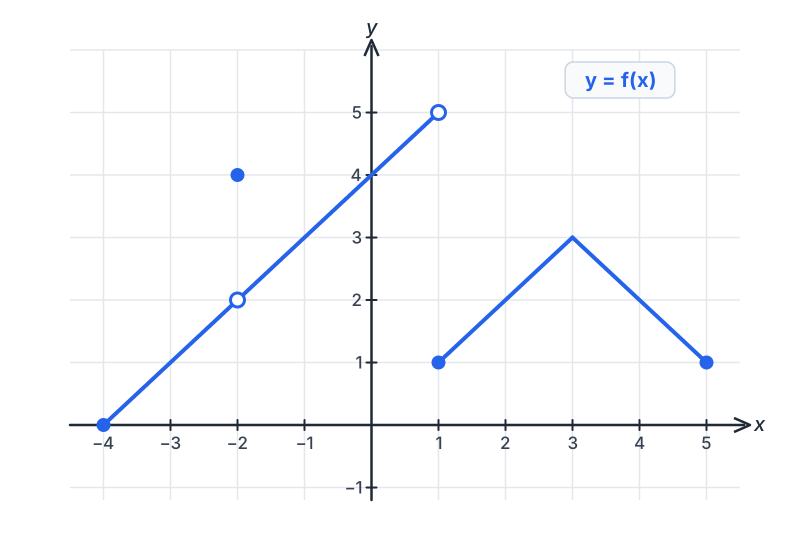
Use the graph of . What is ?
Does not exist
The curve approaches the open circle at height 2 from both sides. The filled dot at 4 is f(-2), which does not change the limit.
Use the graph. What is ?
Does not exist
From the right, the graph starts at the filled dot (1, 1). 5 is the limit from the left.
Use the graph. What is ?
Does not exist
The left-hand limit is 5 and the right-hand limit is 1. A two-sided limit exists only when they agree.
Use the graph. At which of these x-values is f continuous?
None of them
At x = 3 the limit (3) equals f(3) = 3. The corner there breaks differentiability, not continuity.
Use the graph. What type of discontinuity does have at ?
Jump
Removable
Infinite
Oscillating
The limit exists (2) but f(-2) = 4 is somewhere else. Redefining one point would fix it.
A table gives f(1.9) = 4.9, f(1.99) = 4.99, f(1.999) = 4.999 and f(2.1) = 5.1, f(2.01) = 5.01, f(2.001) = 5.001. What is the best estimate of the limit of f(x) as x approaches 2?
It does not exist
Both sides close in on 5. A limit is the value being approached, not the last number in the table.
For (graph shown), what is ?
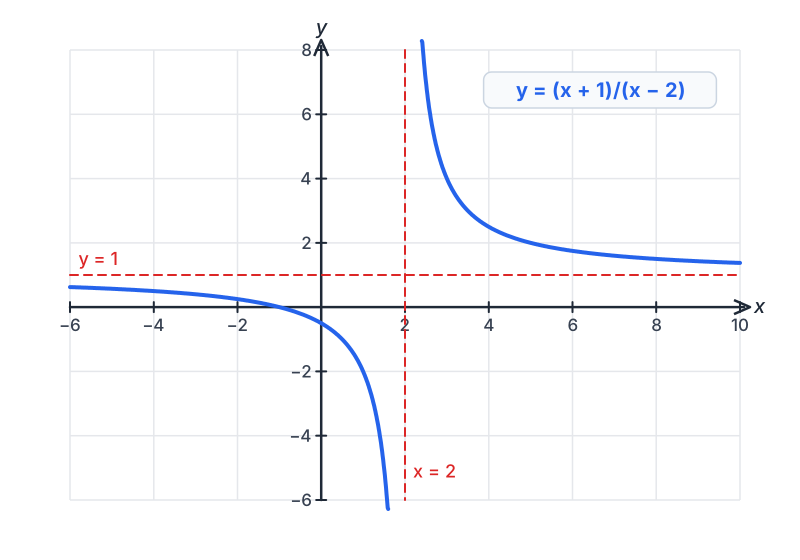
Just left of 2, the numerator is near 3 and the denominator is a tiny negative number, so the quotient is a huge negative number. +∞ is the limit from the right.
What is the horizontal asymptote of ?
Equal degrees, so the asymptote is the ratio of leading coefficients, 1/1. x = 2 is the vertical asymptote.
What is ?
Does not exist
It equals 1 for x > 0 and -1 for x < 0. The one-sided limits differ.
If is undefined, then cannot exist.
True
False
False. The limit depends only on values near 2. (x² - 4)/(x - 2) is undefined at 2, but its limit there is 4.
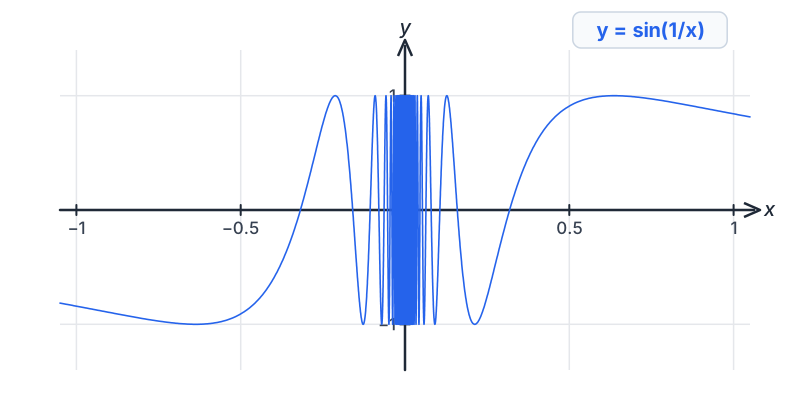
Based on the graph of , what is ?
Does not exist
The graph oscillates between -1 and 1 infinitely often near 0, so it never approaches a single value.
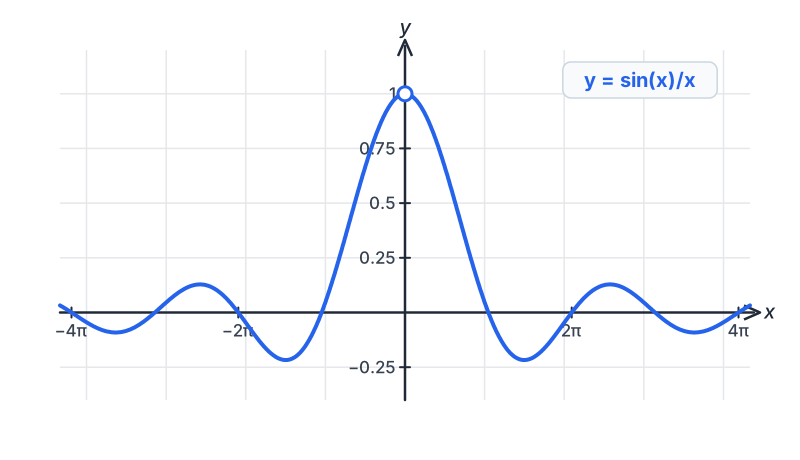
Based on the graph, what is ?
Does not exist
The open circle at (0, 1) marks the limit. The function is undefined at 0, but the limit still exists.
For what is continuous at ? for , and for .
Match the pieces at 1: 1 + k = 2(1) + 3 = 5, so k = 4. k = 5 forgets the 1² on the left.
Evaluate .
Does not exist
x² + x - 6 = (x + 3)(x - 2). After canceling, substitute: -3 - 2 = -5. Getting 0/0 at first does not mean the limit fails to exist.
Based on the graph, what is ?
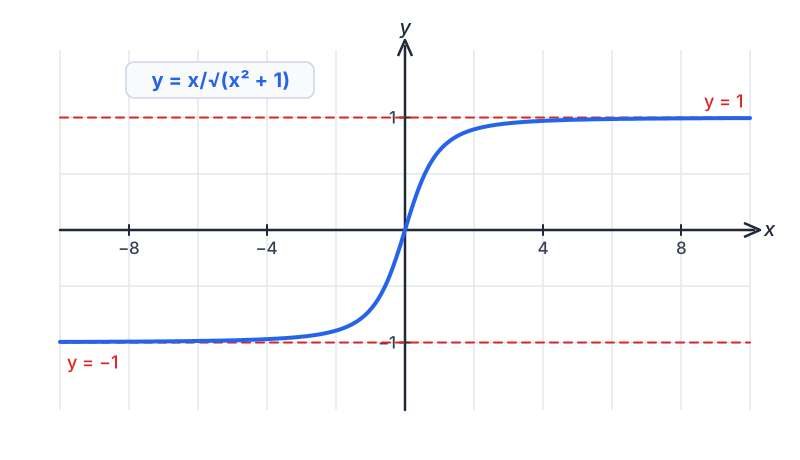
For negative x the numerator is negative and the root is positive, so the ratio approaches -1. The graph has a different asymptote on each side.
is continuous on , and . Which statement must be true?
for some in
is decreasing on
has exactly one zero in
for some in
0 lies between -2 and 3, so the IVT guarantees a zero. It does not say how many zeros, and 4 is not between f(1) and f(4).
Evaluate .
Equal degrees: divide the leading coefficients, 5/2.
Use the picture to find .
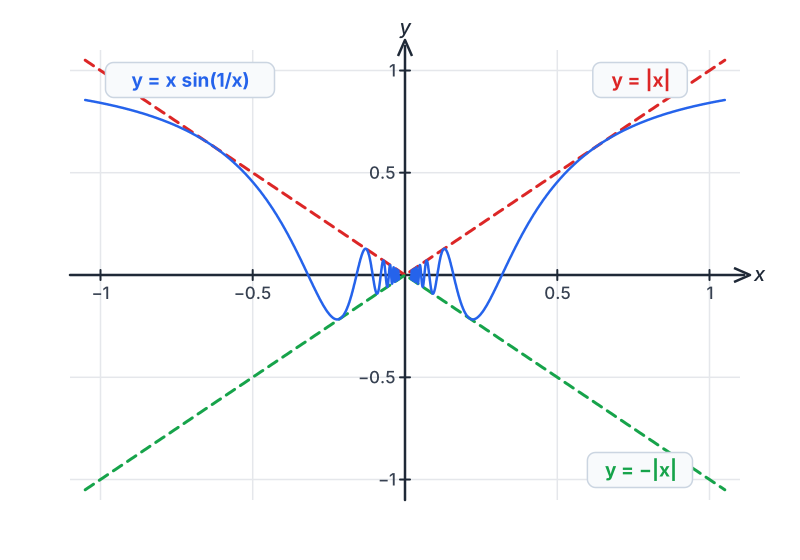
Does not exist
The graph is trapped between y = |x| and y = -|x|, which both go to 0. Squeeze theorem: the limit is 0. Answering 1 confuses it with sin x / x.
A function's graph can cross its horizontal asymptote.
True
False
True. Horizontal asymptotes describe end behavior only. sin(x)/x crosses y = 0 again and again.
Which statement about is always true?
It depends only on the values of near , not at
It means
It requires to be defined
The one-sided limits at a may be different
A limit ignores the point itself. f(a) = L is the extra condition for continuity, and a two-sided limit needs both one-sided limits to agree.
