Quiz · Medium
Free body diagrams, lever classes, gait, bone and soft tissue mechanics for biomedical engineering courses.
A 60 kg person lands at 4 m/s and stops in 0.2 s. The average stopping force (ignoring body weight) is:
240 N
48 N
12 N
1200 N
F = mΔv/Δt = 60(4)/0.2 = 1200 N. Doubling the stopping time halves the force.
Which cortical bone loading is it weakest in?
Shear
Compression
Tension
All equal
Bone's strength ranks compression > tension > shear.
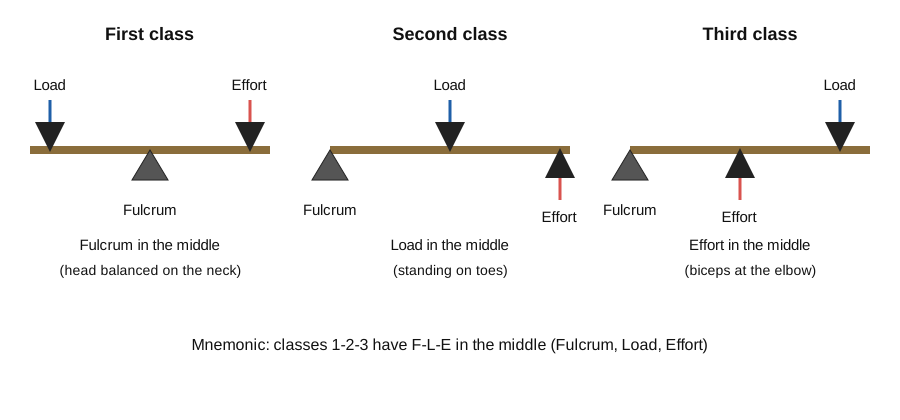
In the diagram shown, the effort lies between the fulcrum and the load in which lever class?
First class
Second class
Third class
None of these
Third-class levers have effort in the middle (F-L-E for classes 1-2-3). Biceps at the elbow is the standard example.
Standing on your toes is an example of which lever class?
Second
First
Third
It is not a lever
The ball of the foot is the fulcrum, body weight the load in the middle, and the calf muscle (Achilles tendon) the effort at the heel. Load in the middle means second class.
Mechanical advantage of a lever is:
Load arm / effort arm
Effort x load
Load / fulcrum distance
Effort arm / load arm
MA = effort arm / load arm. Reversing it is a common slip.
Most skeletal muscle levers are third class. Their mechanical advantage is therefore:
Greater than 1
Less than 1
Equal to 1
Undefined
The effort arm (muscle insertion) is shorter than the load arm, so MA is below 1, trading force for speed and range.
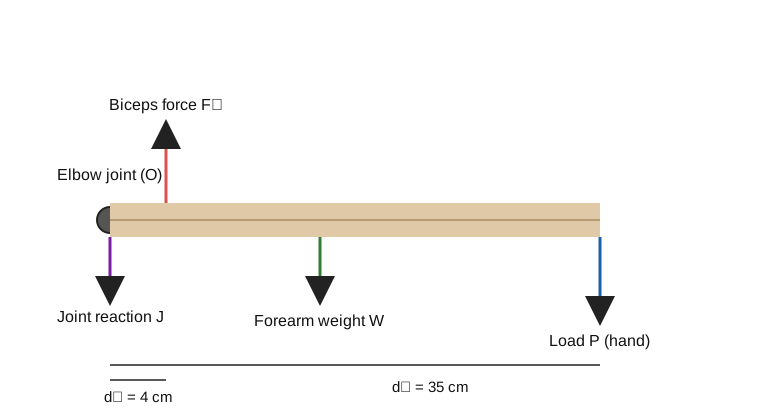
A 50 N weight is held in the hand 35 cm from the elbow. The biceps inserts 4 cm from the elbow. Ignoring forearm weight, the biceps force is about:
57 N
200 N
1750 N
438 N
Moments about the elbow: F_m(4) = 50(35), so F_m = 437.5 N. 57 N results from inverting the distances.
The condition for static equilibrium of a rigid body in 2D is:
ΣFx = 0, ΣFy = 0 and ΣM = 0
Only ΣF = 0
Only ΣM = 0
ΣF = ma
Both force and moment balance are required. A body can have zero net force but still rotate if moments do not cancel.
Why do we often take moments about the joint in a free body problem?
Moments about the joint are always zero
Joints do not exert forces
The unknown joint reaction has zero moment arm and drops out
It makes the load disappear
A force passing through the point of rotation has no moment about it, which removes an unknown from the equation.
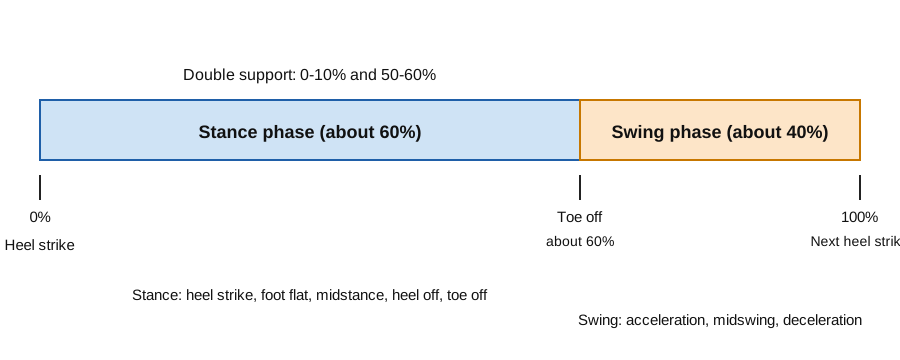
During normal walking, the stance phase is about what percent of the gait cycle?
40%
60%
50%
80%
Stance is about 60% and swing about 40%, giving two double-support periods.
The correct order of stance phase events is:
Toe off, foot flat, heel strike, midstance
Foot flat, heel strike, toe off, heel off
Heel strike, foot flat, midstance, heel off, toe off
Heel strike, midstance, foot flat, toe off
Order: heel strike, foot flat, midstance, heel off, toe off.
Stride length is:
Distance from one heel strike to the next heel strike of the same foot
Distance from left heel strike to right heel strike
Length of the foot
Distance between the feet side to side
Step length is left-to-right heel strike; a stride is two steps.
A patient's pelvis drops on the left in right single-leg stance. The weak muscle group is most likely the:
Left hip abductors
Right hip flexors
Left quadriceps
Right hip abductors
The stance-side (right) abductors fail to hold the pelvis level, so the unsupported left side drops (positive Trendelenburg). Mixing up sides is the common error.
Joint force at the hip in walking is roughly:
Equal to body weight
2.5 to 3 times body weight
0.5 times body weight
10 times body weight
Abductor muscle force across the short lever arm adds to body weight, so hip contact force is a multiple of body weight.
Doubling the diameter of a solid round bone multiplies its bending stiffness (EI) by:
2
4
16
8
I = πd⁴/64, so doubling d multiplies I by 2⁴ = 16. Eight is the answer for doubling a rectangle's height.
Why are long bones tubular?
Marrow needs room
Hollow bone is lighter and has higher I for the same material
Tubes are stronger in compression only
Solid bone would be too stiff
Material far from the neutral axis contributes most to bending stiffness, so a tube resists bending almost as well as a solid rod of much greater mass.
The toe region of a tendon stress-strain curve is due to:
Plastic yielding
Bone mineralization
Straightening of crimped collagen fibers
Fluid flow out of cartilage
Initially wavy collagen fibers straighten with little load, then the tissue stiffens.
A material is held at constant strain and the stress falls over time. This is:
Stress relaxation
Creep
Fatigue
Hysteresis
Stress relaxation is decreasing stress at fixed strain. Creep is increasing strain at fixed stress.
Which model captures creep?
Maxwell
A single spring
A single dashpot
Kelvin-Voigt
Kelvin-Voigt (parallel spring and dashpot) shows delayed elastic strain under constant stress, i.e. creep.
Halving the radius of an artery at the same pressure drop changes flow by what factor?
1/2
1/16
1/4
1/8
Poiseuille's law has ΔP r⁴, so (1/2)⁴ = 1/16.
Which statement about articular cartilage is true?
It is richly supplied by blood vessels
It is mainly type I collagen
It heals quickly after injury
It is a biphasic material with high water content
Cartilage is a solid matrix of type II collagen and proteoglycans with 65-80% water; being avascular, it heals poorly.
True or false: Eccentric muscle contraction means the muscle lengthens while producing force.
True
False
For example, the quadriceps controlling knee flexion when sitting down slowly.
Peak muscle force during shortening contractions as velocity increases will:
Decrease
Increase
Stay the same
Become zero immediately
The Hill force-velocity relation shows force decreases as shortening velocity increases.
A thin-walled cylindrical vessel with internal pressure P, radius r and wall thickness h has circumferential stress:
Pr/(2h)
Ph/r
Pr/h
2Pr/h
Laplace's law for a cylinder gives σ = Pr/h (the hoop stress). Pr/2h is the axial stress, which is half as large.
