Quiz · Hard
Composite and inverse functions (including domain restrictions), transformations of points and graphs, symmetry and one-to-one reasoning.
Let and . What is ?
12
13
7
9
, then . 12 is : and , the other order.
For and , what is ?
. is , and forgets the middle term of the square.
x goes through f(x) = x + 3 and then g(x) = 2x. Which expression gives the output?
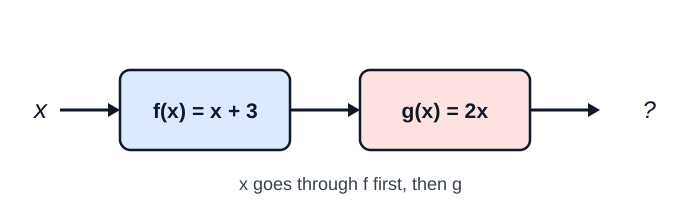
. Doubling only the gives , which is wrong because g acts on the whole of .
Find the inverse of .
Swap: . Then , so . The reciprocal is not the inverse.
Find the inverse of .
Swap and solve: , so . Subtract 4 inside the root before taking the cube root.
The blue line is f(x) = 2x + 1 and the red line is its inverse. Which equation is the red line?
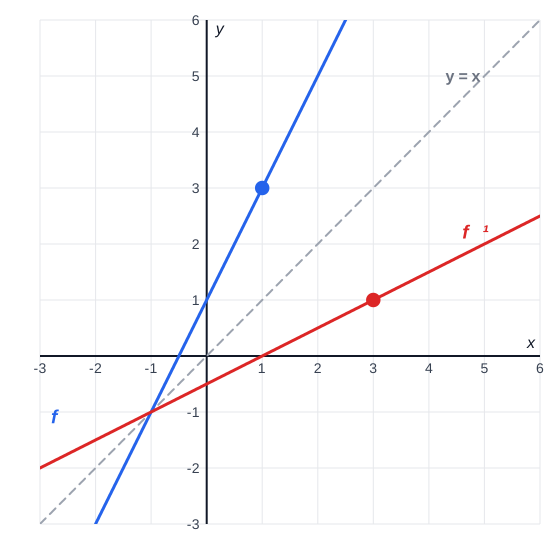
Swap the coordinates of : lies on the red line, and . is the reciprocal, not the inverse.
Find the inverse of , including its domain.
for
for all real
for
for
Swap: , so . The range of is , so the inverse's domain is .
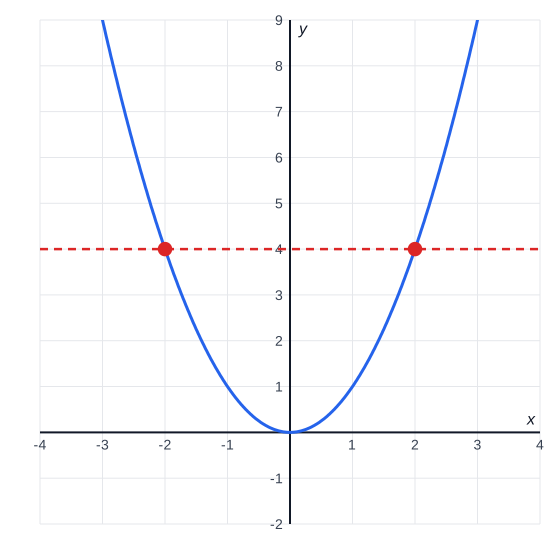
Why does f(x) = x^2 not have an inverse function on all real numbers?
It is not continuous
It has a minimum
Its domain is all reals
It is not one-to-one: the horizontal line y = 4 meets the graph twice.
, so reversing the pairs would give 4 two outputs. Restricting the domain to fixes this.
For any invertible function , .
True
False
The exponent on a function name means inverse function, not reciprocal. For , while .
If and , what are and ?
5 and 9
9 and 5
9 and 2
14 and 5
. Because , the inverse sends 9 back to 5.
For and , what is the domain of ?
and
. Need for the root, and , so .
Which choice decomposes as ?
,
,
,
,
The inside function is what is calculated first: x² + 1. The outside function cubes the result. Swapping them would give x⁶ + 1.
Which gives the Celsius temperature C in terms of Fahrenheit F, given F = (9/5)C + 32?
Undo the steps in reverse order: subtract 32, then multiply by 5/9. The subtraction must apply to F before multiplying.
What are the domain and range of ?
Domain ; range
Domain ; range
Domain ; range
Domain ; range
Shift left 2 (domain starts at ), reflect across the x-axis, shift up 1 (range is ). The reflection reverses the range direction.
The point (3, -2) is on y = f(x). What point is on y = 2f(x - 1) + 3?
Shift right 1: . Then . Left 1 would give ; the stretch applies to y, not x.
If f is odd and g is even, what can you say about the product fg?
It is odd
It is even
It is neither
It is both even and odd
, so the product is odd.
Which function is the inverse of ?
. The choice subtracts 6 after dividing instead of before, giving .
Which of the diagrams represents a function that has an inverse function?
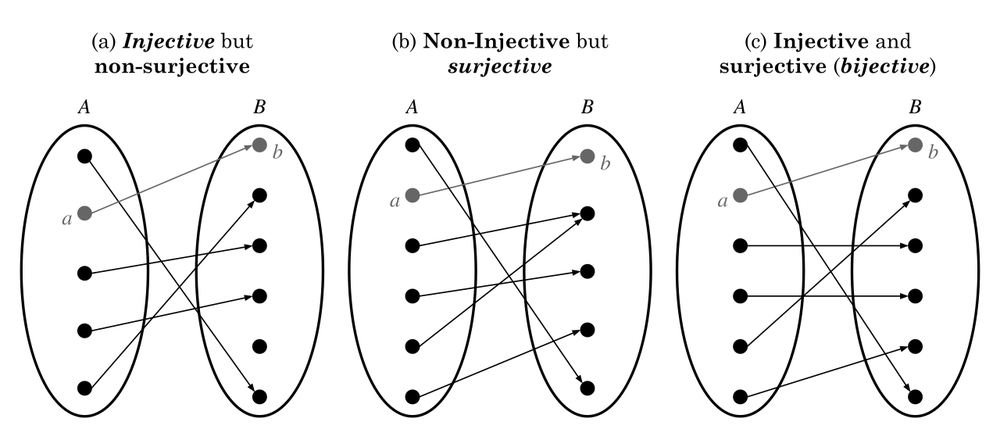
(a): injective but not surjective
(c): injective and surjective
(b): surjective but not injective
None of them
An inverse function needs each output to come from exactly one input (injective) and every element of B to be an output (surjective). In (a) one element of B is unused; in (b) two inputs share an output. Image: Musical Inquisit, CC BY-SA 4.0, via Wikimedia Commons.
The function is restricted to . What is ?
Complete the square: , so . Since we take the plus sign: .
