Quiz · Easy
22 questions on particles, negation, requests, future, honorifics, comparison and speech levels, including questions based on a sentence-structure diagram.
Which sentence means "I eat an apple"?
저는 사과를 먹어요
저는 사과가 먹어요
저를 사과는 먹어요
저는 먹어요 사과를
사과 is the object, so it takes 를. The verb must come last. 사과가 would make the apple the one doing the eating.
저는 학교___ 가요. (I go to school.)
를
에
에서
도
에 marks the destination of 가다. 에서 is for the place where an action happens.
도서관___ 책을 읽어요. (I read a book at the library.)
에
를
에서
으로
읽다 is an action verb, so the place takes 에서. 에 is for existence (있다) and destinations (가다).
According to the diagram, what does 에서 mark?
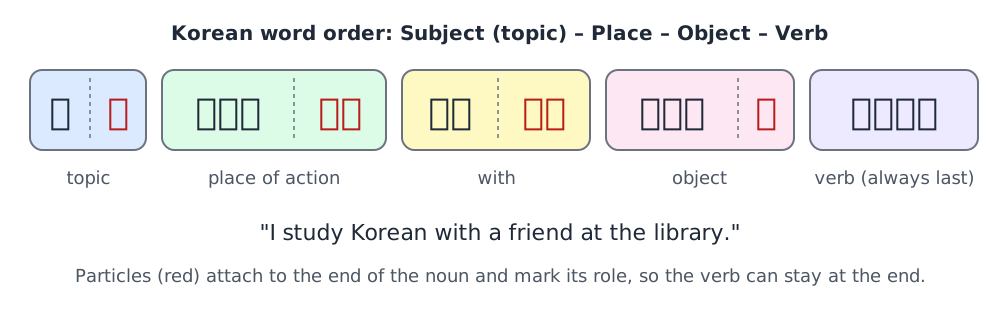
The object
The place of the action
"With" (a companion)
The topic
In 도서관에서, 에서 shows where the studying happens.
According to the diagram, where must the verb go?
At the very end
Between the place and the object
Anywhere, because of the particles
Right after the topic
Particles let the nouns move around, but the verb (공부해요) stays last.
누가 왔어요? 민수___ 왔어요.
에
는
를
가
The answer to "who" is new information, so it takes the subject marker 가. 민수는 would make Minsu a contrast or old topic.
동생___ 같이 가요. (with a younger sibling)
과
를
가
와
동생 ends in a consonant (ㅇ), so use 과. Use 와 after vowels (친구와).
버스___ 가요. (I go by bus.)
에서
를
으로
로
버스 ends in a vowel, so 로. After a consonant it would be 으로, but after ㄹ it is also 로.
친구___ 선물을 줬어요. (I gave a friend a present; spoken Korean)
처럼
에서
한테
를
한테 (written: 에게, honorific: 께) marks the person receiving. 에서 would mean "from" or "at".
How do you say "I can't swim"?
저는 수영을 아니에요
저는 수영을 안 해요
저는 수영을 못 해요
저는 수영이 없어요
못 = cannot (inability). 안 means you don't do it by choice or as a fact.
Which means "Please sit here"?
여기 앉세요
여기 앉아세요
여기 앉시오
여기 앉으세요
The stem 앉 ends in a consonant, so -으세요 is used. Vowel stems use -세요 (가세요).
Which means "Please don't run"?
안 뛰세요
뛰지 않세요
뛰지 못하세요
뛰지 마세요
-지 마세요 is the polite prohibition. 안 뛰세요 only states "doesn't run".
Which sentence says "I will go to Korea next year"?
내년에 한국에 가세요
내년에 한국에 갔어요
내년에 한국에 갈 거예요
내년에 한국에 가고 싶어요
-(으)ㄹ 거예요 is the future. 가고 싶어요 is "want to go", 갔어요 is past.
Which question invites someone to do something together?
같이 먹지 마세요
같이 먹을까요?
같이 먹었어요?
같이 먹고 있어요?
-(으)ㄹ까요? = shall we? 먹었어요 asks about the past; 먹고 있어요 asks about something in progress.
Which is correct? "Because it's raining, let's take umbrellas."
비가 와서 우산을 가져갑시다
비가 오고 우산을 가져갑시다
비가 오니까 우산을 가져갑시다
비가 오지만 우산을 가져갑시다
Suggestions and commands need -(으)니까. -아/어서 cannot be followed by -ㅂ시다 or -(으)세요.
저는 의사___. (I am a doctor.)
이예요
이야요
이에요
예요
의사 ends in a vowel, so 이에요 contracts to 예요. After a consonant: 학생이에요.
Which is the polite way to say "Grandfather is sleeping"?
할아버지께서 주무세요
할아버지께서 계세요
할아버지께서 잡수세요
할아버지가 자요
자다 → 주무시다 (honorific). 잡수시다 is the honorific of "eat"; 계시다 is the honorific of 있다 ("be at").
Which sentence means "This bag is more expensive than that one"?
이 가방보다 저 가방이 더 비싸요
이 가방이 저 가방보다 더 비싸요
이 가방이 저 가방에서 더 비싸요
이 가방이 저 가방보다 가장 비싸요
The noun before 보다 is the standard of comparison. The option 이 가방보다 저 가방이 더 비싸요 reverses the meaning. 가장 (the most) can't go with 보다 (than).
What is the formal polite (합쇼체) form of 먹다?
먹어
먹어요
먹습니다
드세요
Consonant stem + 습니다. 먹어요 is informal polite; 먹어 is casual; 드세요 is honorific.
저는 한국에 ___ 싶어요. (I want to go to Korea.)
갈
가면
가고
가서
-고 싶다 = want to. Stem + 고 + 싶어요.
Which time word does NOT take the particle 에?
어제
월요일
일곱 시
아침
어제, 오늘, 내일, 지금 and 언제 take no 에. You say 어제 영화를 봤어요, not 어제에.
True or false: because particles mark the role of each noun, the verb can go anywhere in a Korean sentence.
True
False
False. Nouns with particles are flexible, but the verb stays at the end of the sentence.
