Quiz · Medium
Sixteen questions on plot structure (with a labeled diagram), the inverted pyramid in news writing, figurative language, theme, point of view, tone vs mood and fact vs opinion.
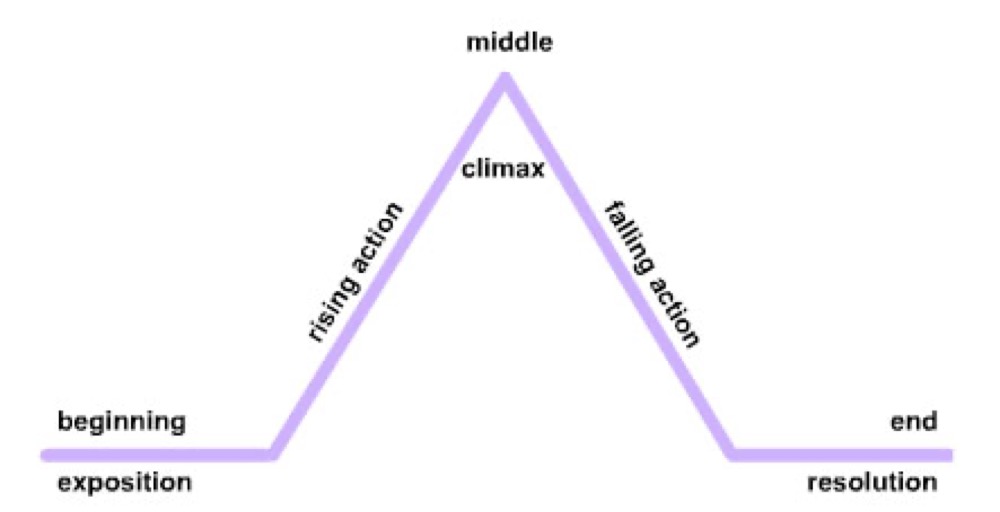
Look at the diagram. Which part of a story is the highest point of tension?
The exposition
The climax
The resolution
The rising action
The climax sits at the top of the plot mountain: the turning point where tension peaks.
In the diagram, what comes immediately after the climax?
Rising action
Falling action
Exposition
Resolution
After the climax the story moves through falling action to the resolution.
In the diagram, where do we usually meet the characters and setting?
Climax
Falling action
Resolution
Exposition
The exposition at the beginning introduces characters, setting and background.
In a news story shaped like this inverted pyramid, what goes at the top?
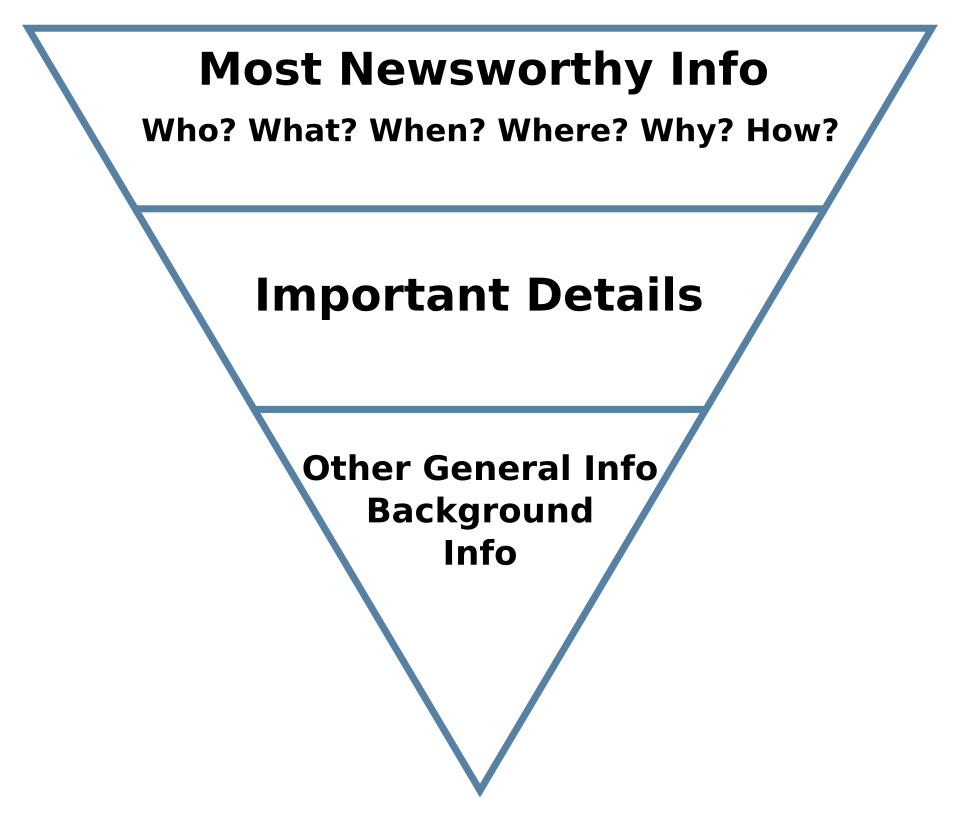
The most important facts (who, what, when, where, why, how)
Background information
The writer's opinion
A conclusion
The inverted pyramid puts the most newsworthy information first and the least important last, so readers can stop at any point.
Why is the inverted pyramid useful for news editors?
It makes stories longer.
It adds suspense.
They can cut from the bottom without losing the key facts.
It hides the facts until the end.
Because the least important details are last, a story can be shortened from the bottom.
'The wind whispered through the trees.' Which device is used?
Simile
Hyperbole
Personification
Irony
The wind is given a human action (whispering).
'Her smile was as bright as the sun.' Which device is used?
Simile
Metaphor
Personification
Alliteration
A simile compares using 'like' or 'as'.
'Time is a thief.' Which device is used?
Simile
Onomatopoeia
Idiom
Metaphor
A metaphor states one thing IS another without 'like' or 'as'.
'I've told you a million times!' is an example of ____.
understatement
hyperbole
irony
paradox
Hyperbole is deliberate exaggeration for emphasis.
A fire station burns down. Which type of irony is this?
Verbal irony
Situational irony
Dramatic irony
Hyperbole
The outcome is the opposite of what would normally be expected.
'The buzzing bees went bang, boom, crash.' Which device uses words that imitate sounds?
Alliteration
Assonance
Oxymoron
Onomatopoeia
Buzz, bang, boom and crash imitate sounds.
'Peter Piper picked a peck of pickled peppers' is mainly ____.
alliteration
onomatopoeia
metaphor
irony
Alliteration repeats the same initial consonant sound.
Which is the best definition of 'theme'?
The place and time of the story
The order of events
The central message or insight about life
The narrator's voice
Theme is the underlying idea the story conveys; setting is the place/time; plot is the order of events.
A narrator who says 'I was terrified' is using which point of view?
Second person
Third person limited
First person
Third person omniscient
First person uses I/me/we and tells events from the narrator's own perspective.
True or False: Mood and tone mean the same thing.
True
False
Tone is the author's attitude toward the subject; mood is the feeling the reader gets. They often overlap but are not identical.
Which of these is a fact rather than an opinion?
Water boils at 100 degrees Celsius at sea level.
Winter is the best season.
Math is boring.
Dogs are better than cats.
Facts can be checked and proven; the others are judgments.
