Quiz · Hard
Ideal gas problems, work and internal energy, Carnot and Otto efficiency, refrigerator COP, entropy changes and cycle diagrams.
A gas is compressed rapidly and no heat can leave (adiabatic compression). What happens to its temperature?
It falls
It stays the same
It cannot be determined
It rises
With Q = 0, ΔU = −W; work done on the gas increases its internal energy, so the temperature rises (a bicycle pump warms up; diesel fuel ignites).
A gas at 1.0 atm in a 2.0 L cylinder is compressed isothermally to 0.50 L. What is the final pressure?
0.25 atm
4.0 atm
2.0 atm
1.0 atm
: atm.
A sealed rigid container of ideal gas at 300 K and 100 kPa is heated to 600 K. What is the final pressure?
200 kPa
50 kPa
100 kPa
400 kPa
is constant at fixed volume: doubling the Kelvin temperature doubles P. Converting to Celsius (27 °C → 327 °C) would give a wrong factor of 12.
What is the rms speed of O₂ molecules (M = 0.032 kg/mol) at 300 K?
About 2.4 m/s
About 48 m/s
About 4800 m/s
About 480 m/s
m/s.
At the same temperature, how does the rms speed of H₂ (M = 2 g/mol) compare with that of O₂ (M = 32 g/mol)?
16 times greater
2 times greater
4 times greater
The same
: .
A gas expands at constant pressure 2.0×10⁵ Pa from 1.0 L to 3.0 L while absorbing 600 J of heat. What is the change in its internal energy?
+600 J
+200 J
+1000 J
−200 J
J, J.
One mole of ideal gas at 300 K expands isothermally to twice its volume. How much work does it do on its surroundings?
About 1.7 kJ
0
About 3.5 kJ
About 0.9 kJ
kJ. ΔU = 0 so the heat absorbed equals this work; work is not zero just because T is constant.
A monatomic ideal gas is heated at constant pressure. What fraction of the heat added is converted into work done by the gas?
100%
60%
40%
0%
, : 2/5. The other 60% raises the internal energy.
An engine absorbs 800 J from a hot reservoir and exhausts 600 J to a cold reservoir each cycle. What is its efficiency?
75%
25%
33%
133%
J, . 75% is the fraction of heat rejected.
What is the maximum possible efficiency of a heat engine operating between 500 K and 300 K?
40%
60%
20%
100%
.
An inventor claims that an engine operating between 400 K and 300 K has an efficiency of 30%. What is wrong?
The first law forbids any engine from doing work
Efficiency must be greater than 50%
Nothing; 30% is possible
The Carnot limit is 25%, so the claim violates the second law
Carnot limit: 1 − 300/400 = 25%. No real engine beats a Carnot engine between the same two temperatures.
In the Carnot cycle shown, which segment is the isothermal expansion during which heat Q_H is absorbed?
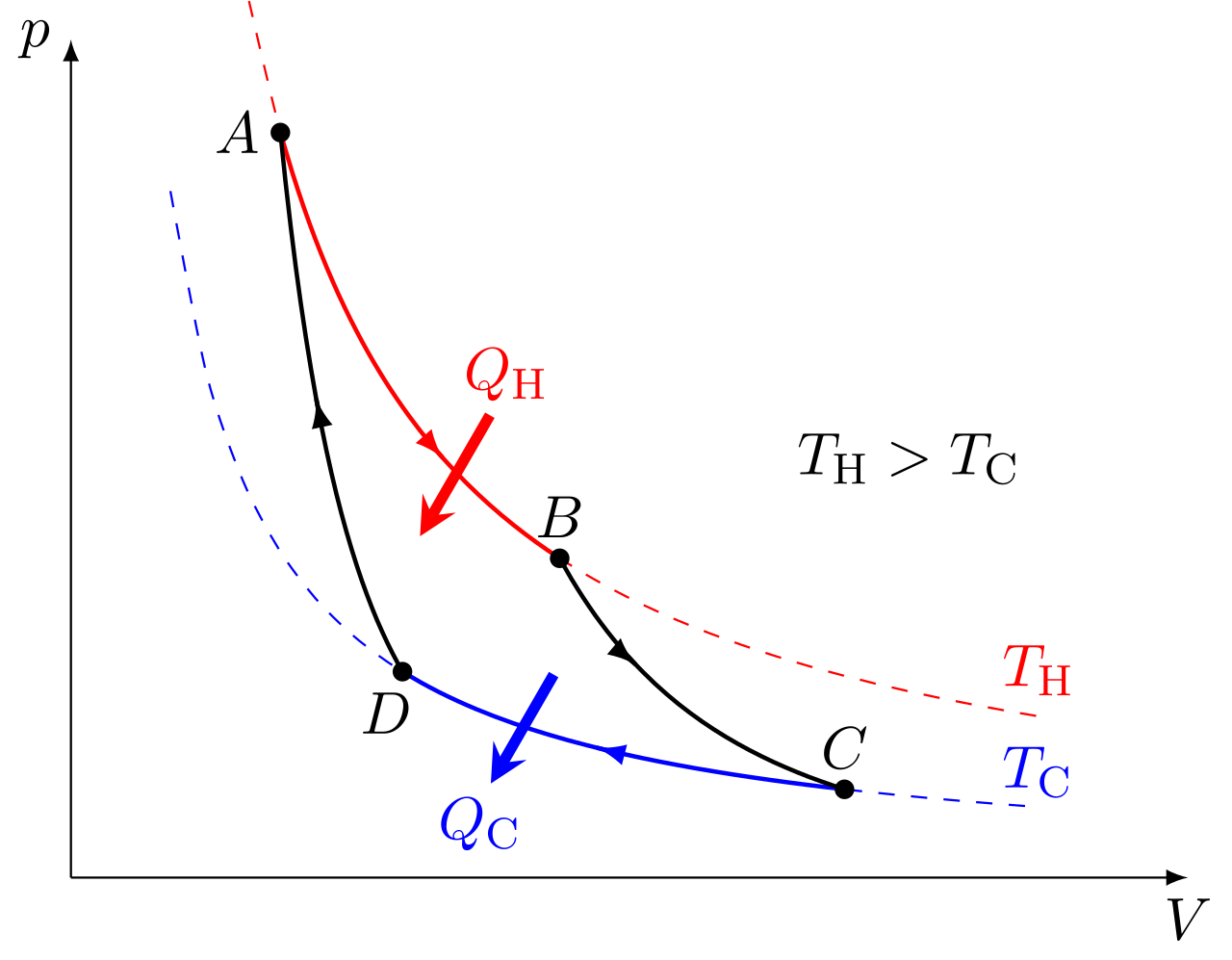
B → C
C → D
A → B
D → A
The red isotherm at T_H runs from A to B with heat absorbed (red arrow). B → C and D → A are adiabatic; C → D is the isothermal compression at T_C. Image: Cristian Quinzacara, CC BY-SA 4.0, via Wikimedia Commons.
What is the maximum coefficient of performance of a refrigerator keeping its inside at 277 K in a 295 K kitchen?
About 0.94
About 15
About 1.07
About 0.06
. Real refrigerators reach 2–5.
1000 J of heat flows from a 400 K reservoir to a 300 K reservoir. What is the total entropy change?
+0.83 J/K
−0.83 J/K
0
+3.3 J/K
J/K, positive because the process is irreversible.
0.10 kg of ice melts at 0 °C (L_f = 334 kJ/kg). What is the entropy change of the ice?
About −122 J/K
About +33 J/K
0
About +122 J/K
J/K. The liquid has more microstates, so entropy increases.
An ideal gas expands freely into an evacuated chamber (free expansion). Which statement is true?
The temperature falls and the entropy is unchanged
The gas does work and cools
The temperature is unchanged but the entropy increases
The entropy of the gas decreases
Q = 0 and W = 0, so ΔU = 0 and T stays the same for an ideal gas. The process is irreversible: ΔS = nR ln(V₂/V₁) > 0.
An Otto engine has a compression ratio of 8 and γ = 1.4. Its ideal efficiency is closest to…
44%
56%
88%
25%
.
According to the phase diagram, what happens when ice at a pressure well below 611 Pa (the triple-point pressure) is warmed?
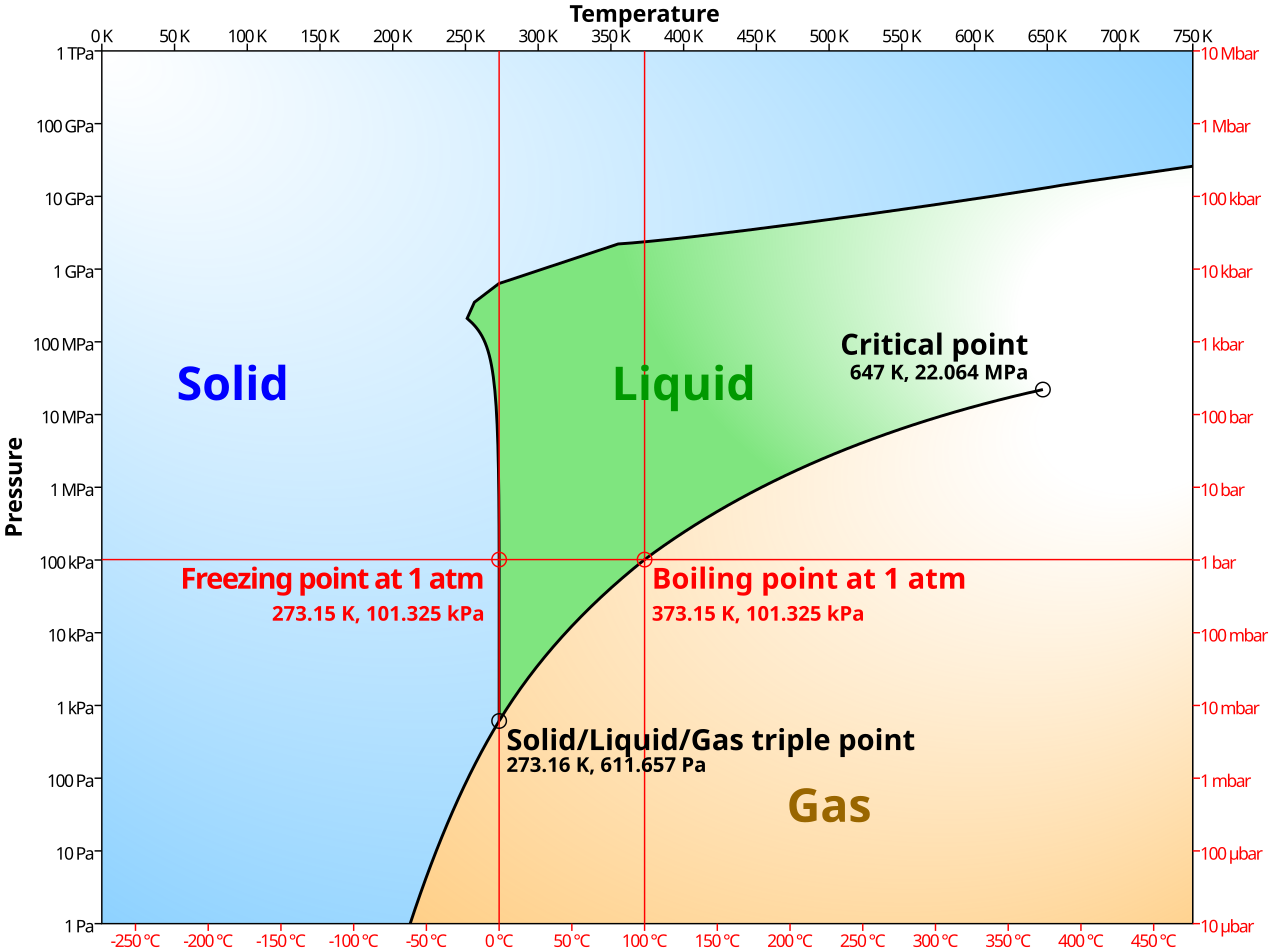
It sublimes directly to vapour
It melts to liquid, then boils
It stays solid at any temperature
It becomes a supercritical fluid
Below the triple-point pressure there is no stable liquid phase, so warming gives solid → gas. Image: Cmglee and Manlleus, CC BY-SA 3.0, via Wikimedia Commons.
The Maxwell–Boltzmann curves show the same gas at three temperatures. Which curve is the hottest?
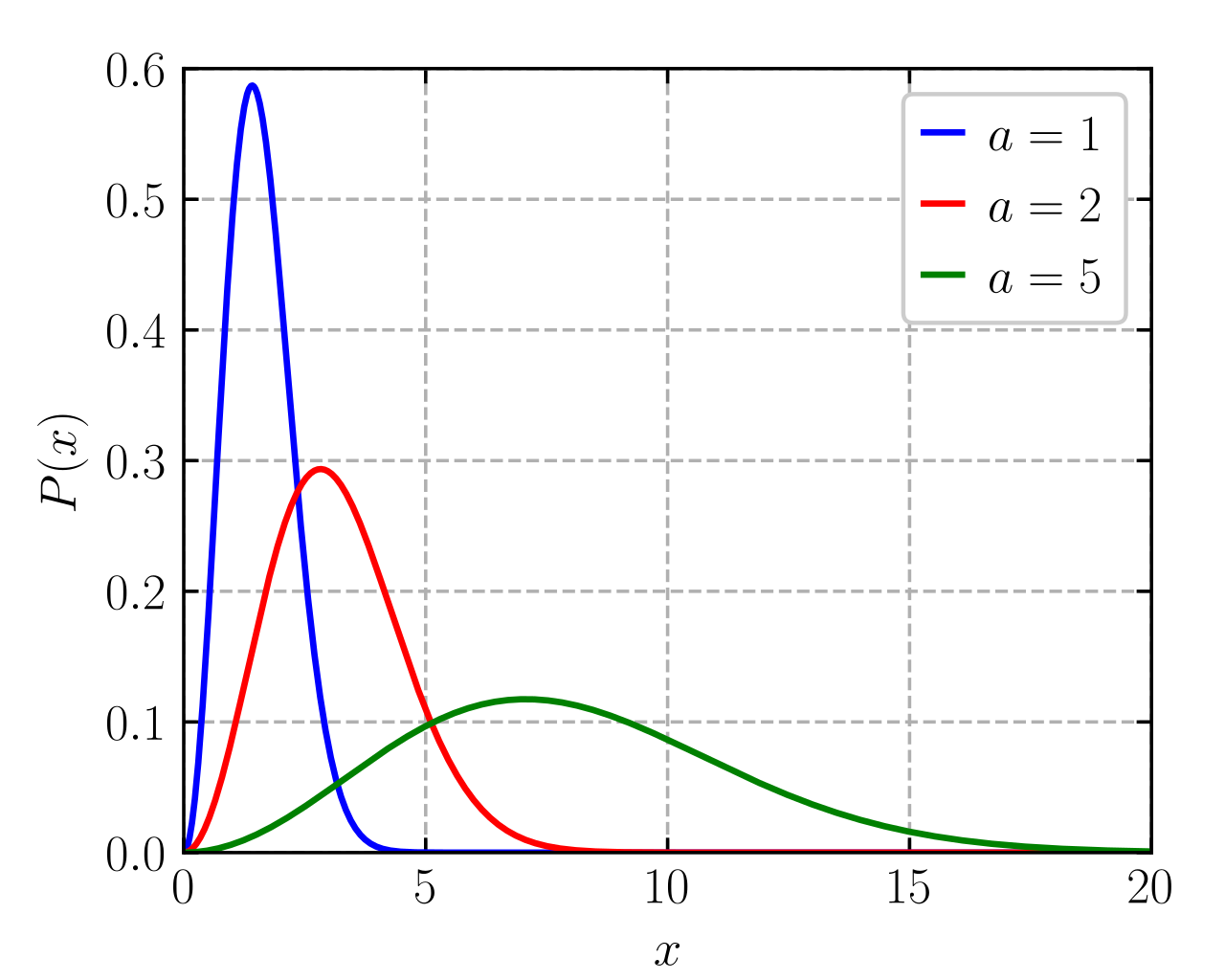
The blue curve, with the tallest peak
The red curve, which is in the middle
They are all at the same temperature
The green curve, with the broadest distribution and highest peak speed
Higher temperature shifts the peak to higher speed and flattens the curve (the total area stays 1). Image: Krishnavedala, CC0, via Wikimedia Commons.
In a household refrigerator, in which component does the refrigerant absorb heat from the food compartment?
The condenser
The compressor
The evaporator
The expansion valve
In the evaporator the cold, low-pressure liquid evaporates, absorbing heat from the inside. The condenser (back coils) releases it to the room; the compressor does the work.
