Quiz · Medium
Foundational questions on atomic structure, electron configurations, gas laws, phase changes, solutions and lab basics.
Which particle has the smallest mass?
Proton
Neutron
Electron
Alpha particle
An electron is about 1/1836 the mass of a proton. Protons and neutrons are both about 1 u; an alpha particle is about 4 u.
An atom of has how many neutrons?
26
30
56
82
Neutrons = A − Z = 56 − 26 = 30. 26 is the number of protons, and 56 is the mass number.
Which quantum number describes the shape of an orbital?
Principal, n
Angular momentum, ℓ
Magnetic, mℓ
Spin, ms
ℓ sets the subshell shape (s, p, d, f). n sets size and energy; mℓ sets orientation; ms is spin.
What is the ground-state electron configuration of chromium (Z = 24)?
[Ar] 4s² 3d⁴
[Ar] 4s¹ 3d⁵
[Ar] 4s² 3d⁵
[Ar] 3d⁶
Chromium is an exception: one 4s electron moves to give a half-filled 3d⁵ subshell. [Ar] 4s² 3d⁴ is what the simple Aufbau order predicts.
Which rule says electrons spread out over degenerate orbitals with parallel spins before pairing?
Pauli exclusion principle
Aufbau principle
Hund's rule
Heisenberg uncertainty principle
That is Hund's rule. Pauli limits an orbital to two electrons of opposite spin; Aufbau sets the filling order.
In the hydrogen atom, which transition emits the photon with the highest energy?
n = 3 → n = 2
n = 4 → n = 3
n = 2 → n = 1
n = 5 → n = 4
Energy levels get closer together as n increases, so the drop to n = 1 is by far the largest gap. These n → 1 lines are in the ultraviolet (Lyman series).
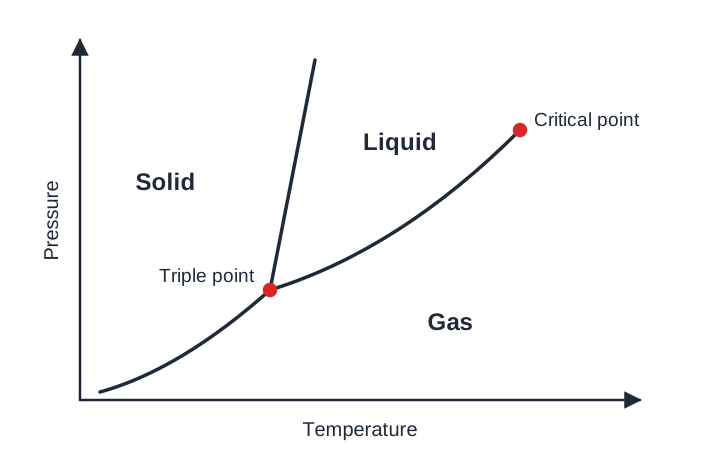
In the phase diagram, what is happening at the point labeled "Triple point"?
The gas becomes a supercritical fluid
Solid, liquid and gas coexist in equilibrium
The liquid boils at 1 atm
The solid sublimes at room temperature
The triple point is the only temperature and pressure where all three phases are in equilibrium. The supercritical fluid appears beyond the critical point.
Which glassware should you use to prepare a standard solution of exact concentration?
Beaker
Erlenmeyer flask
Volumetric flask
Graduated cylinder
A volumetric flask is calibrated to contain one exact volume. Beakers and Erlenmeyer flasks have only approximate markings; a graduated cylinder is less accurate.
How many significant figures are in 0.020 40?
3
4
5
6
Leading zeros don't count; 2, 0 (between nonzero digits), 4 and the trailing 0 after the decimal point do: four significant figures.
Which graph shows Charles's law?
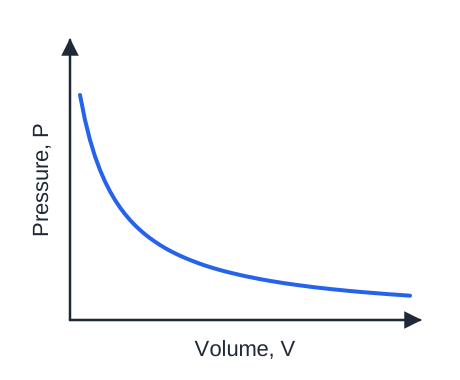
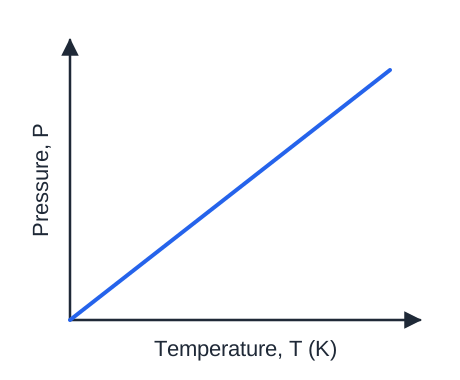
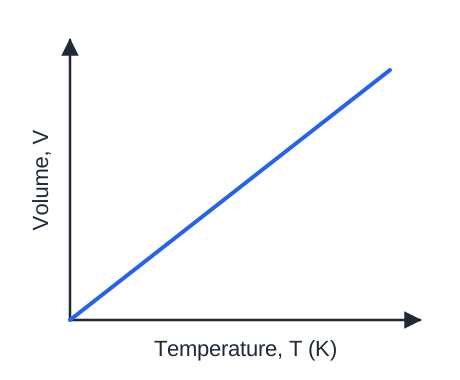
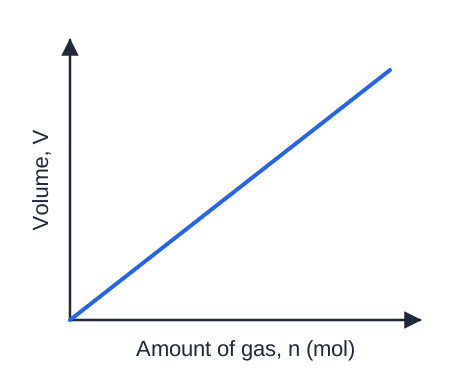
Charles's law is V vs T (in kelvin) at constant pressure: a straight line through the origin. Gay-Lussac's law looks similar but plots P vs T.
A gas at 3.0 atm occupies 4.0 L. At constant temperature the pressure drops to 1.0 atm. What is the new volume?
1.3 L
4.0 L
7.0 L
12 L
Boyle's law: V₂ = P₁V₁/P₂ = (3.0)(4.0)/1.0 = 12 L. Lower pressure means larger volume; 1.3 L would be the result of multiplying by the wrong ratio.
At the same temperature, which gas has the highest average molecular speed?
He
N₂
O₂
CO₂
All gases have the same average kinetic energy at the same temperature, so the lightest molecules move fastest. Helium (4 g/mol) is the lightest here.
Real gases behave most like ideal gases at:
High pressure and low temperature
Low pressure and high temperature
High pressure and high temperature
Low pressure and low temperature
At low pressure the molecules are far apart (their volume is negligible), and at high temperature attractions matter less. High pressure and low temperature cause the biggest deviations.
During boiling at constant pressure, the temperature of pure water keeps rising as long as heat is added.
True
False
False. While both liquid and gas are present the temperature stays at the boiling point; the energy goes into separating molecules.
Which is the correct definition of molality?
mol solute per L of solution
mol solute per kg of solvent
g solute per 100 g of solution
mol solute per mol of solution
Molality is mol solute per kg solvent. Mol per L of solution is molarity, which changes slightly with temperature.
Which aqueous solution has the lowest freezing point? (all 0.10 m)
Glucose
NaCl
CaCl₂
Ethanol
Freezing-point depression depends on the number of particles: CaCl₂ gives 3 ions (i ≈ 3), NaCl gives 2, and glucose and ethanol stay as single molecules.
How many mL of 2.00 M NaOH are needed to make 500. mL of 0.200 M NaOH?
20.0 mL
50.0 mL
100. mL
200. mL
M₁V₁ = M₂V₂ → V₁ = (0.200)(500.)/2.00 = 50.0 mL. 200. mL comes from flipping the concentration ratio.
Which pictogram means "corrosive"?
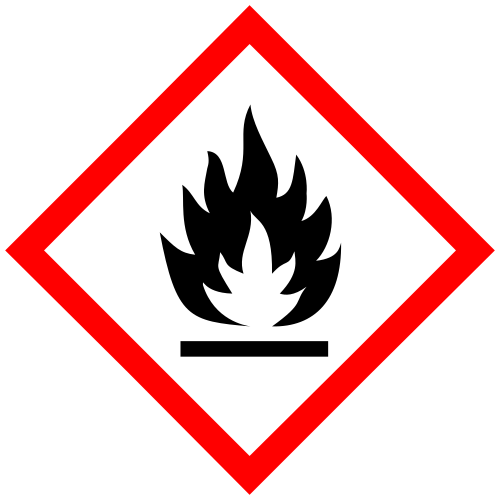
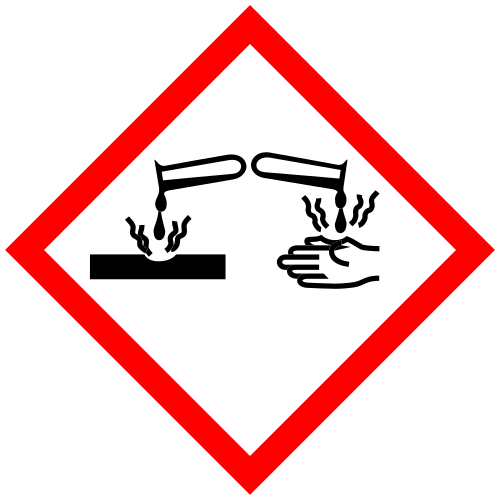
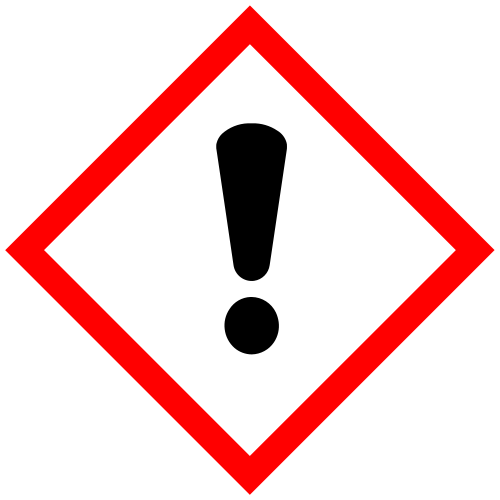
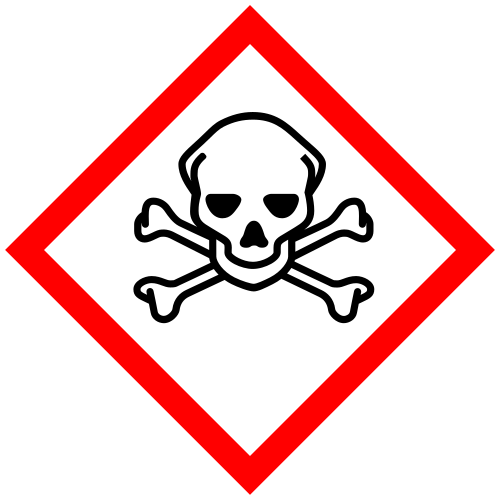
The corrosive pictogram shows liquid eating into a surface and a hand. The exclamation mark is for irritants and less severe hazards.
undergoes alpha decay. What is the product nucleus?
Alpha decay removes : A drops by 4 and Z by 2, giving lead-206. Increasing Z by 1 would be beta decay.
Why does iron lose its 4s electrons before its 3d electrons when it forms Fe²⁺?
4s electrons have higher n and, once 3d is occupied, higher energy
3d orbitals are always empty in iron
4s electrons have opposite spin
The Pauli principle forbids removing d electrons
In transition-metal atoms with occupied 3d orbitals, 4s is the outermost, higher-energy subshell, so it ionizes first. That is why Fe²⁺ is [Ar] 3d⁶.
