Quiz · Medium
Quiz on process capacity, takt time, queues, lean, Six Sigma, the bullwhip effect, scheduling and project critical paths.
Two machines in series have reliabilities of 0.9 and 0.8. What is the system reliability?
0.85
0.72
0.98
0.80
For series components multiply: 0.9 x 0.8 = 0.72. Redundant parallel parts would give 0.98.
Which Theory of Constraints step comes right after 'exploit the constraint'?
Elevate the constraint
Repeat the process
Identify the constraint
Subordinate everything else to the constraint
The five steps are identify, exploit, subordinate, elevate, repeat.
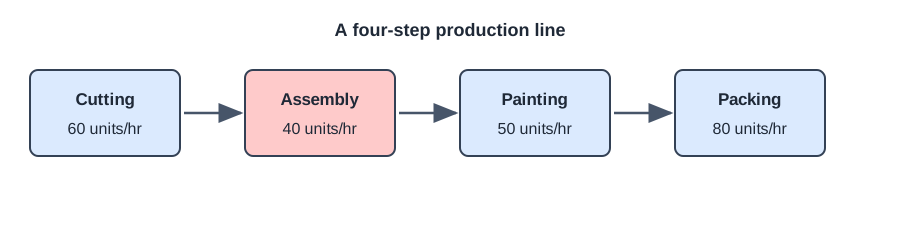
A process has four steps with capacities of 60, 40, 50 and 80 units per hour. What is the process capacity?
230 units per hour
57.5 units per hour
40 units per hour
80 units per hour
A serial process produces at the rate of its slowest step. Adding or averaging capacities is wrong.
In the bottleneck diagram, doubling the capacity of Cutting will
not change system output
double system output
raise output to 60 units per hour
reduce the capacity of Assembly
Cutting is not the bottleneck. Output stays at 40 units/hr (Assembly) until the bottleneck is improved.
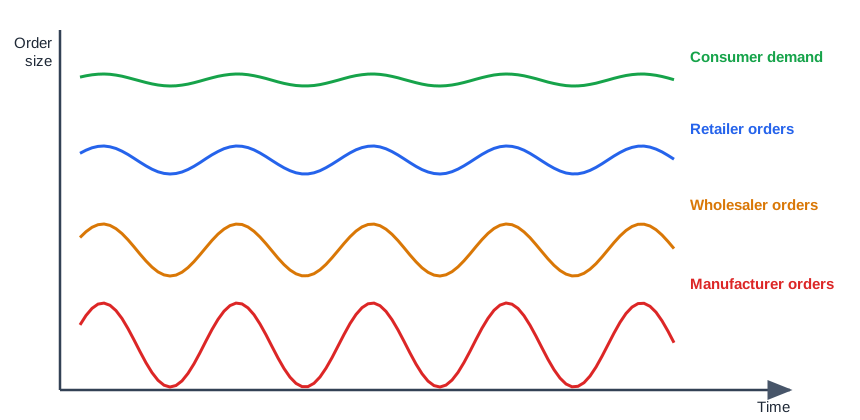
The chart shows the variability of orders growing at each stage upstream from the consumer. The effect is called the
Pareto effect
learning curve
kanban effect
bullwhip effect
The bullwhip effect is the amplification of demand variability upstream, caused by forecasting, batching, price changes and shortage gaming.
Which is NOT one of the seven classic lean wastes?
Waiting
Overtime
Overproduction
Motion
The seven wastes are transport, inventory, motion, waiting, overproduction, over-processing and defects. Overtime is a symptom, not a waste category.
A plant has 450 minutes available per shift and must produce 300 units. The takt time is
0.67 minutes per unit
1.5 minutes per unit
150 minutes per unit
2.5 minutes per unit
Takt time = available time / demand = 450 / 300 = 1.5 min. The inverse (0.67) is a rate, not a time per unit.
A design capacity is 200 units a day, the effective capacity is 160 and actual output is 120. What are utilization and efficiency?
Utilization 75%, efficiency 60%
Utilization 80%, efficiency 75%
Utilization 60%, efficiency 80%
Utilization 60%, efficiency 75%
Utilization = 120/200 = 60%. Efficiency = 120/160 = 75%. Mixing the denominators swaps the results.
In a kanban system, production of a part is triggered by
consumption by the downstream process
the monthly forecast
the master production schedule
the supplier's availability
Kanban is a pull system: a signal is sent when downstream uses material. Forecast- and schedule-driven release is push (MRP).
An M/M/1 queue has arrival rate 6 per hour and service rate 8 per hour. What is the average time a customer spends in the system?
22.5 minutes
7.5 minutes
30 minutes
45 minutes
W = 1/(mu - lambda) = 1/2 hour = 30 minutes. Wq (waiting only) = 0.75/2 = 0.375 hour = 22.5 minutes, which excludes service time.
Which statement about Six Sigma is correct?
It targets 3.4 defects per hundred units
It is a scheduling rule
It targets about 3.4 defects per million opportunities
It focuses only on cutting inventory
Six Sigma aims for 3.4 DPMO using the DMAIC method.
40 defects are found in 2,000 units, each with 5 opportunities for a defect. DPMO is
4,000
20,000
800
400
DPMO = 40 / (2,000 x 5) x 1,000,000 = 4,000. Ignoring the opportunities (20,000) overstates it.
A process that is in statistical control always meets customer specifications.
True
False
Control limits describe the process's natural variation; specification limits come from customers. A stable process can still produce out-of-spec output.
A project has paths A-B-D (9 days) and A-C-D (11 days). Which statement is correct?
The critical path is A-B-D, 9 days
The critical path is A-C-D, 11 days, and B has 2 days of slack
The project takes 20 days
Both paths have zero slack
The critical path is the longest path and sets the project duration.
Jobs are scheduled using the shortest processing time rule. Compared with FCFS, SPT typically
minimizes maximum lateness
always meets due dates
ignores processing time
minimizes average flow time but may delay long jobs
SPT reduces average flow time and WIP. EDD is the rule that minimizes maximum lateness.
Exponential smoothing with alpha = 0.2, previous forecast 150 and actual demand 160 gives the next forecast of
152
158
160
155
0.2 x 160 + 0.8 x 150 = 32 + 120 = 152. A low alpha gives a small adjustment.
Which layout type is best for a low volume, high variety shop with varied routings?
Product (line) layout
Fixed-position layout
Process (functional) layout
Continuous-flow layout
Similar machines are grouped, giving flexibility at the cost of longer flows and more WIP. Product layout suits high-volume standardized items.
A fishbone diagram is used to
rank problems by cost
track a process over time with limits
group possible causes of a problem by category
measure process capability
The cause-and-effect diagram organizes causes (6 Ms). A Pareto chart ranks problems; a control chart tracks over time.
A machine has availability 90%, performance 80% and quality 95%. OEE is about
68%
88%
72%
95%
OEE = 0.90 x 0.80 x 0.95 = 0.684. Taking an average (88%) is wrong because the factors multiply.
Which production approach would be best for a company whose demand is volatile and products are short-lived?
Lean with minimal buffers only
Level production only
Single sourcing for cost
Agile supply chain
Agile focuses on responsiveness and flexibility for volatile demand. Lean emphasizes efficiency for stable demand.
