Quiz · Medium
Twenty questions on counting GDP: final goods, value added, C+I+G+NX, real vs nominal, per capita, depreciation and common traps.
A farmer sells wheat to a miller for $1. The miller sells flour to a baker for $3. The baker sells bread to consumers for $5. How much do these transactions add to GDP?
$9
$3
$5
$4
Only the final good counts: the $5 bread. Adding all three sales ($9) double counts the wheat and flour already embedded in the bread's price. Equivalently, value added is $1 + $2 + $2 = $5.
Which of the following is included in this year's US GDP?
A US resident buys shares of stock
The government pays Social Security benefits
A family sells its used car to a neighbor
A US firm builds a new factory
New factory construction is investment. Stock purchases are only transfers of ownership, Social Security is a transfer payment, and a used-car sale involves goods already counted in GDP when produced.
C = 800, I = 200, G = 300, exports = 150, imports = 200 (all in billions). What is GDP?
$1,250 billion
$1,450 billion
$1,300 billion
$1,150 billion
GDP = C + I + G + (X − M) = 800 + 200 + 300 + (150 − 200) = 1,250. The tempting $1,450 forgets that net exports are negative; adding exports and imports ($350) would be wrong too.
Nominal GDP is $5,400 billion and the GDP deflator is 120. Real GDP is:
$6,480 billion
$4,500 billion
$5,280 billion
$5,400 billion
Real GDP = nominal ÷ deflator × 100 = 5,400 ÷ 120 × 100 = 4,500. Multiplying (6,480) is the common slip, which would be right for converting real to nominal.
Real GDP rises 4% while population rises 6%. Real GDP per capita:
Rises by about 2%
Falls by about 2%
Rises by about 4%
Stays the same
Per capita growth ≈ GDP growth − population growth = 4% − 6% = −2%. Total output rose, but it was spread over more people.
A Japanese company owns a car plant in Ohio. The plant's output is counted in:
Japan's GDP and US GNP
US GDP only, not in any country's GNP
US GDP and Japan's GNP
Japan's GDP and Japan's GNP
GDP is based on location (Ohio, so US GDP). GNP is based on ownership of the factors of production, so the Japanese-owned plant's income counts in Japan's GNP.
A furniture maker produces $10,000 of chairs this year but sells only $8,000 worth. The effect on this year's GDP is:
+$8,000, the value of sales
+$10,000: $8,000 in consumption and $2,000 in inventory investment
+$10,000, all counted as consumption
+$2,000, only the unsold chairs
GDP measures production, not sales. Unsold output is added to inventories, which count as investment. The tempting +$8,000 ignores inventory investment.
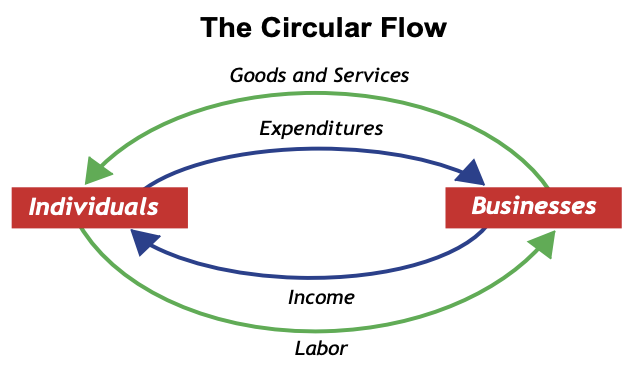
In the circular flow diagram, what do businesses pay to individuals in exchange for labor?
Expenditures
Goods and services
Income
Taxes
Households supply labor and receive income; they use that income to buy goods and services (expenditures). Image: BEA, public domain.
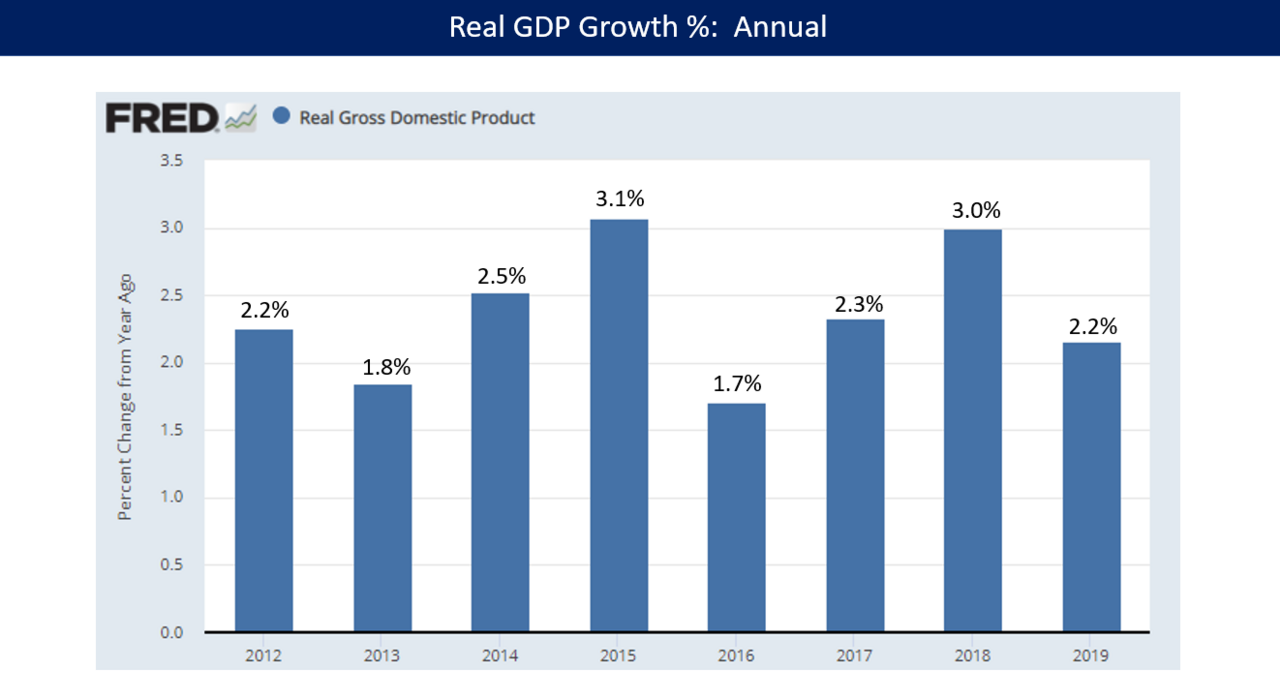
Which year in the chart shows the lowest real GDP growth?
2012
2016
2013
2019
Real GDP growth was about 1.7% in 2016, below 2013's 1.8% and 2012's and 2019's 2.2%. Image: Farcaster, public domain; data from FRED.
Why is real GDP per capita a better measure of average living standards than total real GDP?
It adjusts for differences in population size
It adjusts for inflation
It includes the underground economy
It measures how equally income is shared
Dividing by population shows output per person. Real (not per capita) already adjusts for prices; per capita says nothing about inequality or the underground economy.
True or False: GDP includes the value of unpaid housework that family members do for each other.
True
False
False. GDP counts only market transactions, so unpaid household production and volunteering are excluded. This is one reason GDP understates total economic activity.
GDP is $20,000 billion and depreciation is $3,000 billion. Net domestic product (NDP) is:
$23,000 billion
$17,000 billion
$20,000 billion
$6,000 billion
NDP = GDP − depreciation = 20,000 − 3,000 = 17,000. NDP nets out the capital used up in production.
Which item is NOT part of GDP measured by the income approach?
Government transfer payments
Wages and salaries
Corporate profits
Rent and interest
Transfers are redistributions, not payments for productive services. Wages, rent, interest and profit are the incomes earned from producing output.
Nominal GDP rises 6% while the GDP deflator rises 4%. Real GDP grew by roughly:
2%
10%
4%
6%
Real growth ≈ nominal growth − price growth = 6 − 4 = 2%. Adding the two (10%) is a common error.
Which of these is counted as investment in GDP?
A family buys shares in an index fund
A family deposits money in a savings account
A family buys a newly built house
A family buys an existing house from its owner
New residential construction is investment. Financial assets and sales of existing houses are transfers of ownership, though the realtor's fee is counted as a service.
US real GDP grows 0.5% in a quarter. The annualized rate that would be reported is about:
0.5%
2.0%
1.0%
5.0%
Annualizing compounds four quarters: 1.005⁴ − 1 ≈ 2.0%. Simply multiplying by 4 gives roughly the same answer; staying at 0.5% would be the quarterly rate.
Imports rise by $50 billion and, as a result, consumption rises by $50 billion (consumers buy imported goods). The effect on GDP is:
+$50 billion
−$50 billion
+$100 billion
No change
The extra $50 billion in C is exactly offset by the extra $50 billion subtracted as imports. GDP counts only domestic production, so it does not change.
A baker buys $3 of flour and sells bread for $5. The baker's value added is:
$5
$3
$2
$8
Value added = revenue − cost of intermediate goods = 5 − 3 = 2. The bread's full $5 is the final good, but only $2 is created at the baking stage.
Which statement about the base year is correct?
Nominal GDP equals real GDP and the deflator is 100
Real GDP is always zero
The deflator equals 1
Real GDP is higher than nominal GDP
In the base year, current prices equal base-year prices, so nominal = real and the deflator = 100.
