Quiz · Medium
Questions across phonetics, morphology, syntax, pragmatics, historical and sociolinguistics.
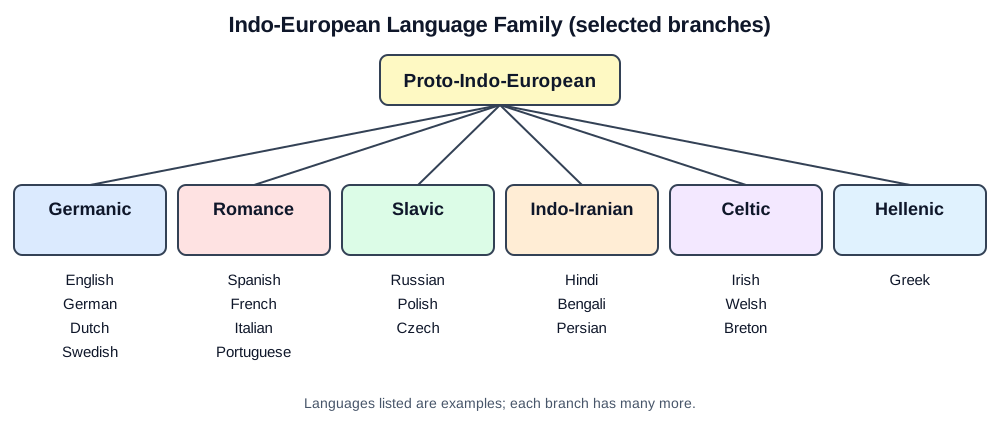
The diagram shows which language family?
Sino-Tibetan
Austronesian
Niger-Congo
Indo-European
The branches include Germanic, Romance, Slavic, Indo-Iranian, Celtic and Hellenic.
Words like 'here', 'now' and 'you' are examples of:
Polysemy
Deixis
Overgeneralization
Hyponymy
Their reference depends on speaker, time and place.
A minimal pair is:
Two sounds that never occur together
Two words that differ in exactly one sound and have different meanings
Two words with the same meaning
A word with two morphemes
Minimal pairs such as pat/bat show that /p/ and /b/ are separate phonemes.
The English /p/ in 'pin' and in 'spin' are:
Both voiced
Allophones of one phoneme
Different morphemes
Different phonemes
Aspirated and unaspirated /p/ never change meaning in English, so they are allophones.
The consonant /k/ has which place of articulation?
Bilabial
Glottal
Velar
Alveolar
/k/ is made with the back of the tongue against the soft palate (velum).
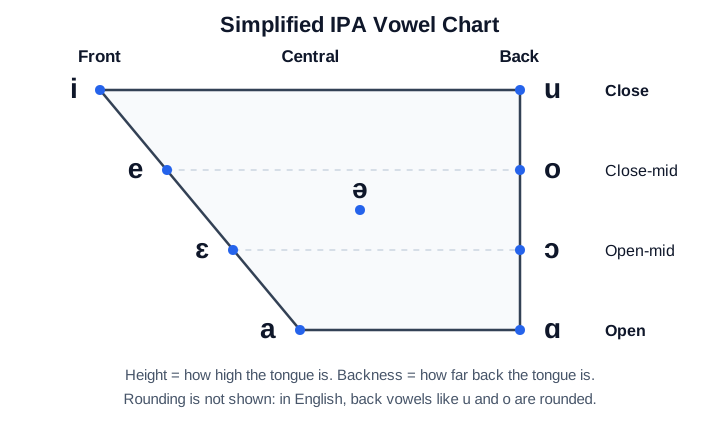
In the IPA vowel chart shown, the vowel at the close back corner is:
/u/
/i/
/ɑ/
/ə/
/u/ is close back (as in 'boot'). /i/ is close front, /ɑ/ open back, /ə/ central mid.
Which feature distinguishes /s/ from /z/?
Place of articulation
Nasality
Aspiration
Voicing
Both are alveolar fricatives; /z/ is voiced.
How many morphemes are in the word 'unbreakable'?
2
1
3
4
un- + break + -able.
The plural suffix -s in 'cats', 'dogs' and 'buses' is realized as /s/, /z/ and /ɪz/. These are:
Phonemes
Homonyms
Cognates
Allomorphs
Allomorphs are variants of one morpheme.
Turkish adds many separate suffixes, each with one meaning, to a root. Turkish is:
Polysynthetic
Tonal
Isolating
Agglutinative
Agglutinative languages like Turkish have clearly segmentable affixes. Fusional ones (Latin) merge meanings.
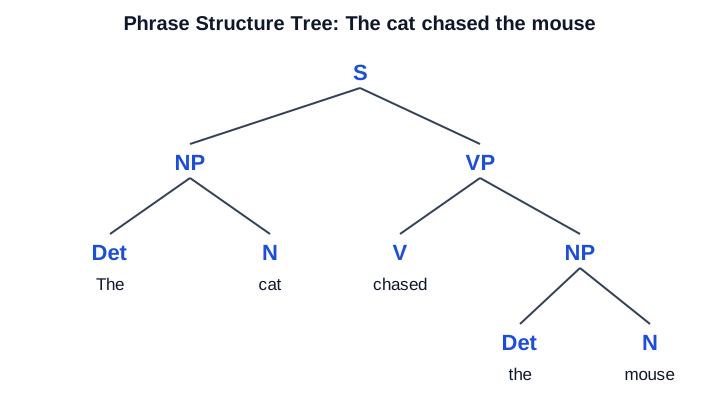
In the phrase structure tree for 'The cat chased the mouse', the VP consists of:
the mouse
chased the mouse
The cat
The cat chased
The VP contains the verb and its object NP.
Basic word order of Japanese is:
OVS
SOV
SVO
VSO
Japanese is SOV; English is SVO; Welsh is VSO.
Chomsky's claim that humans are born with an innate language faculty is called:
Behaviorism
Diglossia
Linguistic relativity
Universal Grammar
The poverty of the stimulus is one argument for it.
'Can you pass the salt?' typically functions as:
A promise
A question about ability
An indirect request
A greeting
This is a speech act and an implicature: the literal question implies a request.
Which Gricean maxim is violated by a vague, rambling answer?
Quality
Relation
Manner
Quantity
Manner = be clear, brief, and orderly. Quantity concerns how much information is given.
English 'father' and German 'Vater' are:
Loanwords from Latin
Homonyms
Allophones
Cognates
They descend from the same ancestor word; the f/v correspond to Proto-Indo-European /p/ by Grimm's Law.
A language that develops from a pidgin and becomes the native language of a community is a:
Dialect
Creole
Lingua franca
Register
Creoles have native speakers and full grammar; pidgins do not.
Switching between two languages within one conversation is called:
Diglossia
Reduplication
Assimilation
Code-switching
Diglossia is the allocation of two varieties to different domains.
Labov's department store study of /r/ found that:
Pronunciation varies with social class and speech style
Women never use /r/
Pronunciation is random
Accent has no social meaning
It is a classic demonstration of sociolinguistic variation.
The weak form of the Sapir-Whorf hypothesis states that:
Thought is independent of language
All languages share one grammar
Language can influence perception and memory
Language determines thought
The strong form (determinism) is largely rejected; the weak form has experimental support.
A child says 'goed' instead of 'went'. This shows:
The child is imitating adults
Code-switching
A speech impairment
Overgeneralization of a regular rule
Overgeneralization suggests children learn rules, not just memorize forms.
Damage to which region typically causes fluent but meaningless speech?
Broca's area
Cerebellum
Wernicke's area
Motor cortex
Wernicke's area (comprehension). Broca's area damage causes halting, effortful speech.
Which of the following is TRUE of sign languages?
They are universal
They are simple gestures without grammar
They are full languages with their own grammar
They are signed versions of the local spoken language
ASL, BSL and others differ from each other and from spoken languages.
