Quiz · Easy
Complement, addition and multiplication rules, independence, conditional probability, permutations and combinations.
P(A) = 0.5, P(B) = 0.4, P(A and B) = 0.1. What is P(A or B)?
0.9
0.8
0.7
0.2
0.5 + 0.4 - 0.1 = 0.8.
Independent events A and B have P(A) = 0.6 and P(B) = 0.5. What is P(A and B)?
0.3
1.1
0.1
0.55
For independent events, multiply: 0.6 x 0.5 = 0.3.
A fair coin is flipped once. What is P(tails)?
1/4
1/2
1
0
There are two equally likely outcomes, so P(tails) = 1/2.
P(A) = 0.3. What is P(not A)?
0.7
0.3
0.03
1.3
Complement rule: 1 - 0.3 = 0.7.
A fair die is rolled. What is P(even number)?
1/6
1/3
2/3
1/2
{2, 4, 6} are 3 of 6 outcomes, so 1/2.
What is P(roll a 2 or a 5) on a fair die?
1/6
1/12
1/3
5/6
The outcomes are mutually exclusive: 1/6 + 1/6 = 1/3.
Which pair of events is mutually exclusive?
Drawing a heart and drawing a king from a deck
Rolling an even number and rolling a 6
Drawing a card that is red and a card that is a queen
Rolling a 3 and rolling a 4 on one die
A single roll cannot be both 3 and 4. A card can be the king of hearts, an even number can be 6, and a card can be a red queen.
Which formula defines P(A | B)?
P(A and B) / P(A)
P(A) x P(B)
P(A and B) / P(B)
P(A) + P(B)
Conditional probability restricts attention to B, so divide the overlap by P(B).
How many ways can 4 different books be arranged on a shelf?
16
24
12
4
4! = 4 x 3 x 2 x 1 = 24.
How many ways can 2 people be chosen from a group of 6 to form a pair?
15
30
12
36
C(6,2) = 15. P(6,2) = 30 counts order.
An outfit uses 1 of 4 shirts and 1 of 3 pants. How many outfits?
7
24
9
12
Counting principle: 4 x 3 = 12.
Which situation involves a permutation (order matters)?
Choosing 3 members for a committee
Choosing 5 cards for a hand
Choosing president, vice president and treasurer from a club
Choosing a sample of 10 students
Different offices make order matter. The others are unordered selections.
The probability of at least one head in 3 fair coin flips is...
1/8
7/8
3/8
1/2
1 - P(no heads) = 1 - (1/2)^3 = 7/8.
A bag has 3 red and 2 blue marbles. One marble is drawn at random. P(red)?
3/5
2/5
1/2
3/2
3 red out of 5 total.
Two marbles are drawn from the bag above (3 red, 2 blue) without replacement. P(both red)?
9/25
3/5
1/5
3/10
(3/5)(2/4) = 6/20 = 3/10.
A coin has landed heads 5 times in a row. For a fair coin, P(heads on the next flip) is...
Less than 1/2
More than 1/2
1/2
0
Flips are independent; the coin has no memory.
In the Venn diagram, what is P(A or B)?
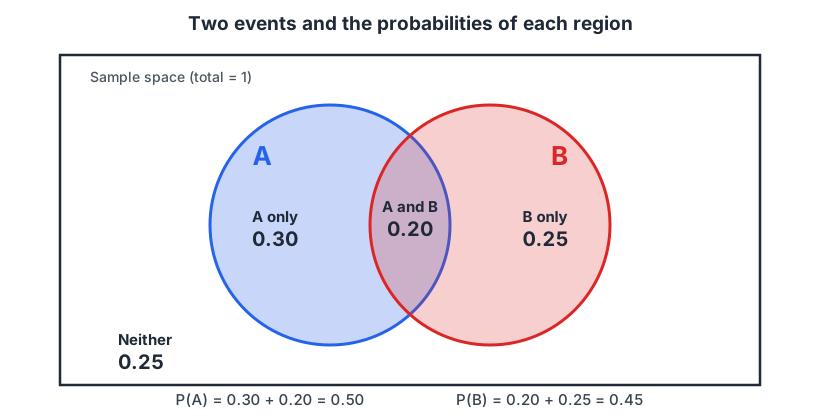
0.50
0.75
0.95
0.25
0.30 + 0.20 + 0.25 = 0.75. Equivalently, 1 - P(neither) = 0.75.
In the dice grid, what is the probability the sum is 7?
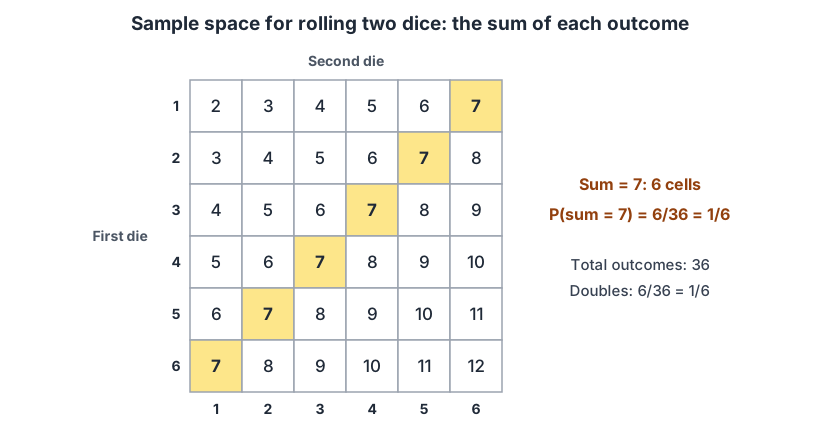
1/6
1/12
7/36
1/36
Six of the 36 cells show a sum of 7.
Which statement about the empirical probability of heads for a fair coin is true?
It is exactly 0.5 after any 10 flips
It becomes larger than 0.5 after tails streaks
It must stay constant for every sample
It approaches 0.5 as the number of flips increases
The law of large numbers describes long-run convergence.
0! equals...
0
undefined
1
-1
By definition 0! = 1, so C(n, 0) = 1.
