Quiz · Hard
Multi-step problems on RLC damping, first-order transients, complex power, Q factor and AC maximum power transfer.
Series RLC: , H, F. What is the damped natural frequency?
About 316 rad/s
About 245 rad/s
About 200 rad/s
About 116 rad/s
, , rad/s. 316 is the undamped frequency.
A 5 V step is applied to R = 1 kΩ in series with C = 1 μF (initially uncharged). The capacitor voltage at t = 1 ms is
about 5 V
about 1.84 V
about 3.16 V
about 2.5 V
ms, so V. 1.84 V is the resistor voltage .
An RL circuit (R = 10 Ω, L = 50 mH) is connected to 20 V at t = 0. What is the current at t = 5 ms?
About 2 A
About 0.74 A
About 1.0 A
About 1.26 A
ms, A, A. 0.74 A is the unreached remainder.
A capacitor starts at 2 V, is switched to a 10 V source, and the circuit has ms. Its voltage at t = 2 ms?
About 7.06 V
About 8.74 V
About 5.0 V
About 6.32 V
V. 6.32 V would apply only if starting from 0 V and heading to 10 V.
A Thevenin source (9 V, 3 Ω) drives a 6 Ω load. The load voltage is
9 V
6 V
4.5 V
3 V
Divider: V (current 1 A). 4.5 V would be a matched 3 Ω load.
Why is a dependent source NOT turned off when finding R_th?
Because dependent sources have zero internal resistance
Because turning it off would short the load
Because its value is set by a circuit variable, so removing it changes the network's behavior; use a test source instead
Because dependent sources are always current sources
A dependent source depends on voltages or currents in the circuit, so it must remain. Apply a test voltage or current at the terminals to find R_th = V_test / I_test.
A 10 Ω resistor is in parallel with a capacitor of reactance 10 Ω. The impedance is
, magnitude 7.07 Ω at -45°. Series addition (10 - j10) is the usual trap.
A load has V rms and A rms. The reactive power Q is
300 var (inductive)
520 var (inductive)
300 var (capacitive)
600 var (inductive)
VA, W, var. Current lags, so inductive. 520 is P.
A series RLC has , mH. What is its bandwidth?
10 rad/s
1000 rad/s
100 rad/s
10 000 rad/s
rad/s (159 Hz). It equals .
Series RLC: , mH, F. The quality factor is
about 0.16
about 63
about 6.3
about 3162
rad/s, . 3162 is the resonant frequency itself.
A source has . For maximum average power, the load impedance should be
The load must be the complex conjugate so reactances cancel: . A 5 Ω resistor matches only the magnitude.
A 24 V source in series with 6 Ω is converted to a Norton source. The result is
4 A in parallel with 6 Ω
144 A in parallel with 6 Ω
4 A in series with 6 Ω
24 A in parallel with 6 Ω
I = V/R = 4 A with the same 6 ohms in parallel.
A capacitor discharges through a circuit with tau = 5 ms. How long until it has fallen to 10% of its initial voltage?
About 5 ms
About 11.5 ms
About 25 ms
About 2.3 ms
ms. 2.3 ms drops the tau factor.
In a circuit three elements absorb 20 W, 15 W and 5 W, and one more element is the only source. By Tellegen's theorem, the power absorbed by the source is
+40 W
0 W
-40 W
-20 W
Absorbed power sums to zero, so the source absorbs -(20+15+5) = -40 W; that is, it delivers 40 W.
The curve marks the capacitor voltage at one time constant. If V, what is its value there?
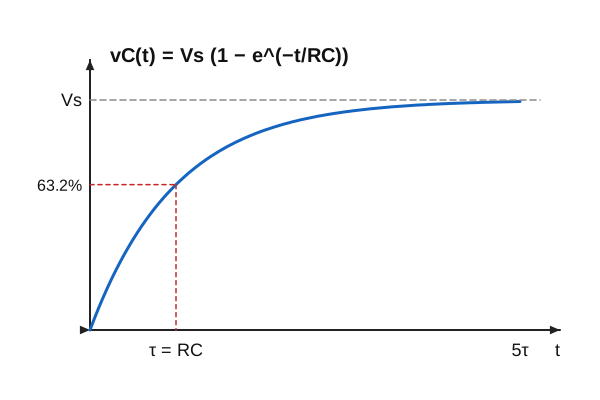
3.68 V
10 V
5 V
6.32 V
V. 3.68 V is what remains below .
