Quiz · Medium
Foundational questions on necrosis vs apoptosis, adaptations, amyloid, acute inflammation, wound healing and thrombosis.
A 58-year-old man has a myocardial infarction. A section of the infarct 2 days later shows preserved cell outlines with loss of nuclei. This is:
Liquefactive necrosis
Caseous necrosis
Coagulative necrosis
Apoptosis
Ischemic infarcts of solid organs such as the heart show coagulative necrosis. Liquefactive necrosis occurs in the brain and abscesses. Apoptosis would show shrunken cells with fragmented nuclei, no inflammation.
Which type of necrosis occurs in an ischemic stroke of the brain?
Liquefactive necrosis
Coagulative necrosis
Fat necrosis
Fibrinoid necrosis
The brain is rich in lipids and digestive enzymes with little structural protein, so infarcts liquefy. Coagulative necrosis is the pattern for other solid organs.
Which change is the earliest hallmark of reversible cell injury?
Pyknosis
Karyolysis
Amorphous densities in mitochondria
Cellular swelling
Failure of the Na+/K+ pump from ATP depletion causes swelling. Pyknosis and karyolysis are nuclear changes of necrosis; amorphous mitochondrial densities mark irreversibility.
A lymphoma shows t(14;18). Why does this mutation help the tumor cell survive?
Fas receptor is constitutively activated
BCL-2 overexpression blocks mitochondrial release of cytochrome c
Caspase-3 is overactive
p53 is hyperactive
t(14;18) moves BCL-2 next to the IgH enhancer. BCL-2 inhibits the intrinsic apoptotic pathway. p53 and caspases promote apoptosis, so their activation would not help survival.
Which pair correctly matches necrosis type and setting?
Fat necrosis: tuberculosis
Caseous necrosis: tuberculosis
Fibrinoid necrosis: acute pancreatitis
Liquefactive necrosis: myocardial infarct
TB produces caseous necrosis. Fat necrosis occurs in pancreatitis; fibrinoid necrosis occurs in vasculitis and malignant hypertension; heart infarcts show coagulative necrosis.
Which feature distinguishes apoptosis from necrosis?
Cell swelling
Release of lysosomal enzymes
Always pathologic
Absence of inflammation
Apoptotic cells shrink and are packaged into membrane-bound bodies cleared by phagocytes without inflammation. Swelling and enzyme leakage describe necrosis, and apoptosis also occurs physiologically.
Chronic alcohol use produces yellow, greasy, enlarged liver with lipid vacuoles in hepatocytes. This represents:
Reversible fatty change (steatosis)
Irreversible coagulative necrosis
Dystrophic calcification
Hemosiderosis
Triglyceride accumulation in hepatocytes is steatosis, which is reversible. Hemosiderosis is iron accumulation and would appear golden-brown with Prussian blue staining.
A tissue section stained with Congo red shows pink deposits with apple-green birefringence under polarized light. Which protein could be deposited in a patient with rheumatoid arthritis for 20 years?
AL (light chains)
β2-microglobulin
AA (serum amyloid A)
Transthyretin
Chronic inflammation raises serum amyloid A, producing AA amyloid (usually in kidney). AL is plasma cell dyscrasia; β2-microglobulin is dialysis-related; transthyretin is senile cardiac or familial.
A patient with hyperparathyroidism develops calcium deposits in the kidneys and gastric mucosa. This is:
Dystrophic calcification
Hemosiderosis
Metastatic calcification
Psammoma body formation
Hypercalcemia causes deposition in normal tissue (metastatic). Dystrophic calcification happens in damaged tissue with normal serum calcium.
Smokers often develop replacement of the bronchial columnar epithelium with stratified squamous epithelium. This is:
Metaplasia
Dysplasia
Hyperplasia
Anaplasia
Reversible replacement of one mature cell type with another is metaplasia. Dysplasia would show disordered growth with nuclear atypia.
Which statement about Barrett esophagus is correct?
It is columnar-to-squamous metaplasia
It increases risk of squamous cell carcinoma
It is caused by achalasia
It increases the risk of esophageal adenocarcinoma
Chronic reflux replaces squamous epithelium with columnar epithelium containing goblet cells (squamous to columnar), and the risk is adenocarcinoma.
The pregnant uterus enlarges by which adaptation?
Hypertrophy only
Both hypertrophy and hyperplasia of smooth muscle
Hyperplasia only
Metaplasia
Estrogen-driven uterine growth involves increased cell size and number. Cardiac muscle, by contrast, can only hypertrophy.
Which step of leukocyte recruitment is shown being mediated by the integrin LFA-1 binding ICAM-1?
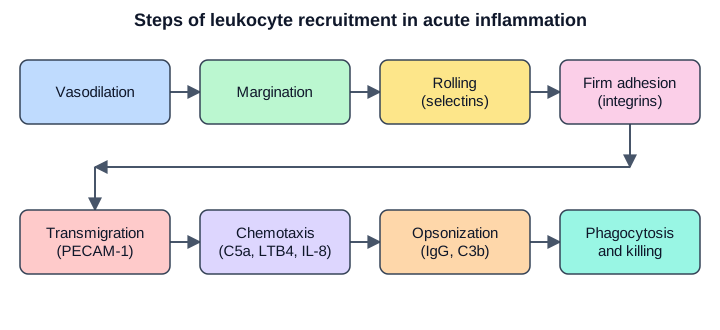
Rolling
Firm adhesion
Transmigration
Chemotaxis
Rolling uses selectins; integrins on activated leukocytes bind ICAM-1 for firm adhesion; PECAM-1 mediates transmigration. In the diagram, it is the fourth box.
A newborn has delayed separation of the umbilical cord, recurrent skin infections without pus and marked neutrophilia. Which defect is most likely?
NADPH oxidase deficiency
LYST gene mutation
Complement C3 deficiency
CD18 integrin deficiency (LAD type 1)
Failure of integrin-mediated adhesion prevents neutrophil emigration, so there is no pus. NADPH oxidase defect is CGD; LYST is Chediak-Higashi.
A child has recurrent abscesses due to Staphylococcus aureus and Aspergillus. The nitroblue tetrazolium test does not turn blue. Which enzyme is defective?
NADPH oxidase
Myeloperoxidase
Catalase
Superoxide dismutase
CGD: no respiratory burst. Myeloperoxidase deficiency usually causes mild disease; catalase-positive organisms are the problem because they destroy their own H2O2.
Which mediator is the main cause of fever in acute inflammation?
Histamine
C3b
Prostaglandin E2 stimulated by IL-1 and TNF
Leukotriene B4
IL-1 and TNF act on the hypothalamus via PGE2; aspirin and NSAIDs lower fever by inhibiting COX. Histamine causes vasodilation, LTB4 is chemotactic, C3b is an opsonin.
Which chemical mediator is the strongest neutrophil chemoattractant derived from complement?
C3b
C5b-9
C5a
C1q
C5a causes chemotaxis and neutrophil activation. C3b is an opsonin and C5b-9 is the membrane attack complex.
A granuloma with central caseous necrosis is most likely caused by:
Mycobacterium tuberculosis
Sarcoidosis
Crohn disease
Foreign body reaction
Caseation points to TB or fungi. Sarcoidosis and Crohn granulomas are non-caseating.
A patient develops swollen, painful left calf 10 days after hip surgery, then sudden dyspnea. Which component of Virchow triad is the main contributor?
Endothelial injury only
Hypercoagulability only
Turbulent flow
Stasis
Immobilization causes venous stasis (plus hypercoagulability from surgery). The dyspnea suggests pulmonary embolism.
Which infarct is typically hemorrhagic (red)?
Renal infarct
Pulmonary infarct from embolism
Splenic infarct
Myocardial infarct (early)
Red infarcts occur in loose tissue or tissue with dual blood supply (lung, intestine). Kidney, spleen and heart have end-arterial supply and show pale infarcts.
Which edema mechanism explains pedal edema in nephrotic syndrome?
Increased hydrostatic pressure
Decreased plasma oncotic pressure
Lymphatic obstruction
Increased vascular permeability from inflammation
Urinary protein loss lowers albumin and oncotic pressure. Heart failure raises hydrostatic pressure; filariasis obstructs lymph.
Which is the best description of the wound-healing change that depends on vitamin C?
Conversion of type I to type III collagen
Angiogenesis via VEGF
Wound contraction by myofibroblasts
Hydroxylation of proline and lysine in collagen
Vitamin C is a cofactor for prolyl and lysyl hydroxylases. Type III is replaced by type I (not the reverse). Angiogenesis and contraction do not need vitamin C directly.
A 3-week-old surgical scar extends beyond the original incision with thick, disorganized collagen. Which is most likely?
Keloid
Hypertrophic scar
Granulation tissue
Dystrophic calcification
A hypertrophic scar stays within wound boundaries and may regress; a keloid grows beyond the wound margins.
A patient with sepsis has bleeding from IV sites, low platelets, prolonged PT/PTT, low fibrinogen and schistocytes. This is:
Thrombotic thrombocytopenic purpura
Immune thrombocytopenia
Disseminated intravascular coagulation
Hemophilia A
DIC consumes platelets and factors, so PT/PTT are prolonged. TTP has normal PT/PTT; ITP has isolated low platelets.
Which statement about free radical injury is correct?
Catalase converts H2O2 to hydroxyl radical
Fenton reaction removes iron
Superoxide dismutase converts O2•− to H2O2
Glutathione peroxidase generates superoxide
SOD makes hydrogen peroxide, which catalase and glutathione peroxidase then detoxify. The Fenton reaction (Fe2+ + H2O2) generates the hydroxyl radical, not a defense.
