Quiz · Hard
Eighteen multi-step problems on weak acid pH, hydrolysis, buffers, titration curve points, polyprotic species and temperature effects.
What is the pH of 0.200 M CH₃COOH? (Ka = 1.8 × 10⁻⁵)
5.04
2.37
2.72
0.70
x = √(1.8 × 10⁻⁵ × 0.200) = 1.9 × 10⁻³ M; pH = 2.72. 0.70 would be right for a strong acid.
A 0.100 M solution of a weak monoprotic acid has pH 3.20. What is its Ka?
4.0 × 10⁻⁶
6.3 × 10⁻⁴
1.0 × 10⁻³
3.2 × 10⁻⁷
[H⁺] = 10⁻³·²⁰ = 6.3 × 10⁻⁴. Ka = (6.3 × 10⁻⁴)²/(0.100 − 0.00063) = 4.0 × 10⁻⁶. 6.3 × 10⁻⁴ is [H⁺], not Ka.
What is the pH of 0.25 M NaCH₃COO? (Ka of acetic acid = 1.8 × 10⁻⁵)
4.93
8.87
5.35
9.07
Kb = 5.6 × 10⁻¹⁰; [OH⁻] = √(5.6 × 10⁻¹⁰ × 0.25) = 1.2 × 10⁻⁵; pOH 4.93; pH 9.07.
A buffer is made from 0.30 mol NH₃ and 0.20 mol NH₄Cl in 1.0 L. What is the pH? (pKa of NH₄⁺ = 9.25)
9.25
4.57
9.43
9.07
pH = 9.25 + log(0.30/0.20) = 9.25 + 0.18 = 9.43. 9.07 has the ratio inverted.
1.00 L of buffer holds 0.100 M HA and 0.100 M A⁻ (pKa 4.76). After adding 0.020 mol NaOH, the pH is:
9.00
4.94
4.76
4.58
OH⁻ converts HA to A⁻: HA = 0.080, A⁻ = 0.120. pH = 4.76 + log(1.5) = 4.94.
25.0 mL of 0.100 M HCl is mixed with 40.0 mL of 0.100 M NaOH. What is the pH?
11.81
2.19
7.00
12.36
Excess OH⁻ = 4.00 − 2.50 = 1.50 mmol in 65.0 mL = 0.0231 M; pOH = 1.64; pH = 12.36.
25.0 mL of 0.100 M CH₃COOH is titrated with 30.0 mL of 0.100 M NaOH. What is the pH? (pKa 4.76)
4.94
8.72
12.52
11.96
Past equivalence (25.0 mL) the pH is set by the excess OH⁻: 0.50 mmol in 55.0 mL = 9.1 × 10⁻³ M, pOH 2.04, pH 11.96. The Henderson–Hasselbalch equation does not apply once the acid is used up.
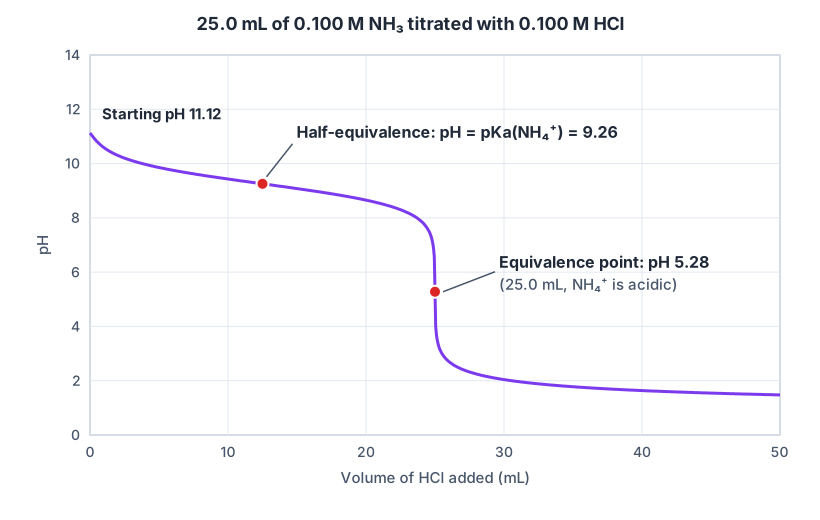
25.0 mL of 0.100 M NH₃ is titrated with 15.0 mL of 0.100 M HCl. What is the pH? (pKa of NH₄⁺ = 9.26)
5.28
9.26
9.08
9.44
NH₃ = 2.50 − 1.50 = 1.00 mmol; NH₄⁺ = 1.50 mmol. pH = 9.26 + log(1.00/1.50) = 9.08. 9.44 inverts the ratio.
Using the titration curve and the indicator chart, which indicator is best for the titration of NH₃ with HCl?
Methyl orange
Methyl red
Phenolphthalein
Bromothymol blue
The equivalence point is acidic (pH 5.28), in methyl red's range (4.4–6.2). Phenolphthalein changes long before equivalence is reached.
What is the pH at the first equivalence point of H₃PO₄ (pKa₁ = 2.15, pKa₂ = 7.20)?
4.68
2.15
7.20
9.78
The amphiprotic H₂PO₄⁻ dominates; pH = (pKa₁ + pKa₂)/2 = 4.68.
The pH of 0.100 M NaHCO₃ is closest to (pKa₁ = 6.35, pKa₂ = 10.33):
8.34
6.35
10.33
7.00
HCO₃⁻ is amphiprotic: pH ≈ (pKa₁ + pKa₂)/2 = 8.34.
Which conjugate pair is best for a buffer at pH 9.0?
H₂PO₄⁻/HPO₄²⁻ (pKa 7.20)
HCO₃⁻/CO₃²⁻ (pKa 10.33)
NH₄⁺/NH₃ (pKa 9.25)
CH₃COOH/CH₃COO⁻ (pKa 4.76)
A buffer works best within ±1 of its pKa. NH₄⁺/NH₃ is 0.25 away; HCO₃⁻/CO₃²⁻ is 1.33 away.
Which is the order of increasing pH for equimolar solutions?
NaOH < CH₃COONa < NaCl < NH₄Cl < HCl
HCl < NH₄Cl < NaCl < CH₃COONa < NaOH
NH₄Cl < HCl < NaCl < NaOH < CH₃COONa
HCl < NaCl < NH₄Cl < CH₃COONa < NaOH
HCl is strongly acidic, NH₄Cl weakly acidic, NaCl neutral, sodium acetate weakly basic and NaOH strongly basic.
What is the percent ionization of 0.0100 M acetic acid (Ka = 1.8 × 10⁻⁵)?
4.2%
1.3%
0.42%
42%
x = √(1.8 × 10⁻⁵ × 0.0100) = 4.2 × 10⁻⁴ M; 4.2 × 10⁻⁴/0.0100 = 4.2%. 1.3% is the value for 0.10 M, since dilution increases ionization.
At 50 °C, Kw = 5.5 × 10⁻¹⁴. What is the pH of 0.010 M NaOH at this temperature?
12.00
13.26
2.00
11.26
pKw = 13.26 and pOH = 2.00, so pH = 11.26. Using pH = 14 − pOH is valid only at 25 °C.
Which is the predominant phosphorus species in solution at pH 9.0 (pKa₁ 2.15, pKa₂ 7.20, pKa₃ 12.35)?
H₃PO₄
HPO₄²⁻
H₂PO₄⁻
PO₄³⁻
Between pKa₂ (7.20) and pKa₃ (12.35) the dominant form is HPO₄²⁻.
20.0 mL of H₂SO₄ is neutralized by 32.0 mL of 0.150 M NaOH. What is the H₂SO₄ concentration?
0.480 M
0.120 M
0.240 M
0.0600 M
NaOH = 4.80 mmol; H₂SO₄ is diprotic so 2.40 mmol; 2.40/20.0 = 0.120 M. 0.240 M forgets the 2:1 ratio.
Why does a buffer resist pH change best when [HA] = [A⁻]?
Both the added acid and added base can be neutralized equally
The pH is then 7
Ka becomes 1
The buffer then has no conjugate pair
With equal amounts of both components the buffer has the most capacity in both directions, and pH = pKa.
