Quiz · Medium
Clinical vignettes for the surgery clerkship: appendicitis, biliary disease, hernias, trauma resuscitation, burns and postoperative complications.
True or false: femoral hernias have a lower risk of strangulation than indirect inguinal hernias.
True
False
False. The narrow femoral canal makes strangulation more likely, so repair is always recommended.
Which finding supports compartment syndrome after a tibial fracture?
Crepitus
Pain out of proportion and with passive stretch
Painless pallor
Mild swelling only
Pain on passive stretch is an early sign. Loss of pulses is late. Treatment is emergent fasciotomy.
A patient develops a high fever and rigidity with rising end-tidal CO2 after anesthesia induction. What is the treatment?
Dantrolene
Naloxone
Flumazenil
Atropine
Malignant hyperthermia is treated with dantrolene, which blocks calcium release from the sarcoplasmic reticulum.
In which abdominal region is the pain of early peptic ulcer or pancreatitis typically felt?
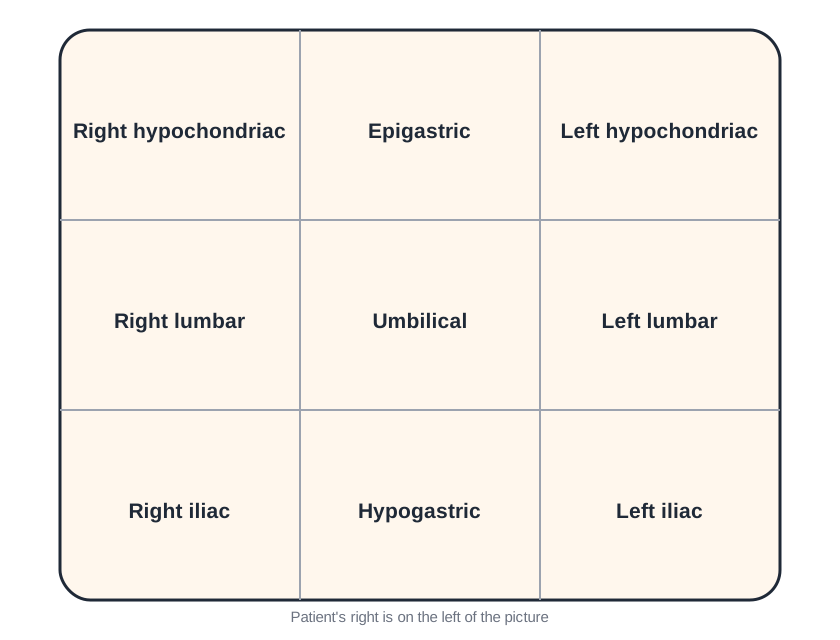
Epigastric
Hypogastric
Right iliac
Left lumbar
The stomach, duodenum and pancreas lie mainly in the epigastrium. The right iliac region holds the appendix.
A patient with appendicitis reports pain that began around the navel and then moved. Which region does it move to?
Left iliac
Right iliac
Hypogastric
Epigastric
Once the parietal peritoneum is inflamed, pain localizes to the right iliac fossa (McBurney point).
A 24-year-old has 18 hours of periumbilical pain that migrated to the RLQ, anorexia and a temperature of 38 C. What is the next best step?
Barium enema
Colonoscopy
Surgical consultation and imaging (CT or ultrasound)
Discharge with antacids
This is classic appendicitis; imaging confirms and surgery treats it. Colonoscopy and barium are contraindicated in acute inflammation.
A 50-year-old woman has RUQ pain, fever, positive Murphy sign and gallstones on ultrasound. Diagnosis?
Choledocholithiasis
Acute hepatitis
Biliary colic
Acute cholecystitis
Persistent pain with fever and a positive Murphy sign indicates cholecystitis. Biliary colic is afebrile and brief.
Fever, jaundice and RUQ pain are called which triad, and what is the urgent treatment?
Charcot triad; antibiotics and biliary decompression
Virchow triad; anticoagulation
Whipple triad; resection
Beck triad; pericardiocentesis
Charcot triad indicates ascending cholangitis requiring antibiotics and ERCP.
Which is the most common cause of small bowel obstruction in adults in developed countries?
Hernia
Adhesions
Gallstone ileus
Tumor
Adhesions from previous abdominal surgery cause most small bowel obstructions. Hernias are the second most common.
A hernia that passes lateral to the inferior epigastric vessels through the deep inguinal ring is?
Umbilical hernia
Direct inguinal hernia
Indirect inguinal hernia
Femoral hernia
Indirect hernias go through the deep ring lateral to the epigastric vessels. Direct hernias bulge medially through Hesselbach triangle.
Which sign suggests pancreatic head cancer: painless jaundice with a palpable nontender gallbladder?
Murphy sign
Rovsing sign
Kehr sign
Courvoisier sign
Courvoisier sign suggests malignant obstruction. A tender, fibrotic gallbladder from stones is usually not palpable.
Immediate management of a trauma patient with hypotension, absent right breath sounds, distended neck veins and tracheal deviation to the left?
Needle decompression of the right chest
CT scan
Intubation only
Chest radiograph
This is a right tension pneumothorax, a clinical diagnosis treated at once with decompression.
A 70 kg man has 40% total body surface area burns. By the Parkland formula, how much lactated Ringer should he receive in the first 8 hours?
2,800 mL
5,600 mL
11,200 mL
1,120 mL
4 mL x 70 kg x 40% = 11,200 mL over 24 hours; half (5,600 mL) goes in the first 8 hours from the time of injury, the rest over 16 hours. 11,200 mL is the 24-hour total.
In an unstable blunt trauma patient with positive FAST, what is the next step?
Diagnostic peritoneal lavage
CT scan
Exploratory laparotomy
Observation
Unstable patients with free fluid go to the OR. CT is for stable patients.
Which postoperative day fever most commonly reflects atelectasis?
Day 5 to 7
Day 14
Day 30
Day 1 to 2
Wind (atelectasis) occurs on day 1 to 2; urinary infection day 3 to 5; wound infection and DVT day 5 to 7.
Which procedure is used for perforated diverticulitis with feculent peritonitis in an unstable patient?
Nissen fundoplication
Whipple
Hartmann procedure
Appendectomy
Sigmoid resection, end colostomy and rectal stump closure avoids a primary anastomosis in a contaminated field.
Which burn finding signals the need for early intubation?
Pain at the burn site
Blisters on the forearm
Fever
Singed nasal hairs with carbonaceous sputum
Signs of inhalation injury predict rapid airway edema.
A man 65 to 75 who has ever smoked should have which screening?
One-time abdominal aortic ultrasound
Annual CT chest
Colonoscopy yearly
PSA every 6 months
AAA screening reduces rupture deaths. Elective repair is generally at 5.5 cm.
