Quiz · Hard
Applied questions on identifying bacteria with Gram stain and biochemical tests, antibiotic resistance, dilution calculations, toxins and herd immunity.
A bacterium is resistant to ampicillin because it carries a plasmid. Which is the fastest way this resistance can spread to another species in the same gut?
Mutation of the host genome
Meiosis
Binary fission
Conjugation
Conjugation allows plasmids to pass between cells, even of different species. Binary fission copies resistance only vertically to daughters.
A patient has a Gram-positive coccus that forms clusters, is catalase-positive and coagulase-positive. The most likely organism is:
Streptococcus pyogenes
Staphylococcus epidermidis
Staphylococcus aureus
Enterococcus faecalis
Clusters + catalase-positive = Staphylococcus. Coagulase-positive separates S. aureus from S. epidermidis. Streptococci form chains and are catalase-negative.
A Gram stain of a smear shows only pink rods. Which statement is correct?
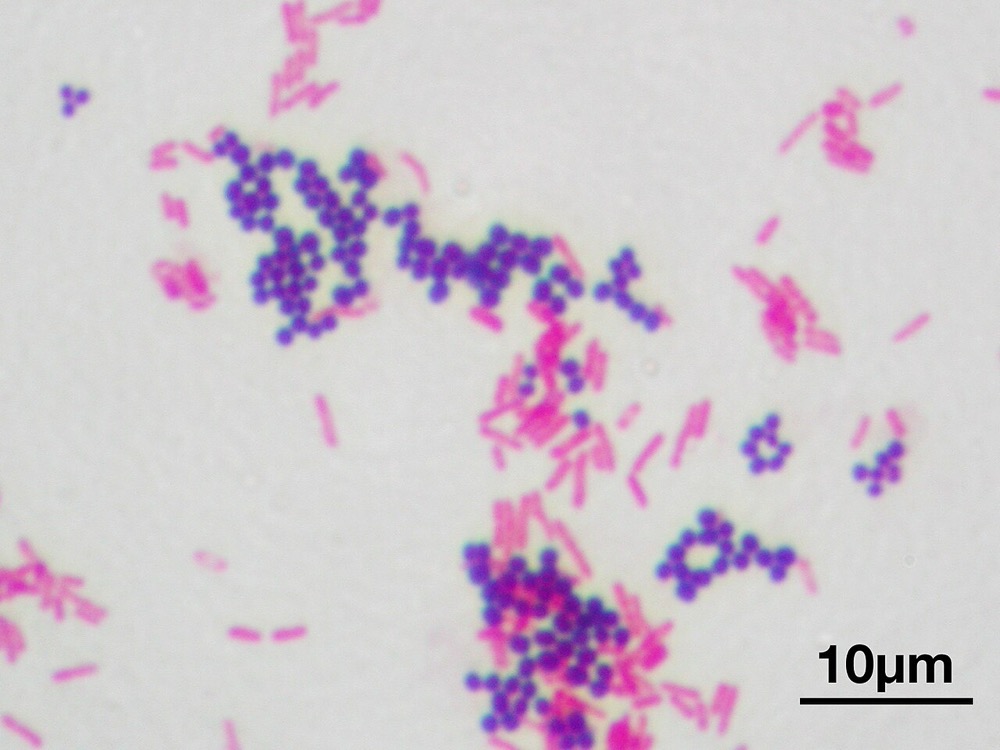
The cells have an outer membrane containing LPS
The cells are certainly Mycobacterium
The cells are Gram-positive and stain purple
The cells have a thick peptidoglycan layer
Pink means the cells lost the crystal violet and took up safranin: Gram-negative, with a thin peptidoglycan layer and an outer membrane containing LPS. Thick peptidoglycan would hold the purple stain.
Image: Y tambe, CC BY-SA 3.0, via Wikimedia Commons.
A colony count of 156 on a plate where 0.1 mL of a 10^-4 dilution was spread gives which concentration in the original culture?
1.56 x 10^8 CFU/mL
1.56 x 10^5 CFU/mL
1.56 x 10^6 CFU/mL
1.56 x 10^7 CFU/mL
CFU/mL = colonies / (volume plated x dilution) = 156 / (0.1 x 10^-4) = 156 / 10^-5 = 1.56 x 10^7. Forgetting the 0.1 mL volume gives 1.56 x 10^6, the tempting wrong answer.
In a growth experiment, a culture is moved from a rich medium (glucose) into a medium with lactose only. The lag phase becomes long. The best explanation is:
The cells are in the death phase
The cells need to induce the lac operon before using lactose
Lactose kills bacteria
Bacteria cannot use disaccharides
Cells must make beta-galactosidase and permease, which means turning on the lac operon. Cells that are already adapted would skip this delay.
A researcher plates bacteria on MacConkey agar and sees pink colonies. This means the bacteria:
Are Gram-positive and ferment lactose
Are Gram-negative and ferment lactose
Are Gram-negative and do not ferment lactose
Are Gram-positive and do not ferment lactose
MacConkey contains bile salts and crystal violet (selects Gram-negatives); pink colonies show lactose fermentation from the pH indicator.
Why are antibiotics usually more effective on bacteria in log phase than in stationary phase?
Cells in log phase are dividing and building walls and ribosomes, the targets
Cells in stationary phase are dead
Cells in log phase are larger
Antibiotics only work in the dark
Penicillin needs growing cells synthesizing peptidoglycan. Stationary-phase cells and biofilm cells are often tolerant for this reason.
Choose the correct pairing of endotoxin properties:
Peptidoglycan fragments that cause photosynthesis
Protein secreted by Gram-positive cells, can be converted to toxoid
Lipid A of LPS in Gram-negative cells, causes fever and shock
DNA fragments that cause mutation
Endotoxin is lipid A, a part of the outer membrane. Exotoxins are proteins and can be toxoided.
Which of the following best explains why tuberculosis treatment lasts at least six months?
TB only grows during the night
Antibiotics cannot enter any human cell
Mycobacterium divides very slowly and has a waxy wall
TB is a virus
A generation time of 15 to 20 h and a mycolic-acid wall mean drugs work slowly and multiple drugs are needed to prevent resistance.
A phage-infected culture of non-toxic Corynebacterium suddenly produces diphtheria toxin. The most likely explanation is:
Lysogenic conversion by a prophage carrying the toxin gene
Binary fission
Spore formation
Transformation by naked DNA
The tox gene is carried by a prophage. When a bacterium becomes lysogenic, it gains toxin production.
In Griffith's experiment, mice injected with heat-killed smooth (S) cells plus living rough (R) cells died. What did this show?
Mice have no immune system
Proteins are the genetic material
The R cells were killed by heat
A substance from the dead S cells transformed living R cells
A transforming principle moved from dead S cells to live R cells. Later Avery, MacLeod and McCarty showed it was DNA.
Which of the following would be killed by an autoclave but survive pasteurization?
E. coli
Bacillus endospores
Salmonella
Influenza virus
Endospores survive pasteurization but not 121 °C steam under pressure. The others are killed at pasteurization temperatures.
A disk diffusion plate shows a 25 mm zone around drug A and 8 mm around drug B for the same bacterium. What can you conclude?
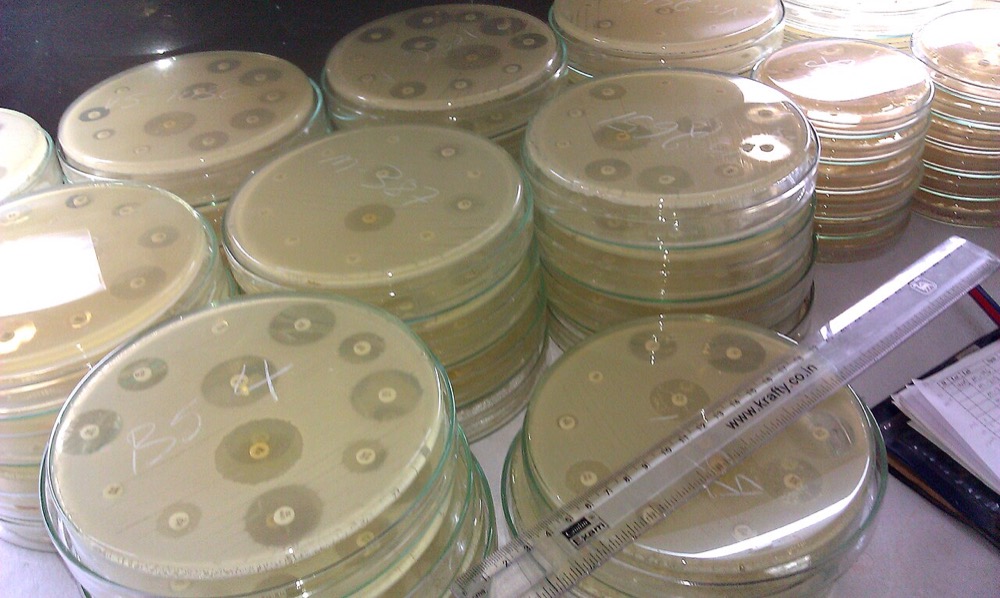
Drug A is always better for any infection
The bacterium looks more susceptible to A, but each result must be compared with that drug's breakpoint
The bacterium is resistant to A
Drug B kills the bacteria faster
Zone sizes cannot be compared directly between drugs because each drug diffuses differently. Interpretation uses standard breakpoints.
Image: Microrao, CC BY-SA 4.0, via Wikimedia Commons.
A virus that is enveloped is most likely to be inactivated by:
Boiling for 1 s
Acid
Cold
Soap and alcohol
Soap and alcohol dissolve the lipid envelope. Naked viruses such as norovirus resist them.
The influenza vaccine must be reformulated almost every year mainly because of:
Antigenic drift
Lysogeny
Binary fission
Endospore formation
Small mutations in hemagglutinin and neuraminidase change the antigens. Antigenic shift is rarer and causes pandemics.
If R0 for a disease is 5, about what fraction of the population needs to be immune for herd immunity?
20%
50%
80%
95%
Threshold = 1 - 1/R0 = 1 - 1/5 = 0.8.
