Quiz · Hard
Ballistic pendulum, loops, banked curves, rolling, energy with friction and other combined-concept problems with numerical answers.
A 2.0 kg block slides from rest down a 30° incline with μₖ = 0.20. How fast is it moving after travelling 3.0 m along the incline (g = 9.8 m/s²)?
5.4 m/s
4.4 m/s
3.8 m/s
7.7 m/s
m/s². m/s. 5.4 m/s ignores friction (); 7.7 m/s is for a free fall of 3 m.
A 10 g bullet moving at 400 m/s embeds in a 1.99 kg block hanging from strings (ballistic pendulum). How high does the block rise (g = 9.8 m/s²)?
0.20 m
0.41 m
0.020 m
8.2 m
Momentum: → m/s. Then m. Using the bullet's own speed (400 m/s) gives absurd heights because energy is lost in the embedding.
A cart on a frictionless track goes down a ramp into a vertical loop of radius R. From what minimum height above the bottom of the loop must it start so that it stays on the track at the top?
2 R
R
3 R
2.5 R
At the top, . Energy: , so . is the height of the loop's top and would leave the cart with zero speed there.
A ball is thrown horizontally at 15 m/s from the top of a 19.6 m high cliff. What is its speed just before hitting the level ground (g = 9.8 m/s²)?
15 m/s
19.6 m/s
24.7 m/s
34.6 m/s
The fall takes 2.0 s, so m/s. Speed = m/s. Adding the components (34.6 m/s) is a common error; they must be combined as perpendicular vectors.
A frictionless banked curve of radius 100 m is designed for cars travelling at 20 m/s. What is the bank angle (g = 9.8 m/s²)?
12°
22°
42°
68°
→ . Mass does not enter.
A 0.20 kg block is pushed against a spring (k = 500 N/m) and compresses it by 0.10 m, then released on a horizontal surface with μ = 0.25. Assuming friction acts throughout, what is the total distance the block travels before stopping (g = 9.8 m/s²)?
5.1 m
2.0 m
0.51 m
12 m
Spring energy J. Friction N. m.
A 3.0 kg block on a frictionless table is connected over an ideal pulley at the table's edge to a 2.0 kg hanging mass. What is the tension in the string (g = 9.8 m/s²)?
19.6 N
7.8 N
29.4 N
11.8 N
m/s². N. 19.6 N would be the hanging weight if the system were stationary.
A uniform solid disk rolls without slipping down a height of 3.0 m from rest. What is its speed at the bottom (g = 9.8 m/s²)?
7.7 m/s
5.4 m/s
6.3 m/s
4.4 m/s
→ m/s. A sliding block would reach 7.7 m/s because none of its energy goes into spinning.
A 1.0 kg object moving east at 4.0 m/s collides with and sticks to a 1.0 kg object moving north at 3.0 m/s. What is the speed of the combined object?
3.5 m/s
2.5 m/s
5.0 m/s
7.0 m/s
Momentum components: , , so kg·m/s. Divide by the total mass 2.0 kg: 2.5 m/s. Adding the speeds directly ignores the vector nature.
An 800 kg elevator accelerates upward at 1.5 m/s². What is the tension in the cable (g = 9.8 m/s²)?
9040 N
7840 N
6640 N
1200 N
→ N. 7840 N is the tension at constant velocity.
A satellite orbits at a distance equal to twice the Earth's radius from Earth's centre. Compared with the gravitational field at Earth's surface, its local field strength is…
one half
the same
zero
one quarter
: at it is . The satellite is still pulled strongly; it is weightless only because it is in free fall.
A 50 kg crate is lifted 10 m at constant speed in 20 s. What is the average power delivered to the crate (g = 9.8 m/s²)?
25 W
490 W
245 W
4900 W
W. Forgetting to divide by the time gives the work (4900 J).
A pendulum clock keeps correct time at sea level. It is taken to a mountain where g is 1.0% smaller. About how many seconds does it lose per day?
About 860 s
About 430 s
About 43 s
About 8640 s
, so the period grows by about 0.5%: s. A 1% smaller g does not give a 1% longer period.
A 20 kg sign hangs from two identical cables, each making 30° with the horizontal (g = 9.8 m/s²). The tension in each cable is…
196 N
98 N
170 N
392 N
→ N. Dividing 196 by 2 forgets that the cables are at an angle and so carry more than half the weight each.
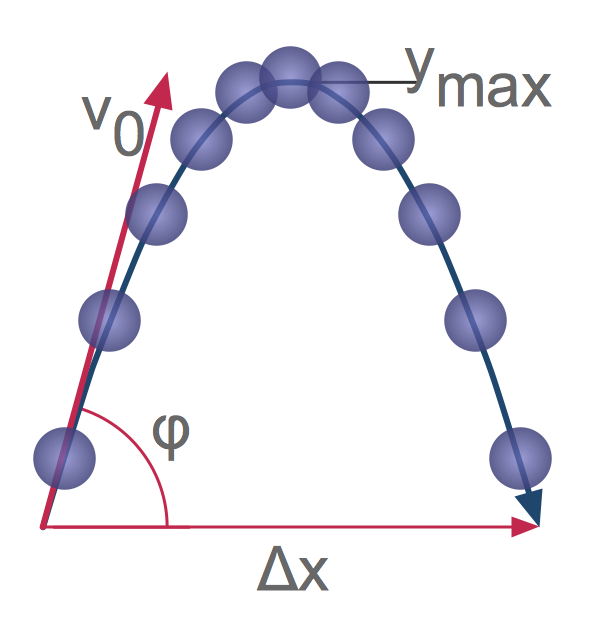
The projectile diagram shows launch speed v₀, angle φ, maximum height y_max and range Δx. At the highest point of the trajectory, the ball's…
velocity is zero and its acceleration is zero
velocity is horizontal and its acceleration is zero
velocity is zero and its acceleration is g downward
velocity is horizontal and its acceleration is g downward
Only the vertical velocity component is zero at the top; the horizontal component remains. Gravity acts throughout, so . Image: CS Odessa, CC BY 4.0, via Wikimedia Commons.
