Quiz · Medium
Foundational questions on incidence, prevalence, study designs, screening and bias.
A study follows 5,000 smokers and 5,000 non-smokers for 20 years and compares lung cancer incidence. What design is this?
Case-control study
Cross-sectional study
Cohort study
Ecological study
Participants are grouped by exposure and followed forward in time to see who develops the outcome. A case-control study would start with people who already have lung cancer.
Which measure counts only NEW cases during a period?
Incidence
Point prevalence
Period prevalence
Case fatality rate
Incidence is new cases; both kinds of prevalence include existing cases.
A new treatment extends survival of people with a chronic disease without curing it. What happens?
Both incidence and prevalence fall
Incidence increases, prevalence is unchanged
Prevalence falls, incidence is unchanged
Prevalence increases, incidence is unchanged
P is roughly I x D. Duration rises so prevalence rises; the treatment does not change how many new cases appear.
Which is the best study design for investigating a very rare disease?
Prospective cohort
Case-control
Randomized controlled trial
Cross-sectional survey
Case-control studies start with cases, so they are efficient for rare outcomes. A cohort would need huge numbers to see enough cases.
In a 2x2 table, the odds ratio is calculated as:
a / (a + b)
(a + c) / (b + d)
ad / bc
ac / bd
The cross-product ratio ad/bc. a/(a+b) is a risk, not an odds ratio.
Which type of prevention is a mammogram?
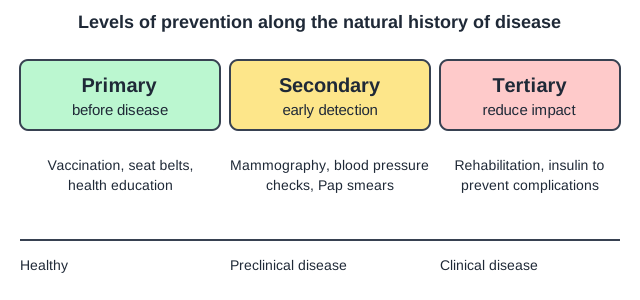
Secondary
Primary
Tertiary
Primordial
Screening detects disease early before symptoms. Primary would prevent disease from occurring at all, such as vaccination.
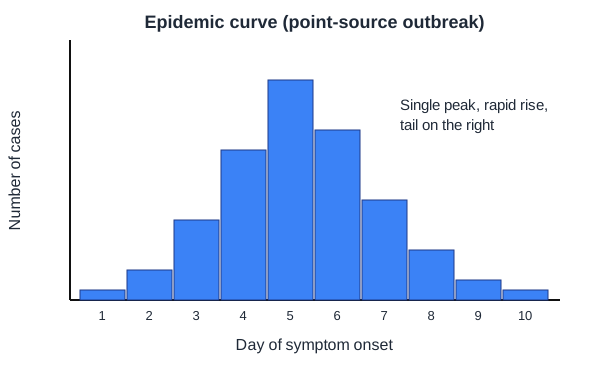
Cases in an outbreak all fall on a single sharp peak within one incubation period. This suggests:
A propagated (person-to-person) outbreak
A point-source exposure
An endemic disease
A continuous common-source exposure
A single exposure event produces a single, compact epidemic curve. Propagated outbreaks show successive waves.
Sensitivity is the proportion of:
Healthy people who test negative
Positive tests that are true positives
Negative tests that are true negatives
Diseased people who test positive
Sensitivity = TP / (TP + FN). The other three describe specificity, PPV and NPV respectively.
If disease prevalence in the tested population falls, the PPV of a test will:
Fall
Rise
Stay the same
Equal the sensitivity
With fewer true cases, a larger share of positive results are false positives, so PPV drops. Sensitivity and specificity are not affected.
A relative risk of 0.6 for a vaccine means:
Vaccinated people have 60% lower risk
Vaccinated people have 40% lower risk than unvaccinated
Vaccinated people have 0.6 times higher risk
The vaccine had no effect
RR 0.6 means risk is 60% of the comparison group's risk, a 40% reduction (vaccine efficacy = 40%).
A factor associated with both exposure and outcome, but not on the causal pathway, is a:
Effect modifier
Mediator
Confounder
Placebo
That's the definition of a confounder. A mediator lies on the causal pathway between exposure and outcome.
Which of the following is an example of primary prevention?
Childhood measles vaccination
Pap smear screening
Cardiac rehabilitation after a heart attack
Treating hypertension found at a screening visit
Vaccination stops disease before it occurs. Pap smears and BP checks are secondary; rehabilitation is tertiary.
Which pair of terms is correctly matched?
Endemic: worldwide spread of a new disease
Epidemic: occurrence clearly above the expected level
Pandemic: constant low-level presence in a region
Sporadic: occurs at regular predictable intervals
Pandemic is global spread; endemic is baseline presence; sporadic is infrequent and irregular.
An epidemiologist compares death rates between two countries with very different age structures. What is the best method?
Compare crude death rates
Compare case fatality rates
Compare proportionate mortality
Compare age-standardized rates
Age differences confound crude rates. Standardization (adjusting to a common age structure) removes that confounding.
Which bias occurs when cases remember past exposures differently from controls?
Recall bias
Lead-time bias
Selection bias
Healthy worker effect
Recall bias is a type of information bias common in case-control studies.
The case fatality rate is calculated as:
Deaths from the disease divided by the whole population
Deaths from the disease divided by all deaths
Deaths from the disease divided by the number of people with the disease
Deaths divided by live births
CFR measures the severity of a disease among those affected. Dividing by the whole population gives a cause-specific mortality rate; dividing by all deaths gives proportionate mortality.
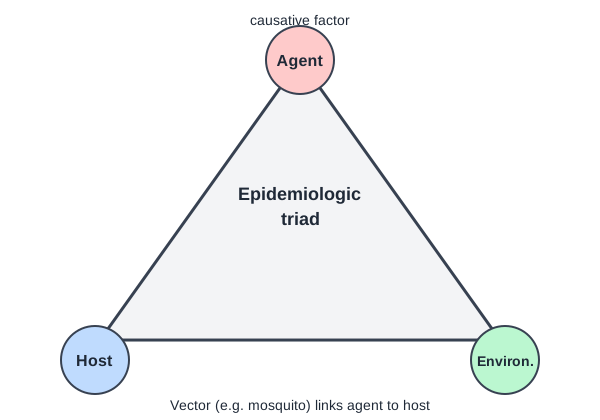
Which corner of the epidemiologic triad does 'crowded housing' belong to?
Agent
Environment
Host
Vector
Crowding is an external factor that affects exposure, so it is part of the environment. Host factors are intrinsic (age, immunity).
True or false: A randomized controlled trial can only control for confounders that the researchers have measured.
True
False
False. Randomization balances both measured and unmeasured confounders between groups on average, which is its key advantage.
What does R0 < 1 mean?
Each case infects fewer than one other person on average, so the outbreak dies out
Each case infects exactly one other person
The disease is spreading exponentially
Herd immunity has been reached by vaccination
If R0 is below 1, transmission cannot sustain itself. R0 = 1 is the threshold for steady spread; above 1 means growth.
Which Bradford Hill criterion is essential for causation?
Specificity
Analogy
Temporality
Strength
The cause must precede the effect. The others strengthen the argument but a cause can lack them (e.g. smoking has low specificity).
