Quiz · Easy
Twenty questions on net worth, budgeting, compounding, inflation, credit scores, debt payoff, mortgages and student loans.
Net worth is calculated as:
Income minus expenses
Total assets minus total liabilities
Total assets plus total liabilities
Salary minus taxes
Net worth is a balance-sheet snapshot. Income minus expenses is cash flow.
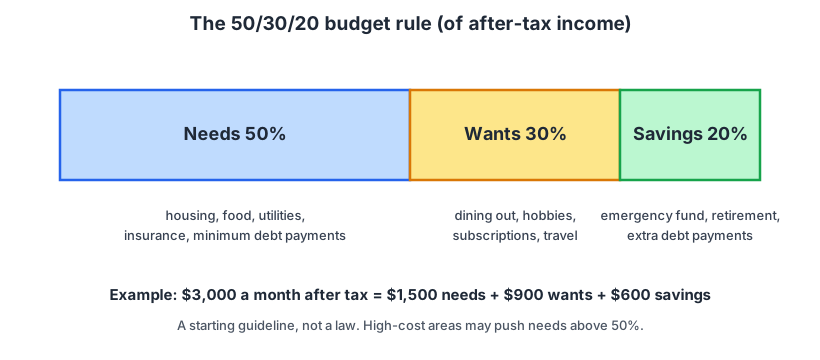
Take-home pay is $4,000 a month. Under the 50/30/20 rule, the 'wants' category is:
$1,200
$800
$2,000
$1,600
30% of 4,000 = 1,200. Needs would be 2,000 and savings 800.
A typical emergency fund guideline is:
1 week of income
12 months of salary
10% of net worth only
3 to 6 months of essential expenses
It is meant to cover job loss or large unplanned bills without borrowing.
A savings account pays 4.5% APR compounded monthly. The APY is closest to:
4.50%
4.75%
4.59%
5.40%
(1 + 0.045/12)^12 - 1 = 4.594%.
By the Rule of 72, money earning 6% a year doubles in about:
6 years
12 years
9 years
18 years
72 / 6 = 12.
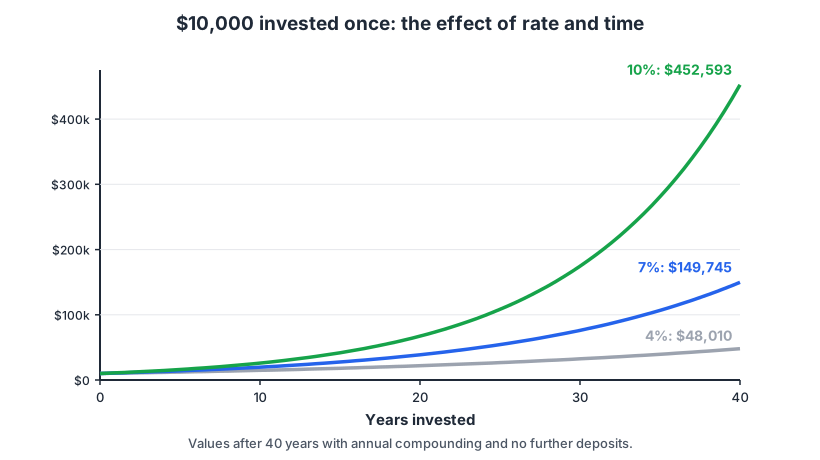
$10,000 is invested once at 7% for 40 years, as in the chart. Its value is closest to:
$150,000
$28,000
$48,000
$450,000
10,000 x 1.07^40 = 149,745. At 4% it is only about 48,010 and at 10% about 452,593.
You save $500 a month for 30 years at 7%, compounded monthly. The balance is closest to:
$180,000
$365,000
$1,000,000
$610,000
FV = 500 x ((1 + 0.07/12)^360 - 1) / (0.07/12) = about 609,985. Contributions total only 180,000.
A savings account earns 7% and inflation is 3%. The real return is about:
10%
4.0% exactly
3.9%
2.1%
1.07 / 1.03 - 1 = 3.88%. The simple 7 - 3 = 4% is a close approximation.
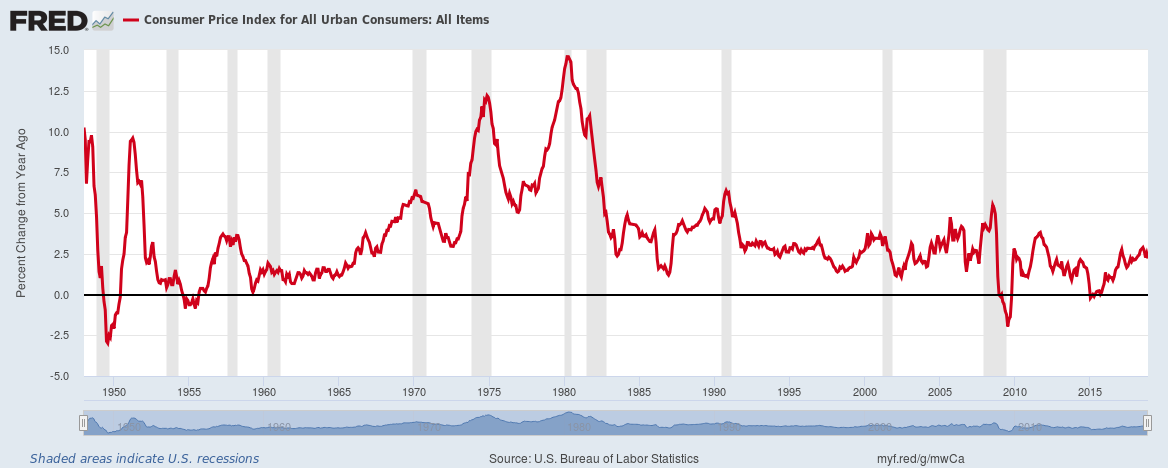
In the chart, US inflation peaked near 15% around which year?
1960
1980
1995
2009
Inflation surged in the 1970s and peaked about 14.8% in 1980, before Paul Volcker's Fed raised rates sharply.
Image: FRED, public domain, via Wikimedia Commons.
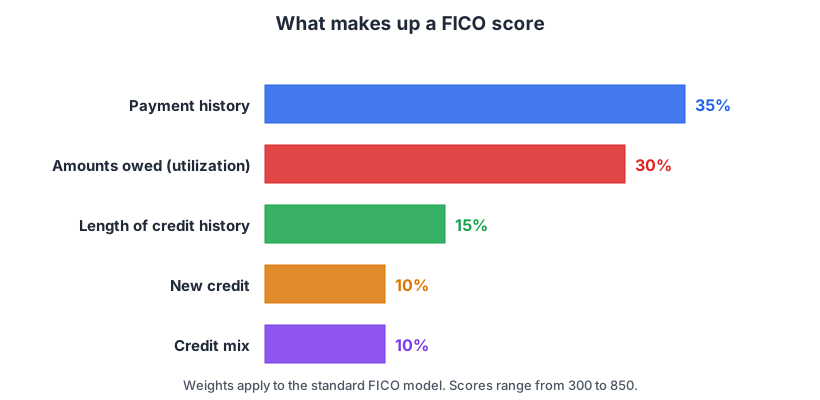
Which FICO factor carries the largest weight?
Payment history, 35%
Credit mix, 10%
Length of history, 30%
New credit, 25%
Payment history at 35% and amounts owed at 30% together make up about two-thirds of the score.
Your total card balances are $1,500 and your total limits are $6,000. Your credit utilization is:
4%
40%
15%
25%
1,500 / 6,000 = 25%, below the usual 30% guideline.
How can you obtain free credit reports in the US?
Only once every 10 years
Only by paying the bureau
At AnnualCreditReport.com from the three bureaus
Only through your bank's app
Reports are available weekly for free. Scores themselves may cost extra.
You owe $3,000 at 18% APR and pay $200 a month. About how long to pay it off, and how much interest?
12 months, about $100
18 months, about $424 of interest
24 months, about $900
36 months, about $1,500
Each month's interest falls as the balance falls. 18 payments total about 3,424.
Which strategy minimizes total interest when paying multiple debts?
Debt avalanche: highest interest rate first
Debt snowball: smallest balance first
Pay equally on all
Pay the newest debt first
Avalanche saves the most interest. Snowball can help motivation.
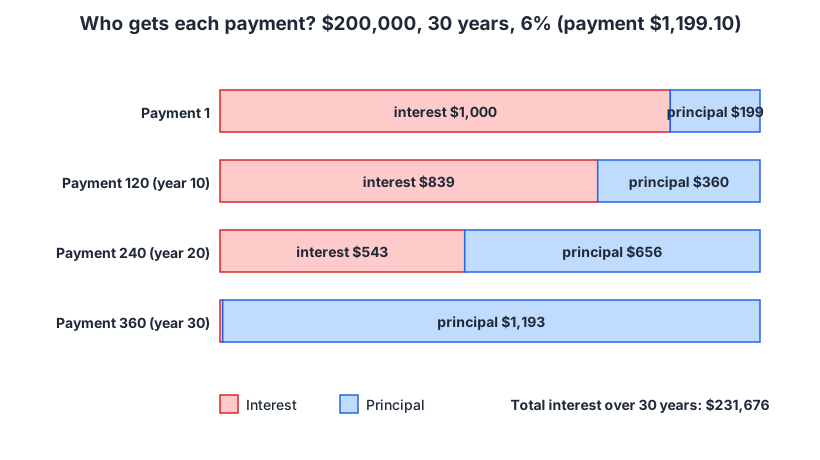
The monthly payment on a $200,000, 30-year fixed mortgage at 6% is closest to:
$1,000
$1,500
$2,000
$1,199
Payment = 200,000 x 0.005 / (1 - 1.005^-360) = 1,199.10.
In the first month of that mortgage, interest and principal are about:
$199 interest and $1,000 principal
$600 interest and $600 principal
$1,000 interest and $199 principal
$1,199 interest and $0 principal
Interest = 200,000 x 0.005 = 1,000. The rest of the 1,199.10 reduces principal.
Gross monthly income is $7,500. By the 28% front-end rule, the maximum housing payment is:
$2,700
$2,100
$1,500
$3,000
0.28 x 7,500 = 2,100. The 36% total-debt limit would be 2,700.
Private mortgage insurance is generally required when:
The down payment on a conventional loan is under 20%
The loan is for more than 30 years
The home is a condo
The borrower is self-employed
PMI protects the lender and can usually be removed once equity reaches about 20%.
A federal student loan program forgives balances after 120 qualifying payments for government and nonprofit workers. It is called:
The Stafford Plan
Pell Forgiveness
Income Share Rebate
Public Service Loan Forgiveness
Payments must be made under qualifying plans while working full-time for a qualifying employer.
Credit card APR is 24% compounded monthly. The effective annual rate is:
24.0%
25.0%
26.8%
28.8%
(1.02)^12 - 1 = 26.82%.
