Quiz · Medium
Twenty questions on 401(k)s, Roth accounts, Social Security, the 4% rule, tax rates, capital gains, insurance and estate planning.
Why does a 401(k) employer match matter?
It reduces your tax bracket
It is an immediate extra return on your contribution
It cancels fees
It is a loan you repay
A 50% match is a 50% instant return on matched dollars, before any investment gain.
Salary $80,000. The employer matches 100% up to 4% of pay. What is the maximum annual match?
$3,200
$4,000
$8,000
$1,600
4% of 80,000 = 3,200.
Which describes a Roth IRA?
Pre-tax contributions, taxed withdrawals
No contribution limit
Only for employers
After-tax contributions, tax-free qualified withdrawals
Traditional accounts give a deduction now and tax later. Roth accounts are the reverse.
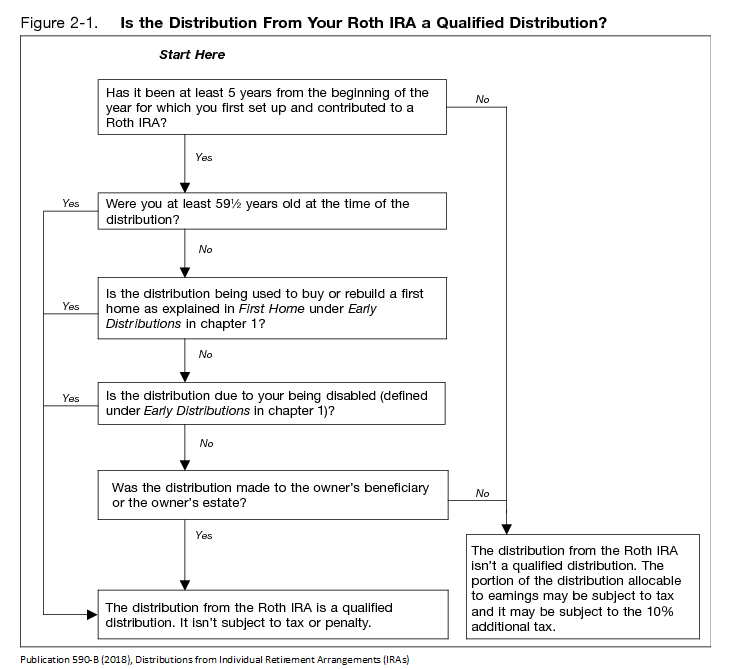
Using the flowchart, a Roth IRA withdrawal is a qualified distribution when:
You are over 40
You earn more than the limit
The 5-year period has passed and you are at least 59 1/2
You withdraw only contributions the same year
After 5 years, being at least 59 1/2, buying a first home (limited), disability or death qualifies.
Chart: IRS Publication 590-B (2018), public domain, via Wikimedia Commons.
The standard additional tax on early withdrawals from most retirement accounts before 59 1/2 is:
1%
10%
25%
50%
It is on top of ordinary income tax unless an exception applies.
A health savings account (HSA) is known for:
Deductible contributions, tax-free growth and tax-free qualified withdrawals
Only deductible contributions
Tax-free withdrawals for any purchase
Having no eligibility rules
An HSA requires a high-deductible health plan.
Dollar-cost averaging means:
Buying only when prices fall
Investing everything at once
Selling high and buying low
Investing a fixed amount on a regular schedule
It spreads out purchase prices and reduces timing risk.
Using the 4% rule, a retiree wanting $60,000 a year needs a portfolio of about:
$240,000
$600,000
$1,500,000
$2,400,000
60,000 / 0.04 = 1,500,000, or 25 times spending.
Social Security full retirement age for someone born in 1962 is:
62
67
65
70
For those born in 1960 or later it is 67. Delaying to 70 adds about 8% per year.
Employees pay what share of FICA tax (Social Security plus Medicare)?
7.65%
15.3%
6.2%
1.45%
6.2% + 1.45% = 7.65%. Employers pay the same share. Self-employed people pay both halves, 15.3%.
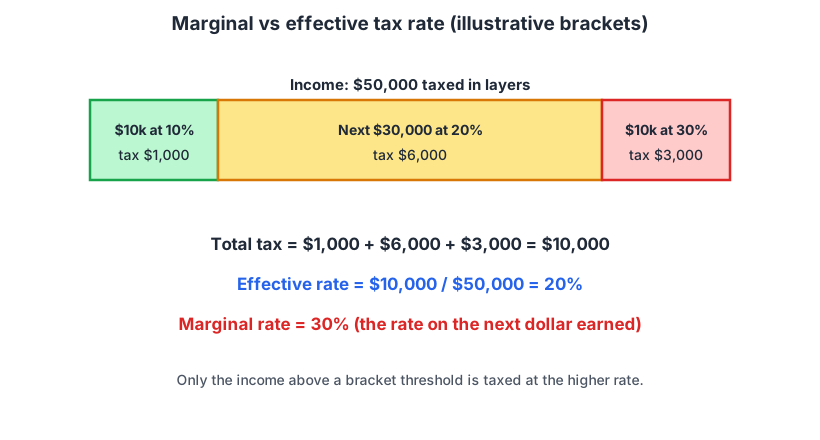
In the chart, taxable income of $50,000 is taxed in layers. The effective rate is:
30%
10%
25%
20%
Total tax 10,000 / 50,000 = 20%, while the marginal rate is 30%.
A $1,000 tax credit compared with a $1,000 deduction for someone in the 22% bracket:
Saves $220 versus $1,000
Saves the same
Saves $1,000 versus $220
Saves $780 versus $220
A credit cuts the bill dollar for dollar. A deduction lowers taxable income, saving the marginal rate times the amount.
An asset held for more than a year and sold at a gain generates:
Ordinary income only
A long-term capital gain taxed at 0%, 15% or 20%
Tax-free income
A deduction
Short-term gains are taxed as ordinary income.
A health plan has a $2,000 deductible and a $5,000 out-of-pocket maximum. After you have paid $5,000 in covered care in a year:
The plan pays 100% of covered in-network care
You start again from zero
You pay 20% more
Coverage ends
The out-of-pocket maximum caps what you pay for covered care.
Compared with whole life insurance, term insurance:
Pays out regardless of when you die
Has a larger savings component
Is always lifelong
Is cheaper per dollar of coverage, with no cash value
Many advisers suggest buying term and investing the difference.
Beneficiary designations on an IRA or life insurance policy:
Are overridden by the will
Apply only if there is no will
Override what the will says
Are optional and ignored
Keep them current after life events.
A revocable living trust is mainly used to:
Remove all taxes
Avoid probate for assets placed in it
Prevent the grantor changing it
Replace insurance
It does not usually reduce income taxes.
You buy a $300,000 home with 10% down. The loan amount is:
$270,000
$300,000
$30,000
$240,000
Down payment 30,000, loan 270,000, a loan-to-value ratio of 90%.
Which is a warning sign of a Ponzi scheme?
Audited statements
Independent custody of assets
Returns that vary with the market
Consistently high, guaranteed returns with little risk
Early investors are paid with new investors' money until recruitment slows.
A fund charges 1% a year. Over 30 years, on $100,000 earning 7% gross, the fee reduces the ending value from about $761,000 to about:
$700,000
$757,000
$574,000
$300,000
At 7% the balance is 100,000 x 1.07^30 = 761,226. At a net 6% it is 100,000 x 1.06^30 = 574,349.
