Quiz · Hard
Sixteen harder questions on the natural rate, Okun's law, the Beveridge curve, efficiency wages, hysteresis and how labor-force changes move the measured unemployment rate.
The natural rate of unemployment is 5% and the actual rate is 9%. Using Okun's law with a 2:1 ratio, real GDP is about what percent below potential?
4%
9%
8%
18%
Gap in unemployment = 4 points × 2 = 8% below potential. Using 1:1 would give 4%.
In the Beveridge curve, the move from 2009 (high unemployment, low openings) to 2018 (low unemployment, high openings) represents:
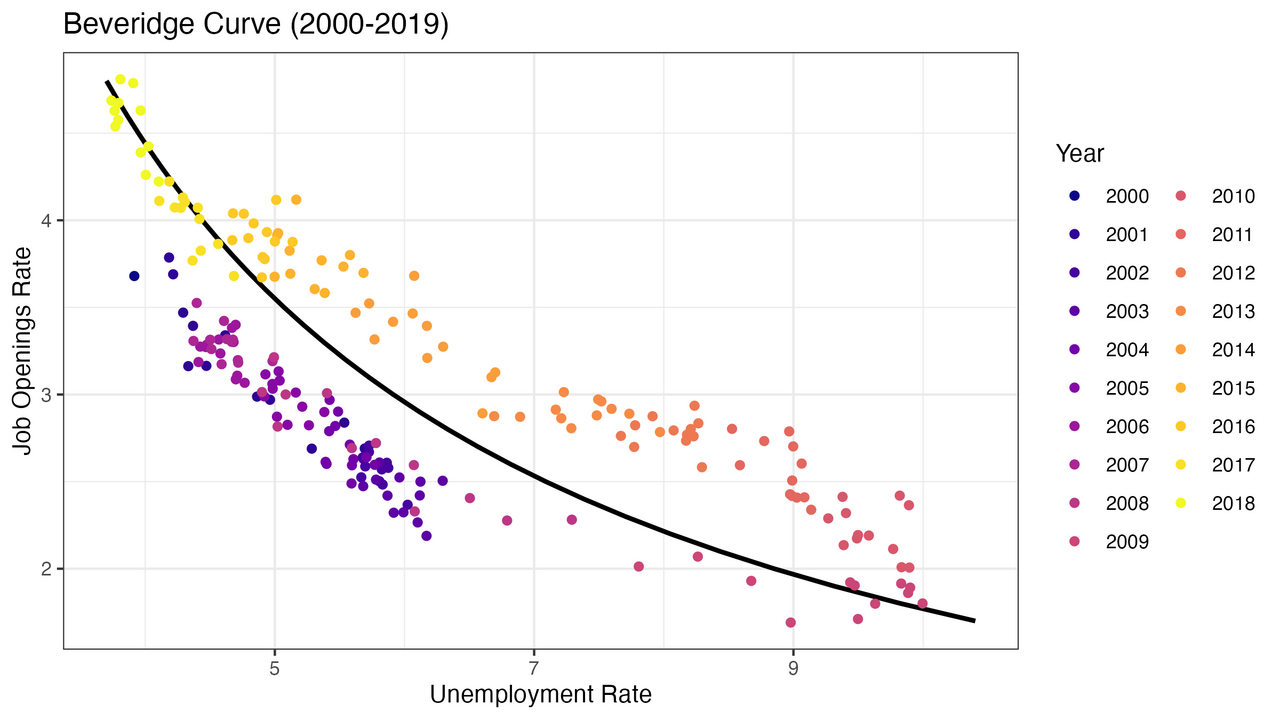
A movement along the curve as the economy expanded
An outward shift of the curve
An inward shift due to worse matching
A permanent rise in the natural rate
Both points lie near the same curve; expansions move the economy up and to the left. Outward shifts indicate worse matching efficiency. Image: Kmfrick, CC BY-SA 4.0.
Which event would most likely shift the Beveridge curve outward?
A recession that cuts job openings
A growing skills mismatch between unemployed workers and open jobs
Faster hiring after a boom
A rise in the labor force participation rate
Worse matching means higher unemployment for any vacancy rate. Recessions and booms move the economy along the curve.
Efficiency wage theory suggests firms pay above-market wages because:
Workers demand more leisure
Government prohibits lower wages
Firms want unemployment to rise
Higher wages raise productivity and lower turnover
Paying more can reduce shirking and turnover and attract better workers, leaving wages above equilibrium and some workers unemployed.
Hysteresis implies that:
A deep recession can raise the natural rate of unemployment
Cyclical unemployment disappears quickly
Inflation always accelerates
The Phillips curve is horizontal
Long unemployment spells erode skills and attachment, raising structural unemployment.
A minimum wage set above the equilibrium wage in a competitive labor market leads to:
A shortage of labor
A surplus of labor (unemployment)
No change in employment
Lower prices
At a wage above equilibrium, quantity of labor supplied exceeds quantity demanded.
Which policy pair is correctly matched with the type of unemployment it targets?
Expansionary fiscal policy: cyclical unemployment
Job training: cyclical unemployment
Lower interest rates: structural unemployment
Better job listings: cyclical unemployment
Demand-side policy closes recessionary gaps; training and matching target structural and frictional unemployment.
In an AD-AS diagram, a decrease in AD pushes output below potential. Which type of unemployment emerges?
Cyclical
Frictional
Structural
Seasonal
Weak demand leads to layoffs: cyclical unemployment rises above the natural rate.
The unemployment rate is below the natural rate. According to the Phillips curve, we would expect:
Inflation to fall
Real GDP to be below potential
Inflation to rise above expectations
Cyclical unemployment to be positive
A tight labor market pushes wages and prices up. Below-natural unemployment means negative cyclical unemployment.
Which of the following would raise the measured unemployment rate?
Unemployed workers finding jobs
More discouraged workers deciding to start searching again but not yet finding jobs
More unemployed people giving up the search
Firms hiring unemployed workers into part-time jobs
Re-entrants who search but do not find jobs add to both the labor force and unemployed. Discouraged workers who give up reduce the rate.
An economy has a labor force of 100 million with 10 million unemployed. Then 5 million of the unemployed give up searching and leave the labor force, and nothing else changes. What is the new unemployment rate?
About 5.3%
5.0%
10%
4.5%
Unemployed = 5 million; labor force = 95 million; u = 5/95 ≈ 5.3%. The rate halves, but no one found a job, which is why economists also watch the employment-population ratio.
What does the employment-population ratio tell us that the unemployment rate may not?
The share of workers who are discouraged
The share of the working-age population that has a job, regardless of searching
The share of unemployed who are long-term
The inflation rate
It is not affected by people leaving the labor force in the way the unemployment rate is.
Which statement best explains why the unemployment rate usually peaks after the recession's trough?
Unemployment benefits end immediately
Prices fall faster than wages
The CPS is revised
Firms are slow to rehire and labor force re-entry raises the rate
Employment is a lagging indicator: hiring waits for sustained demand growth.
True or False: If the unemployment rate equals the natural rate, there is no unemployment.
True
False
False. At the natural rate, frictional and structural unemployment remain; only cyclical unemployment is zero.
A country's natural rate rises from 5% to 7% due to a persistent skills mismatch. In an AD-AS model this is best shown by:
A leftward shift of LRAS
A rightward shift of AD
A rightward shift of LRAS
A rightward shift of SRAS only
A higher natural rate means lower potential output, shifting LRAS left.
