Quiz · Medium
Image-based questions: compute margins from a multi-step income statement, classify items on a balance sheet and follow how the IFRS statements connect.
Using the income statement shown, what is the gross profit margin?
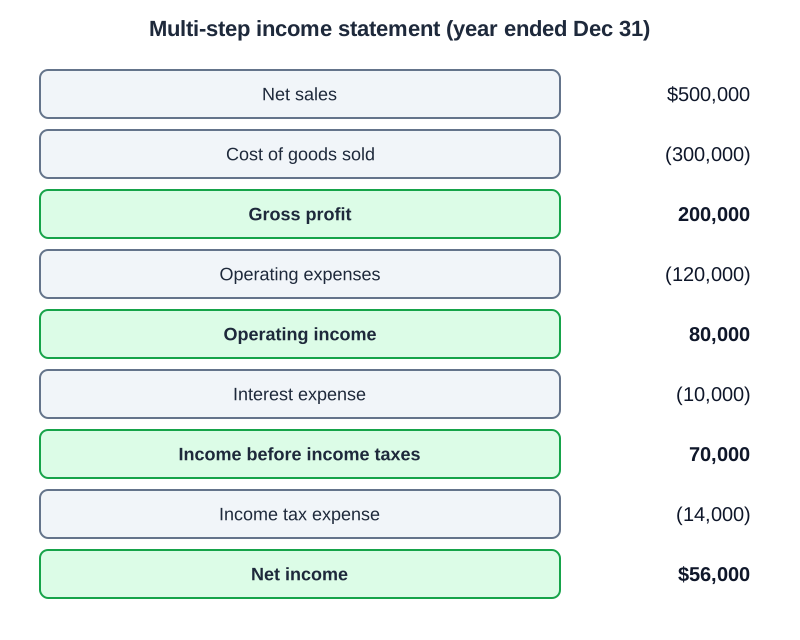
60%
16%
40%
11.2%
Gross profit 200,000 / net sales 500,000 = 40%. 60% is COGS as a share of sales, 16% is the operating margin and 11.2% is the net margin.
What is the effective tax rate on the income statement shown?
20%
25%
17.5%
2.8%
Tax 14,000 / income before taxes 70,000 = 20%. Dividing by net income (56,000) gives 25%, and dividing by operating income (80,000) gives 17.5%.
What is the operating income margin?
40%
14%
11.2%
16%
Operating income 80,000 / sales 500,000 = 16%. 14% uses income before taxes (70,000) and 11.2% uses net income.
If interest expense were $30,000 instead of $10,000 and the tax rate stayed at 20%, what would net income be?
$36,000
$50,000
$40,000
$42,000
Income before taxes = 80,000 - 30,000 = 50,000; tax 20% = 10,000; net income = 40,000. $36,000 subtracts the extra interest without the tax saving.
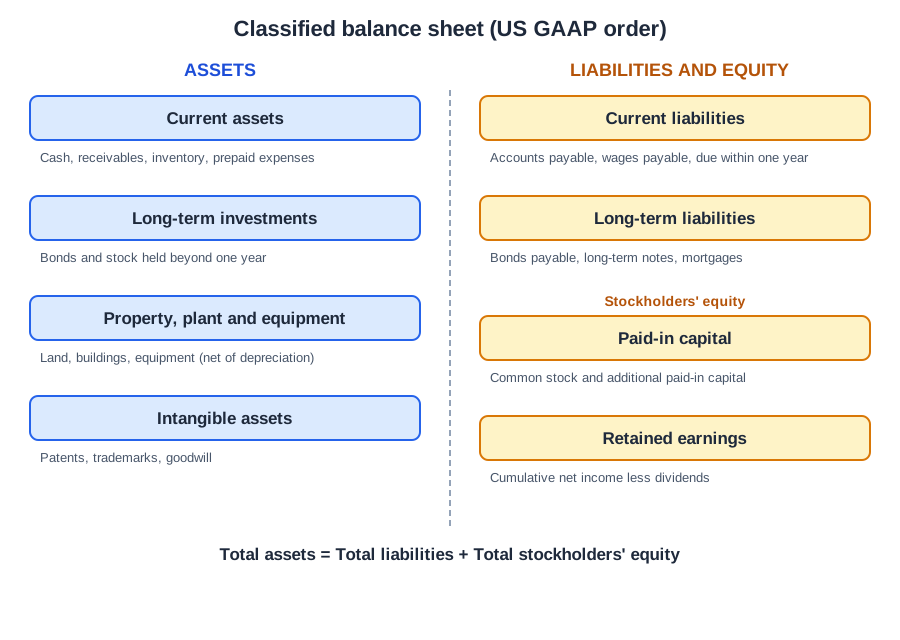
On the balance sheet shown, where would a purchased copyright be reported?
Property, plant and equipment
Long-term investments
Intangible assets
Current assets
A copyright has no physical substance, so it is an intangible asset, amortized over its useful life.
Where would a bank loan due in four years be reported?
Current liabilities
Paid-in capital
Retained earnings
Long-term liabilities
Obligations due beyond one year or the operating cycle are long-term. The portion due within the next year is reclassified as current.
Which section of the balance sheet increases when the company earns net income?
Paid-in capital
Long-term liabilities
Retained earnings
Intangible assets
Net income is closed to retained earnings. Paid-in capital changes only when owners invest or stock is issued.
Total assets are $800,000, total liabilities are $500,000 and retained earnings are $120,000. How much is paid-in capital?
$180,000
$300,000
$420,000
$120,000
Equity = 800,000 - 500,000 = 300,000. Paid-in capital = equity less retained earnings = 180,000. $300,000 is total equity.
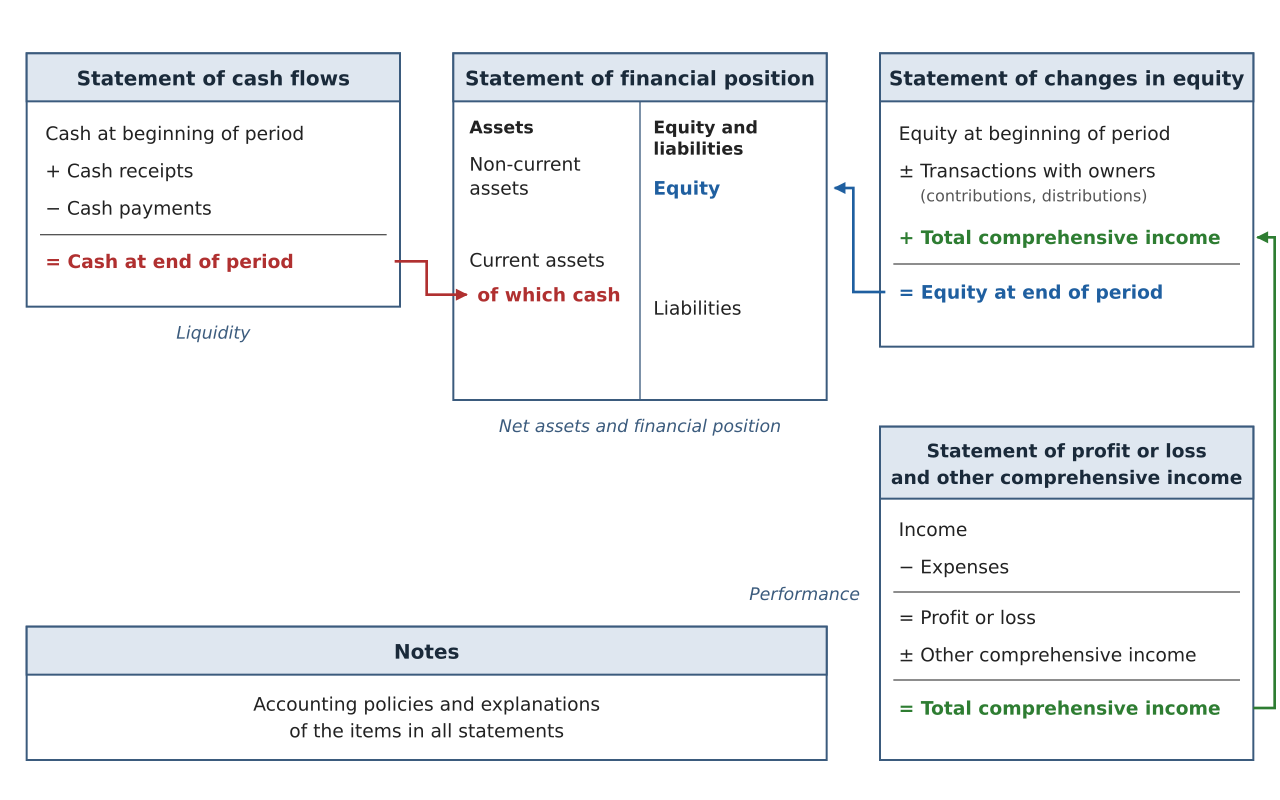
In the diagram, whose ending balance must agree with the cash amount on the statement of financial position?
The statement of changes in equity
The statement of cash flows
The statement of profit or loss
The notes
Cash at end of period from the statement of cash flows is the cash line inside current assets. Image: DHIRZEY1963, CC BY-SA 4.0, via Wikimedia Commons.
In the diagram, what links the profit or loss statement to the statement of changes in equity?
Cash receipts
Liquidity
Total comprehensive income
Total current assets
Profit or loss plus other comprehensive income equals total comprehensive income, which is added to equity. Image: DHIRZEY1963, CC BY-SA 4.0, via Wikimedia Commons.
If net sales rise 10% and cost of goods sold rises in proportion, what is gross profit?
$200,000
$250,000
$220,000
$240,000
Sales become 550,000 and COGS 330,000, so gross profit is 220,000 and the margin stays at 40%. Gross profit grows with sales when COGS moves in proportion.
How does a single-step income statement differ from the multi-step statement shown?
It totals all revenues, subtracts all expenses once and shows no gross profit subtotal
It shows only cash transactions
It omits income tax expense
It reports net income before cost of goods sold
The single-step format has one subtraction. The multi-step format adds gross profit and operating income subtotals that help analysts compare margins.
Which item in the liabilities column would be a current liability?
Bonds payable due in six years
Common stock
Retained earnings
Unearned revenue for service due within the next year
Unearned revenue is an obligation to perform service within a year, so it is current. Bonds due in six years are long-term, and the last two are equity accounts.
Which current asset is listed first on a classified balance sheet?
Inventory
Cash
Accounts receivable
Prepaid expenses
Current assets are listed in order of liquidity, with cash first, then short-term investments, receivables, inventory and prepaids.
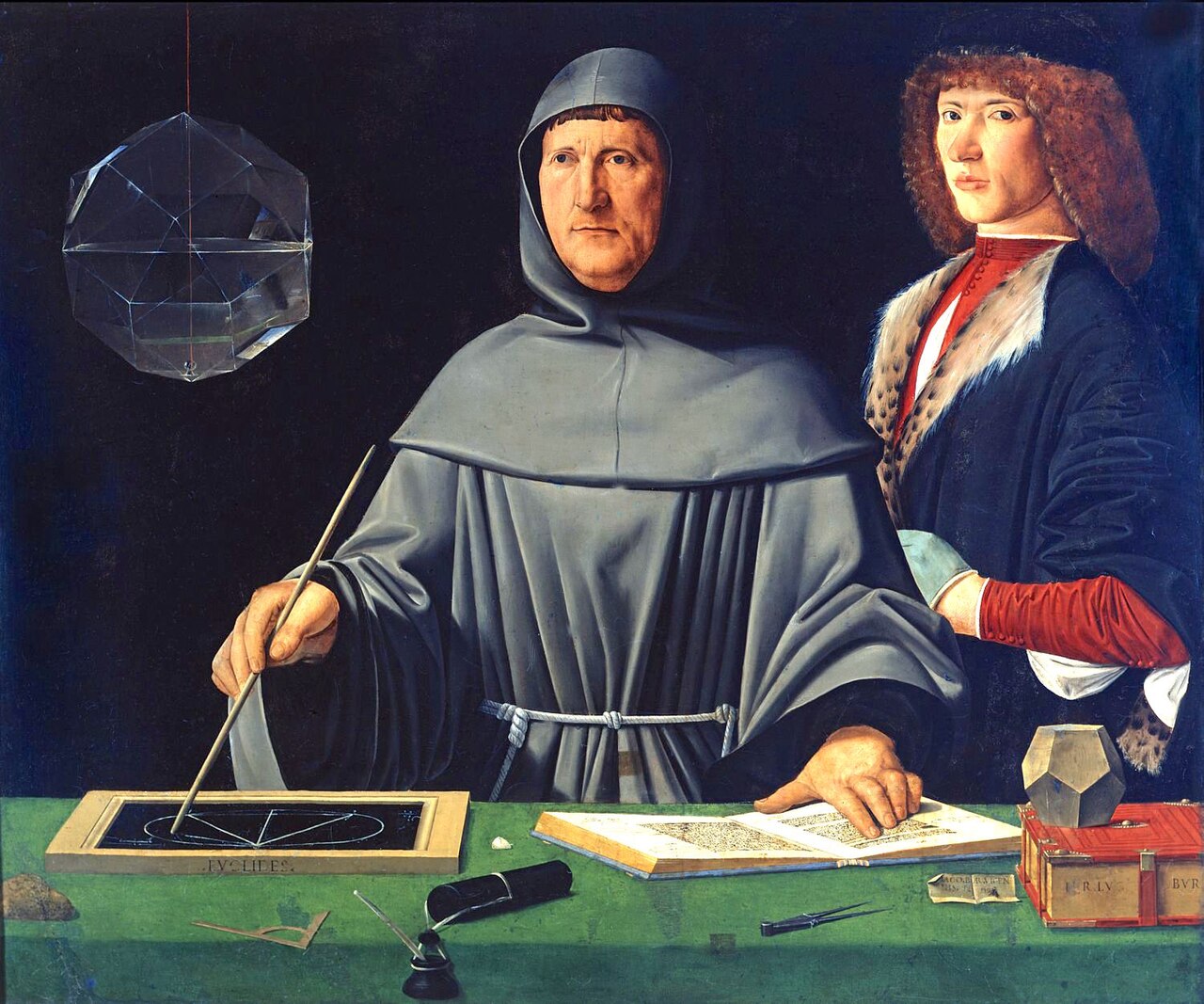
This Renaissance painting shows the friar often called the father of accounting. Who is he?
Leonardo da Vinci
Fibonacci
Adam Smith
Luca Pacioli
Pacioli's 1494 Summa de arithmetica described double-entry bookkeeping. Leonardo da Vinci illustrated Pacioli's later book on proportion, which makes him a tempting wrong answer.
