Quiz · Hard
Applied questions on SAFEs, vesting, liquidation preference, runway, LTV and CAC, plus pivots and validation, with diagram questions.
This one-car garage in Palo Alto is a California Historic Landmark, often called the Birthplace of Silicon Valley. Which company was started here in 1939?

Apple
Intel
Hewlett-Packard
Fairchild Semiconductor
Bill Hewlett and David Packard started HP here with a small audio oscillator. Apple's early garage story belongs to the Jobs family home in Los Altos (1976). Image: Oysterboy9, CC BY-SA 4.0, via Wikimedia Commons.
In the Business Model Canvas shown, which block spans the bottom right of the canvas?
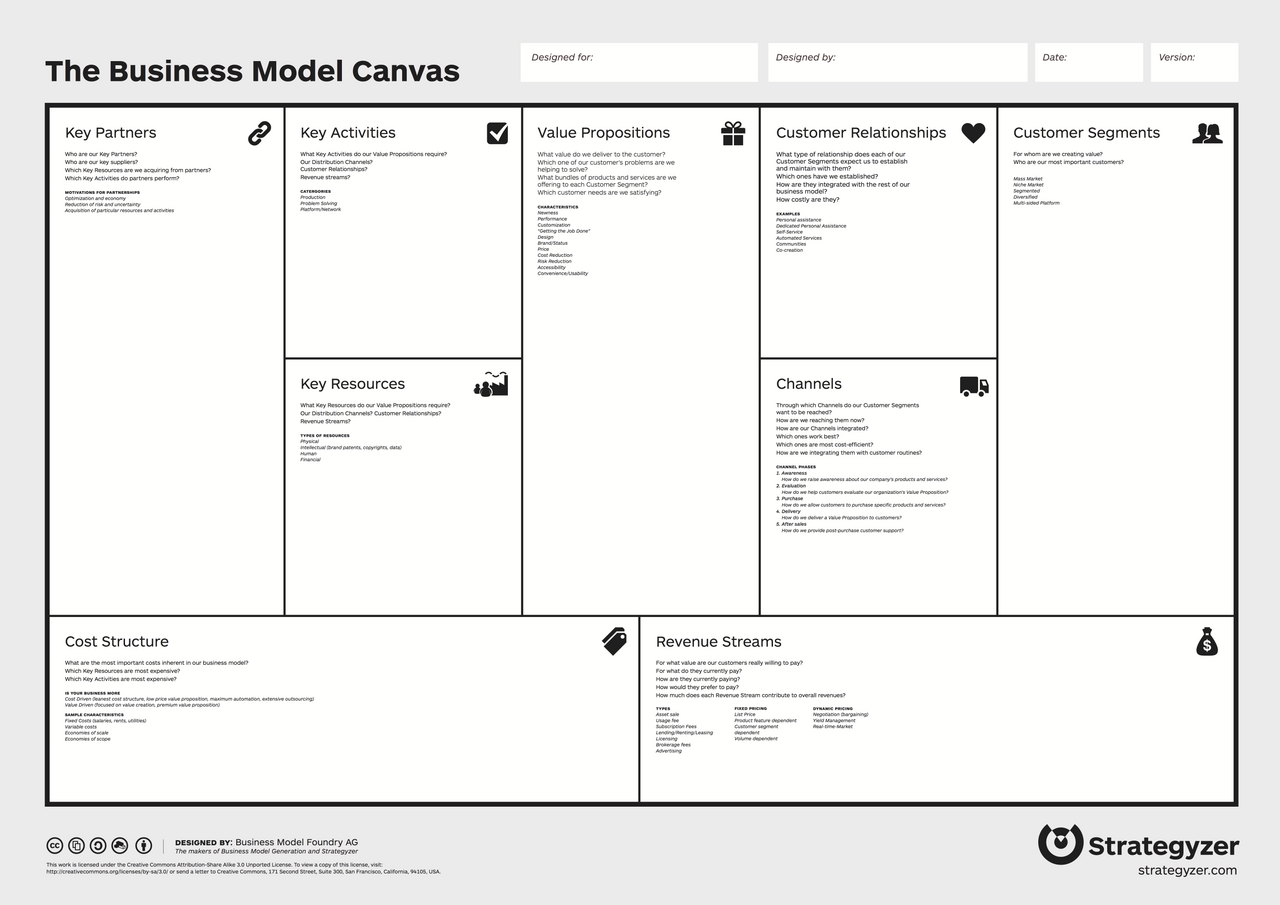
Revenue Streams
Cost Structure
Channels
Key Resources
Revenue Streams sits at the bottom right, beside Cost Structure at the bottom left. Channels is in the right-hand column above Revenue Streams. Image: Business Model Foundry AG (Strategyzer), CC BY-SA, via Wikimedia Commons.
A founder keeps adding features without ever releasing them to customers or measuring any results. According to the loop in the diagram, which step is being skipped?
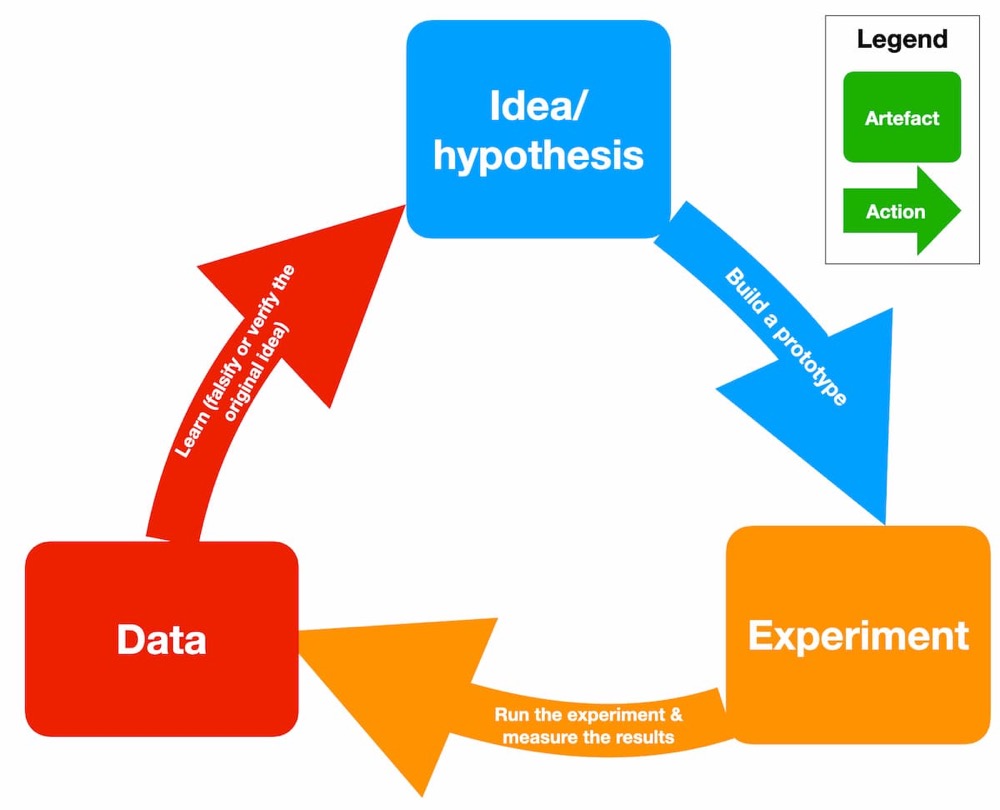
Having an idea or hypothesis
Learning from the data
Building a prototype
Running the experiment and measuring results, which turns the prototype into data
Without experiments and measurement there is no data, so there is nothing to learn from. The team keeps building (which is only one step) and never validates its hypothesis. Image: Antonsk, CC BY-SA 4.0, via Wikimedia Commons.
In the market-size diagram, what does the innermost circle (SOM) represent?
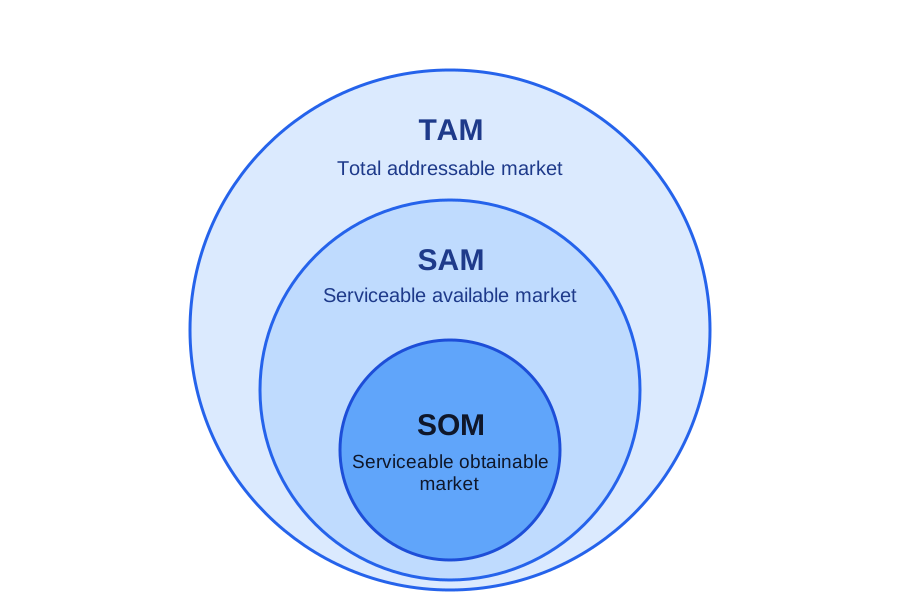
The total demand for the product category worldwide
The share of the market a company can realistically win in the near term
The portion of the market its business model and geography can serve
The investors' expected exit value
SOM is serviceable obtainable market: what you can capture given competition, resources and sales capacity. The outer circle is TAM, and the middle circle (SAM) is the part you could serve in principle.
An investor puts $200,000 into a post-money SAFE with a $4M valuation cap. What percentage does the investor own just before the next priced round (before dilution from it)?
2%
4%
5%
20%
On a post-money SAFE the ownership is investment divided by the cap: 200,000 / 4,000,000 = 5%. A different denominator gives other numbers (200,000 / 10,000,000 = 2%), but the cap is what you divide by.
A $100,000 convertible note has a 20% discount and no cap. The next round prices shares at $2.00. How many shares does the noteholder receive (ignore interest)?
62,500
80,000
50,000
125,000
Conversion price is 2.00 x 0.80 = $1.60 per share. 100,000 / 1.60 = 62,500. 50,000 would be the full price ($2.00); the discount gives MORE shares, not fewer.
A co-founder with four-year vesting and a one-year cliff leaves after 8 months. How many of her shares have vested?
About 17% of her shares
25% of her shares
All shares she was granted
None
Before the cliff nothing vests, so she has no vested shares. After 12 months 25% would vest at once. Monthly vesting only begins to count after the cliff passes.
An investor put $5M into a company for 30% with a 1x non-participating liquidation preference. The company is sold for $12M. How much does the investor receive?
$3.6M
$5M
$6M
$8.4M
30% of $12M is only $3.6M, less than the $5M preference, so the investor takes the preference and the other holders share the remaining $7M. $3.6M would be right only if there were no preference.
A startup has $900,000 in the bank. It spends $150,000 a month and earns $60,000 a month in revenue. What is its runway?
15 months
6 months
10 months
9 months
Net burn is 150,000 - 60,000 = $90,000 per month. 900,000 / 90,000 = 10 months. Using gross burn gives 6 months, which understates the runway.
ARPA is $80 a month, gross margin is 75%, monthly churn is 5% and CAC is $400. What is the LTV:CAC ratio?
3:1
2:1
4.5:1
1:1
LTV = 80 x 0.75 / 0.05 = $1,200. 1,200 / 400 = 3. Forgetting gross margin gives LTV $1,600 and a 4:1 ratio, which overstates the value of a customer.
CAC is $600. Each customer pays $100 a month and the gross margin is 60%. What is the CAC payback period?
6 months
12 months
16.7 months
10 months
Gross profit per month = 100 x 0.60 = $60. 600 / 60 = 10 months. Using revenue instead of gross profit gives 6 months, which is too optimistic.
Founders own 80% before a round. New investors buy 25% of the company after the round. What do the founders own afterwards?
55%
60%
75%
65%
Existing holders keep 75% of the new total: 80% x 0.75 = 60%. Subtracting 25 points (55%) is the common mistake; dilution is proportional, not a flat subtraction.
In Sean Ellis's product-market fit test, what share of users saying they would be "very disappointed" without the product is the usual benchmark?
10%
25%
40%
70%
Ellis found that products with at least 40% "very disappointed" tended to grow well, while those below it struggled. It measures how essential the product feels, not how many people like it.
Which of these is the most actionable metric for a startup, in Eric Ries's sense?
Percent of each weekly sign-up cohort still active 30 days later
Total registered users to date
Total page views this quarter
Number of press mentions
Cohort retention ties directly to product changes and shows cause and effect. Cumulative totals only ever go up, so they can hide a failing product.
A founder manually emails personalized meal plans each week to 10 paying customers who know a person is doing the work, to learn what they value before building an app. What kind of MVP is this?
Wizard of Oz MVP
Landing-page smoke test
Pivot
Concierge MVP
In a concierge MVP the customer knows the service is delivered manually. In a Wizard of Oz MVP the customer believes the product is automated while people work behind the scenes.
Burbn was a location check-in app. The team saw that the photo feature was the most used, dropped the rest and rebuilt the product around photos, creating Instagram. Which kind of pivot is this?
Customer segment pivot
Zoom-in pivot
Platform pivot
Channel pivot
A zoom-in pivot turns a single feature into the whole product. A customer segment pivot would keep the product and target a different type of customer.
According to Geoffrey Moore's Crossing the Chasm, where does the chasm lie?
Between innovators and early adopters
Between the early majority and the late majority
Between the early adopters and the early majority
Between the late majority and the laggards
Early adopters accept incomplete products and bet on a vision; the early majority wants a complete, proven solution with references, so many products stall there.
A widely cited CB Insights analysis of startup post-mortems found which reason cited most often for failure?
No market need for the product
Poor marketing
Pricing too high
A competitor copied the idea
About 42% of failed startups in that analysis cited no market need, ahead of running out of cash (about 29%). It is the strongest argument for validating demand before building.
Which clause in a term sheet is most commonly legally binding even though the term sheet as a whole is not?
The valuation
The board composition
The liquidation preference
Exclusivity (the "no-shop" clause)
The no-shop clause stops the founders from talking to other investors for a period, and confidentiality clauses are also usually binding. Valuation, board terms and preferences are binding only once the final documents are signed.
A SAFE is a form of debt that accrues interest and has a maturity date.
True
False
A SAFE (Simple Agreement for Future Equity) is not debt: it has no interest and no maturity date. Convertible notes are the instruments that are debt and usually carry interest.
