Quiz · Medium
Twenty-four questions on brand equity models, architecture, extensions, trademarks, perceptual maps and famous brand cases.
Which of the following best describes brand equity?
The legal ownership of a trademark
The added value a brand name gives a product beyond its functional benefits
The total sales of a brand
The advertising budget of a brand
Brand equity is the extra value (price premium, loyalty, preference) created by the name. Trademark ownership is a legal asset and sales are an outcome.
In Keller's CBBE pyramid, which level sits at the bottom?
Resonance
Judgments and feelings
Performance and imagery
Salience
The pyramid builds from salience (identity: who are you?) through meaning, responses and finally resonance.
Procter and Gamble sells Tide, Pampers and Gillette as separate brands that do not mention the parent. This is:
A house of brands
A branded house
An endorsed brand strategy
Co-branding
A house of brands keeps each brand independent, so trouble in one does not damage the others. In a branded house (FedEx, Virgin) one master brand covers everything.
Which brand is closest to 'more delicious but less natural' on this perceptual map?
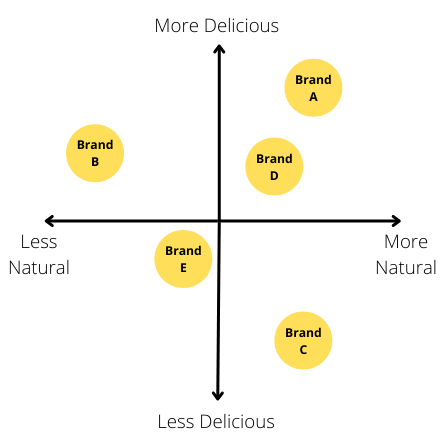
Brand A
Brand C
Brand B
Brand E
Brand B sits in the top-left quadrant: higher on delicious, lower on natural.
A toothpaste brand launches frozen dinners under the same name and sales are weak. The most likely cause is:
Low brand awareness
Excessive private label competition
Too much advertising
A poor fit between the parent brand and the new category
Brand extensions work when the new category fits what the brand stands for. A mismatch can also dilute the parent brand.
Which of these is NOT one of Aaker's brand personality dimensions?
Sincerity
Profitability
Ruggedness
Excitement
The five dimensions are Sincerity, Excitement, Competence, Sophistication and Ruggedness. Profitability is a financial measure.
Intel Inside is an example of:
Line extension
Private label
Ingredient branding
Genericide
A component brand promoted directly to end consumers is ingredient branding. Gore-Tex is another example.
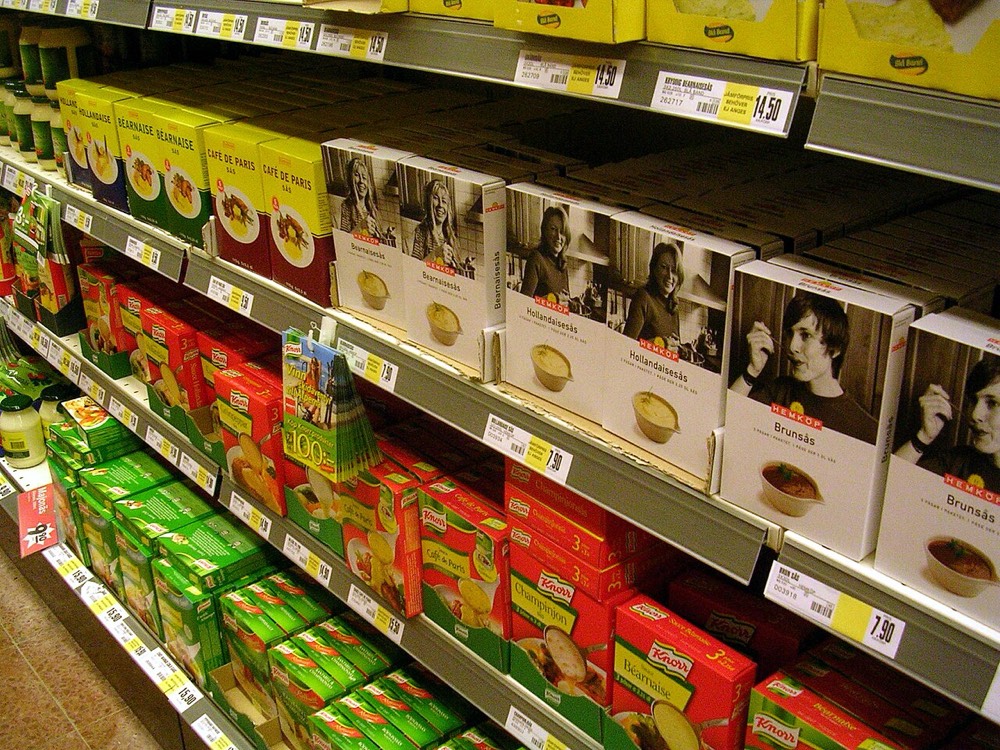
The boxes with a retailer's own name next to Knorr packs are examples of:
Private labels
Manufacturer brands
Co-brands
Licensed brands
Private (store) labels are owned by the retailer. They are cheaper to produce and give the retailer higher margins. Image: Väsk, CC BY-SA 3.0, via Wikimedia Commons.
A brand's identity differs from its image because:
Identity is how consumers see the brand and image is how the company wants it seen
They are the same thing
Identity is what the company wants the brand to stand for and image is how consumers actually perceive it
Identity only concerns the logo
Identity is sent by the company; image is received by consumers. Marketers aim to close the gap.
Unaided recall differs from recognition because recall means the consumer:
Names the brand without being prompted when given the category
Is shown the brand and says they know it
Has bought it before
Prefers it to all others
Recall is stronger than recognition; it is measured by asking people to name brands in a category without showing them any.
Marlboro's move from a women's cigarette to the Marlboro Man cowboy is an example of:
Brand extension
Genericide
Co-branding
Repositioning
The product stayed similar but its position in consumers' minds changed. Repositioning alters perception, while rebranding changes identity elements.
Which of the following is a TRUE statement about the Chevrolet Nova story?
It failed in Latin America because 'no va' means 'doesn't go'
The 'no va' failure story is a myth; it sold normally in Spanish-speaking markets
It was renamed Chevy Go
It was never sold outside the US
Marketing classes often repeat the story, but it is a myth. The lesson about checking names across languages remains valid.
Which is the best definition of a point of difference (POD)?
A feature every competitor also has
A unique, desirable association that distinguishes the brand
The brand's price
The brand's distribution channel
PODs are what make consumers choose one brand over another; parity points are needed just to be considered.
In Kapferer's identity prism, 'reflection' refers to:
The brand's physical features
The brand's culture
The company's history
The image of the typical user the brand seems to address
Reflection is the picture of the target consumer that the brand projects (distinct from the customer's real self-image).
Why did Tropicana's 2009 packaging redesign reportedly fail?
Shoppers could no longer recognize the product on the shelf
The juice formula changed
The price rose sharply
It was too colorful
The redesign dropped familiar visual cues (orange with straw), hurting shelf recognition and sales; the old design returned.
When a brand name becomes the generic word for the product category and loses legal protection, this is called:
Brand dilution
Co-branding
Genericide
Repositioning
Aspirin and escalator were once brands that became generic. Brand dilution is weakening of meaning without loss of the trademark.
A retailer wants customers to see its own-brand products as equal in quality to national brands. Which approach fits best?
Compete only on lowest price
Use only generic packaging
Remove national brands from the store
Build a premium private label with strong design and quality
Premium private labels with strong branding can challenge manufacturers on quality, while still earning higher retailer margins.
True or False: Brand awareness alone guarantees a strong brand.
True
False
Awareness is only the first step. Strong brands also need positive associations, perceived quality and loyalty (Aaker, Keller).
Which company ran the 'Think Different' campaign in 1997?
Microsoft
IBM
Apple
Dell
Apple's campaign celebrated creative people and refocused the brand around creativity after Steve Jobs returned.
A bank gives each customer a consistent experience in app, branch and call center, including tone of voice. The marketing goal is:
Brand consistency across touchpoints
Price skimming
Market penetration
Diversification
Consistency at every touchpoint reinforces recognition and trust; mixed experiences weaken the brand promise.
Which statement about trademarks is correct?
The ® symbol may be used on any brand name
TM means the mark is registered
® indicates the mark is registered
Trademarks only cover words
® is for registered marks only. TM can be used on a claimed mark. Trademarks can also cover logos, shapes, colors and sounds.
Johnson and Johnson's 1982 Tylenol recall is regarded as a model of:
Crisis communication that protects trust
Brand extension
Price discrimination
Product placement
By quickly recalling about 31 million bottles and putting consumer safety first, the company preserved brand trust.
The 'Share a Coke' campaign mainly relied on:
Product placement in film
A new formula
A price cut
Personalizing packaging with first names
Printing popular names on bottles created personal relevance and shareable social content.
Which sentence best describes brand resonance?
Customers know the brand name
Customers feel a deep bond and actively engage and advocate
Customers buy only when discounted
Customers compare features carefully
Resonance is the top of Keller's pyramid: loyalty, attachment, community and engagement.
