Quiz · Medium
Exam-style questions on Maslow, Herzberg, equity and expectancy, reinforcement, perception biases, Tuckman, Johari, media richness, structure, Schein, Hofstede and Lewin.
Which model identifies 'affective, continuance and normative' commitment?
Meyer and Allen
Hackman and Oldham
Herzberg
Hofstede
Meyer and Allen's three-component model of organizational commitment.
In the pyramid shown, which need level sits directly above 'Safety'?
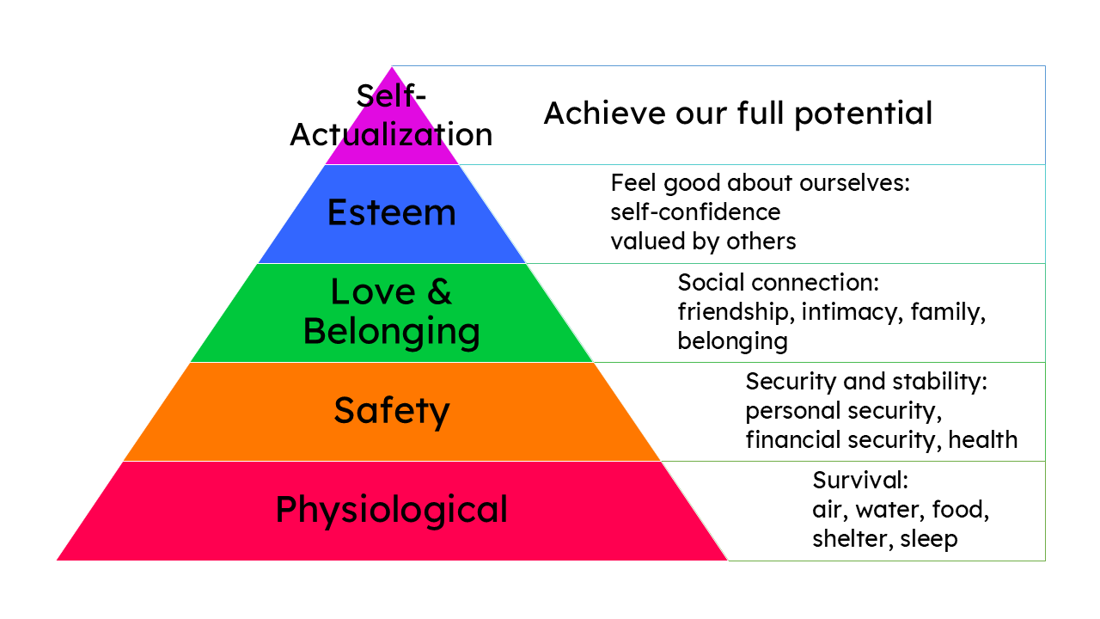
Physiological
Esteem
Love and belonging
Self-actualization
From the bottom: physiological, safety, love and belonging, esteem, self-actualization.
According to Herzberg, which of the following is a MOTIVATOR rather than a hygiene factor?
Salary
Company policy
Recognition for achievement
Working conditions
Achievement, recognition, the work itself, responsibility and advancement are motivators. Salary, policy and conditions are hygiene factors.
An employee compares her pay-to-effort ratio with a colleague's and decides she is underpaid. Which theory explains this?
Expectancy theory
Equity theory
Reinforcement theory
Goal-setting theory
Adams's equity theory: people compare their outcome/input ratio with a referent.
In Vroom's expectancy theory, 'valence' refers to:
The belief that effort leads to performance
The belief that performance leads to rewards
The value placed on the reward
The difficulty of the goal
Expectancy = effort leads to performance. Instrumentality = performance leads to reward. Valence = how much the reward is wanted.
A manager praises an employee every time she submits a report on time, but stops after the employee has been on time for three months. Reports begin to slip. This best illustrates:
Negative reinforcement
Extinction
Punishment
Positive reinforcement
Withholding reinforcement for a previously reinforced behavior leads to extinction.
Which reinforcement schedule is most resistant to extinction?
Fixed ratio
Fixed interval
Variable interval
Variable ratio
Variable ratio (unpredictable number of responses) produces high, steady response rates that persist when reinforcement stops.
In the Job Characteristics Model, which job dimension produces the psychological state of 'knowledge of results'?
Autonomy
Task identity
Feedback
Skill variety
Feedback gives knowledge of results. Autonomy gives experienced responsibility. Variety, identity and significance give experienced meaningfulness.
Which Big Five trait is the best general predictor of job performance across occupations?
Extraversion
Agreeableness
Conscientiousness
Openness
Barrick and Mount (1991) found conscientiousness predicted performance across job types.
A new manager rates an employee highly on every dimension because he gave an outstanding presentation. This is:
The halo effect
Selective perception
The contrast effect
The fundamental attribution error
One strong trait colors the overall judgment: halo effect. Contrast would compare the employee with others recently rated.
In Kelley's covariation model, behavior is attributed to the PERSON when:
Consensus is high, distinctiveness is high and consistency is low
Consensus is low, distinctiveness is low and consistency is high
Consensus is high, distinctiveness is low and consistency is low
Consensus is low, distinctiveness is high and consistency is low
If few others behave that way, the person behaves that way across situations, and it happens repeatedly, the cause is internal.
According to the Johari Window, information known to others but NOT to yourself is in the:
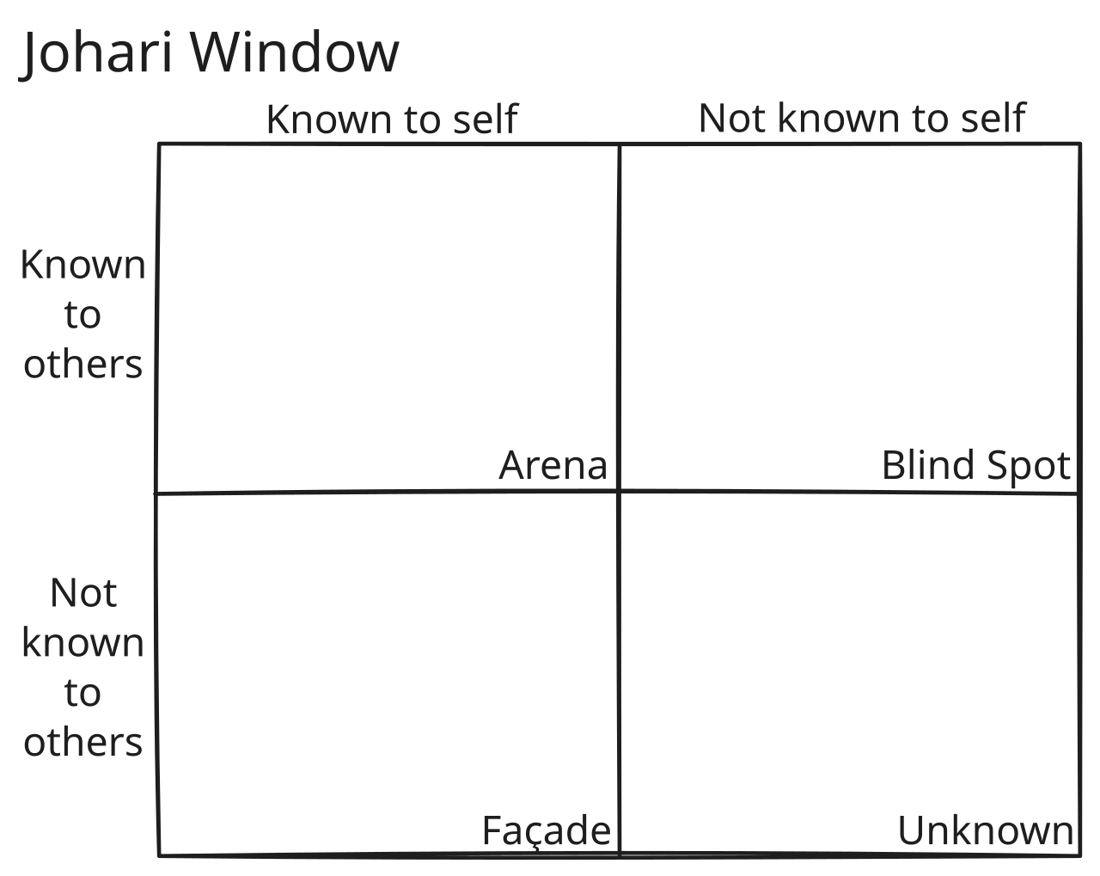
Arena
Façade
Blind spot
Unknown
The blind spot is reduced by seeking feedback. Façade is known to you, not others.
Which of the following is the correct order of Tuckman's original four stages?
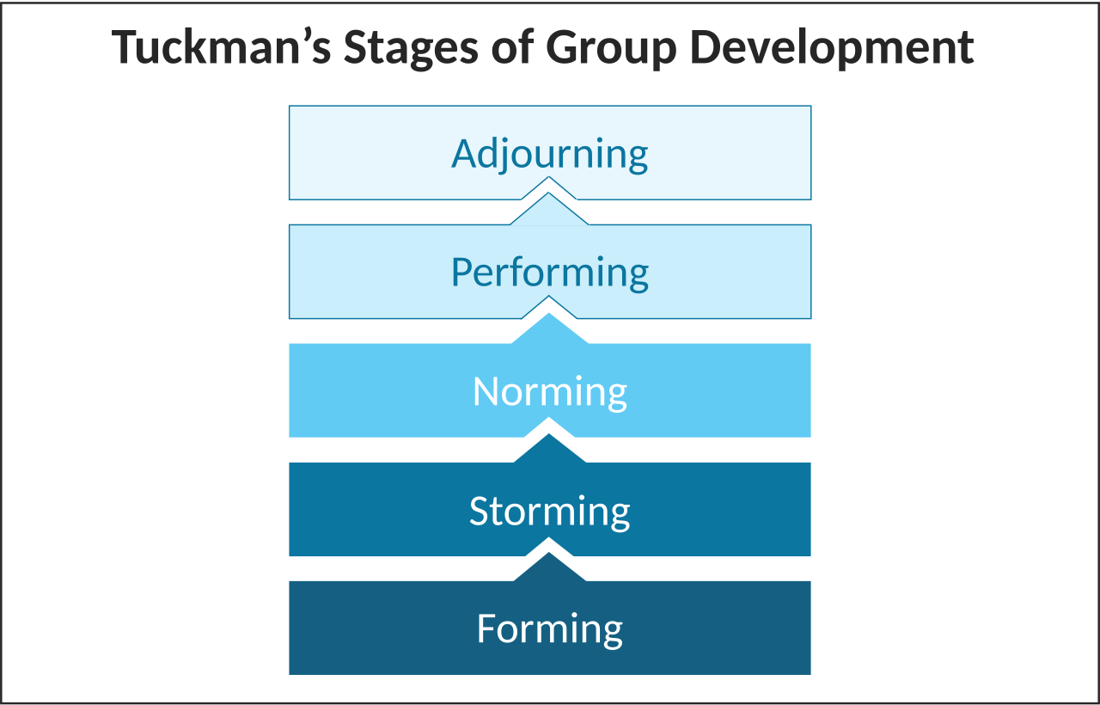
Forming, norming, storming, performing
Forming, storming, norming, performing
Storming, forming, norming, performing
Forming, storming, performing, norming
Forming, storming, norming, performing. Adjourning was added later (1977).
Image: Tens49, CC BY-SA 4.0, via Wikimedia Commons.
Social loafing is MOST likely when:
Individual contributions are not identifiable
Groups are small
Members are highly cohesive and accountable
Individual performance is evaluated
People reduce effort when their individual contribution cannot be identified. The other options reduce loafing.
Which team role in Belbin's model is best described as 'creative, solves difficult problems, but may ignore practical details'?
Shaper
Plant
Implementer
Co-ordinator
The Plant is the idea generator. The Shaper drives the team, the Implementer turns plans into action.
A message that is ambiguous and emotionally sensitive is BEST delivered through:
A memo
Face-to-face conversation
A bulletin board
Media richness theory: use rich media for ambiguous messages.
Which structure creates the 'dual reporting' problem?
Functional
Matrix
Divisional
Simple
Employees report to both a functional manager and a project manager.
Which of the following is the deepest level in Schein's model of organizational culture?
Artifacts
Espoused values
Basic underlying assumptions
Slogans
Basic assumptions are unconscious and taken for granted. Artifacts are visible.
Which Hofstede dimension describes how much a society accepts unequal distribution of power?
Uncertainty avoidance
Masculinity
Power distance
Individualism
Power distance is acceptance and expectation of unequal power.
A company announces a reorganization with no explanation and workers fear losing their jobs. Which source of resistance to change is MOST evident?
Habit
Uncertainty and fear of loss
Poor timing only
Lack of ability
Fear of loss and uncertainty drive this resistance. Better communication and involvement help.
In Lewin's three-step model of change, the step in which new behaviors are made permanent is:
Unfreezing
Moving
Refreezing
Reinforcing
Refreezing stabilizes the change through reinforcement and policy.
A negotiator who has a strong alternative to reaching agreement with this counterpart has a strong:
ZOPA
BATNA
Valence
Referent
BATNA is the Best Alternative To a Negotiated Agreement.
Which of the following is an example of organizational citizenship behavior?
Completing assigned tasks on time
Volunteering to train a new colleague outside job duties
Following safety rules
Attending mandatory meetings
OCB is voluntary and extra-role. The others are formal job requirements.
Employees say, 'We don't trust the promotion process, though we're happy with the pay.' This is mostly a problem of:
Distributive justice
Procedural justice
Interactional justice
Informational overload
Distrust of the process is procedural justice. Distributive concerns outcomes such as pay.
