Quiz · Hard
Harder multi-step elasticity questions: midpoint calculations, revenue changes, tax incidence, income and cross-price elasticity and policy applications.
A coffee shop raises the price of a latte from $4.00 to $5.00 and weekly sales fall from 500 to 400. Using the midpoint method, is approximately:
0.80
1.00
1.29
2.00
%ΔQ = -100/450 = -22.2% and %ΔP = 1/4.5 = +22.2%, so : unit elastic. Using the starting values instead of the midpoint would wrongly give 20%/25% = 0.80.
A theater lowers ticket prices from $20 to $16 and attendance rises from 300 to 450. Using the midpoint method, demand is:
Inelastic, about 0.5
Unit elastic
Perfectly elastic
Elastic, about 1.8
%ΔQ = 150/375 = 40%. %ΔP = -4/18 = -22.2%. The ratio is 1.8, so demand is elastic. Revenue rises from $6,000 to $7,200, which confirms elastic demand.
Demand for a product is . At what price is demand unit elastic?
$25
$10
$40
$50
Unit elastic where , so and , the midpoint of the line. At $50 quantity is zero and is infinite; at $10, , inelastic.
Using , what is the point price elasticity of demand at P = $40?
-0.25
-1
-4
-0.4
, Q = 40 at P = 40, so . The value -0.25 corresponds to P = 10, where Q = 160.
A firm's demand has . Its manager wants to raise revenue. What should it do, and what happens to quantity?
Raise price; quantity falls by a larger percentage
Cut price; quantity rises by a larger percentage
Raise price; quantity falls by a smaller percentage
Cut price; revenue is unchanged
With inelastic demand, a price rise lowers quantity by a smaller percentage (0.6 times the price rise), so revenue rises. A price cut would lower revenue.
Price falls by 20% and total revenue rises. Which statement must be true?
Demand is perfectly inelastic
Price falls and revenue rises, so quantity rose by a larger percentage: demand is elastic. For inelastic demand, a price cut lowers revenue.
For a small price change, . Price rises 2% and . Total revenue changes by about:
+4%
-6%
+2%
-4%
. Check: quantity falls about 6%, and 1.02 × 0.94 = 0.959, a fall of about 4%. -6% is the fall in quantity, not in revenue.
Income rises 6%. Spending on a good rises 3%, and its price is unchanged. The good is:
An inferior good
A normal necessity
A luxury
A Giffen good
, between 0 and 1, so a normal necessity. Luxury needs ; inferior needs .
The price of tea rises 12% and the quantity of coffee demanded rises 3%. Tea and coffee are:
Complements, cross elasticity +0.25
Substitutes, cross elasticity +0.25
Substitutes, cross elasticity +4
Complements, cross elasticity -0.25
, so substitutes, though weak. The direction is positive, so complements are ruled out.
A tax is put on a good with fairly elastic demand and very inelastic supply. Compared with the equilibrium before the tax:
Buyers pay much more and sellers get a little less
Both pay equal shares
The quantity traded rises
Buyers pay a little more and sellers get much less
The less elastic side bears more of the burden. Supply is inelastic, so sellers absorb most of the tax. Quantity falls for any tax; it cannot rise.
In a market, and . A per-unit tax of $10 is imposed on sellers. Approximately how much of the tax do buyers bear?
$7.50
$2.50
$5
$10
Buyers' share is , so $7.50. Demand is inelastic relative to supply, so buyers bear more. It does not matter whether the tax is levied on sellers or buyers.
A bumper wheat harvest increases supply. Demand for wheat is inelastic. What happens to farmers' total revenue?
Rises, because quantity sold rises
Stays the same
Falls, because price falls proportionally more than quantity rises
Cannot be determined without the supply elasticity
Inelastic demand means a large price fall brings a small quantity rise, so P×Q falls. This is the classic farmers' paradox.
Which pair of changes would make a good's demand MORE elastic?
A broader market definition and a shorter time horizon
A greater necessity and fewer substitutes
A more narrowly defined market and a longer time horizon
A lower share of income and fewer substitutes
Narrow definitions have many close substitutes and long horizons give time to adjust. All the other pairings mix in at least one factor that makes demand less elastic.
The figure shows a straight-line demand curve and a revenue curve. At the point marked 'Unit elastic', what is true of marginal revenue?
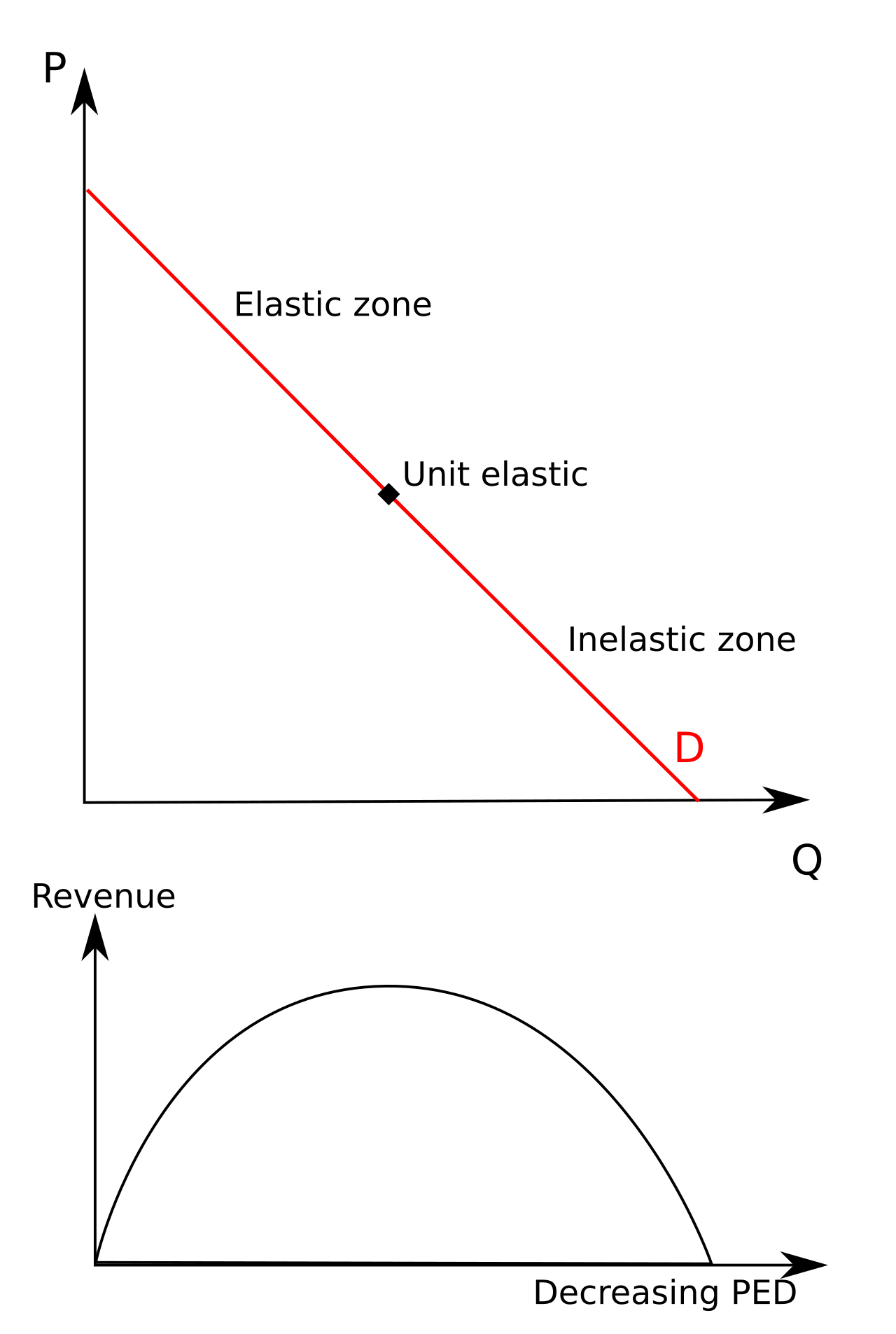
MR equals zero
MR is at its maximum
MR equals price
MR is negative
Total revenue is at its maximum where demand is unit elastic, so the change in revenue from one more unit (MR) is zero.
Image: RedWordSmith (English Wikipedia) and Jarry1250, CC BY-SA 3.0, via Wikimedia Commons.
In the figure, moving down the demand curve from the elastic zone to the inelastic zone, total revenue first rises and then falls. The turning point is:
Where
Where
Where P = 0
Where
Revenue peaks at unit elasticity. Before it (elastic zone), a price cut raises revenue. After it (inelastic zone), a price cut lowers revenue.
Image: RedWordSmith (English Wikipedia) and Jarry1250, CC BY-SA 3.0, via Wikimedia Commons.
The graph plots quantity of good X against the price of good Y. A rise in Y's price increases X. If the price of Y rises 20% and the slope implies a 10% rise in X, the cross-price elasticity and relationship are:
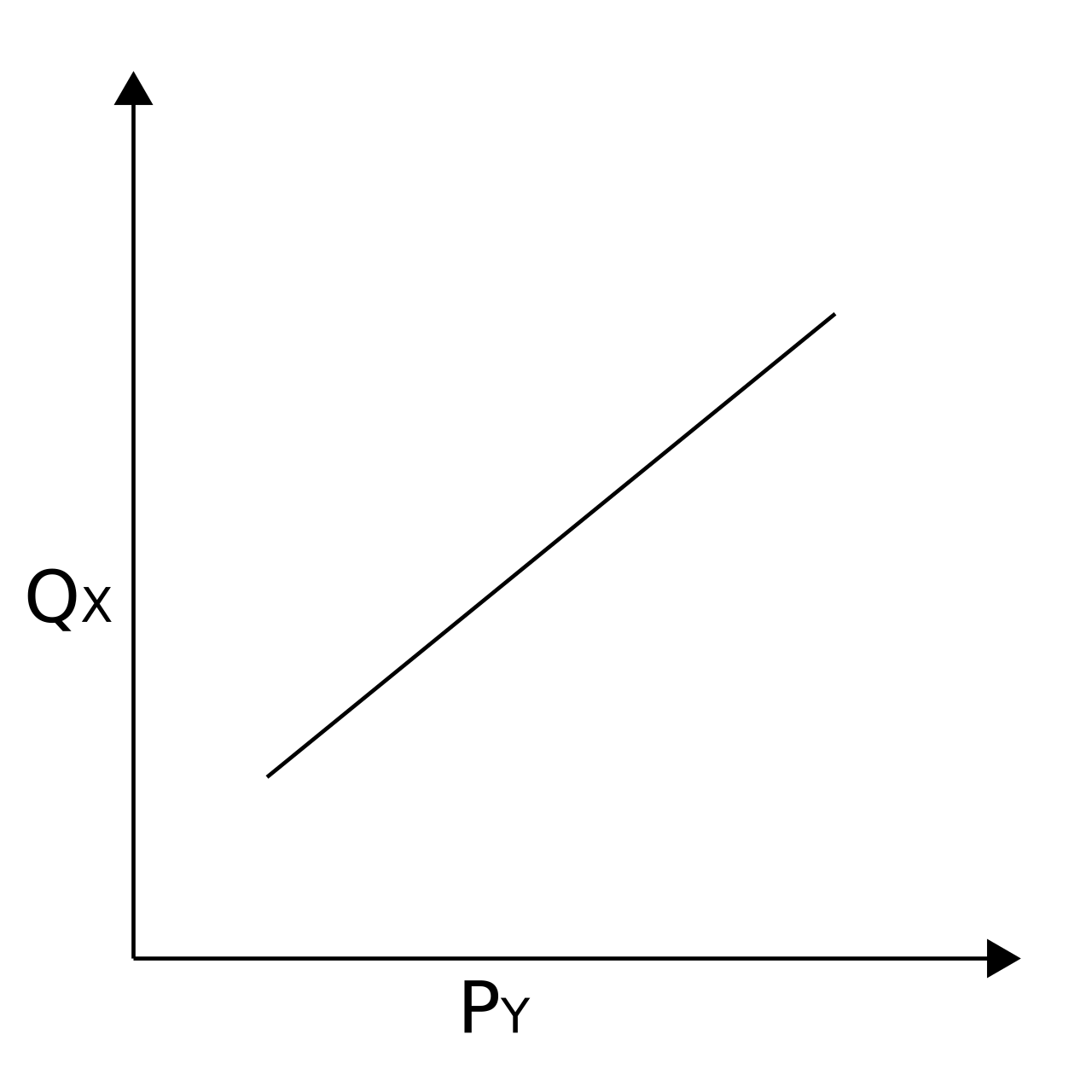
-0.5, complements
+0.5, substitutes
+2, substitutes
+0.5, complements
. A positive sign means substitutes; negative means complements.
A monopolist faces at its current price. Which statement is correct?
It is maximizing profit
It should raise price, because MR is negative here
It should lower price, because demand is inelastic
It cannot change profit by changing price
With , MR is negative, and MC is positive, so MR cannot equal MC at this price. Raising price raises revenue and lowers cost, so profit rises.
A firm sells two goods. A 10% fall in the price of printers raises printer sales by 15% and ink cartridge sales by 12%. The cross-price elasticity of ink with respect to printer price is:
+1.2
-1.5
+0.8
-1.2
. Negative, because printers and ink are complements.
A government wants to raise tax revenue with minimum loss in quantity traded. Which good should it tax?
Salt, with close to 0
A luxury good with many substitutes
A good with
A good with a perfectly elastic supply and elastic demand
A good with very inelastic demand keeps buying about as much after the tax, so revenue is high and deadweight loss is small.
Suppose gasoline demand elasticity is -0.2 in the short run and -0.6 in the long run. Why is the long-run figure larger in absolute value?
Consumers earn higher incomes over time
Gasoline becomes a luxury
Over time consumers can buy efficient cars, move or change commuting
Gasoline supply becomes perfectly elastic
Adjustment takes time: durable goods are replaced slowly, and housing and commuting decisions change gradually, so demand becomes more responsive.
When price is $10, quantity is 100. At $8, quantity is 140. Using the starting values as the base (simple percent changes), elasticity is:
-0.5
-1.4
-2
-0.7
%ΔQ = +40% and %ΔP = -20%, so . The midpoint method gives 1.5 instead, because it uses averages as the base.
