Quiz · Hard
Twenty questions on bond pricing, duration and convexity, yield curves, option payoffs, put-call parity, forwards and futures.
A 3-year bond has a 5% annual coupon, $1,000 face and a 6% yield. Its price is:
$1,000.00
$973.27
$1,026.73
$950.00
PV of coupons = 50 x 2.6730 = 133.65, and PV of face = 839.62. Sum = 973.27, a discount because the coupon is below the yield.
A 5-year zero-coupon bond with $1,000 face yields 4% (annual compounding). Its price is:
$821.93
$800.00
$790.31
$1,000.00
1,000 / 1.04^5 = 821.93.
A bond with a $1,000 face and $60 annual coupon trades at $920. Its current yield is about:
6.0%
8.0%
7.4%
6.5%
60 / 920 = 6.52%. The yield to maturity is higher because it also counts the gain from the price rising back to par.
Market yields rise. What happens to the prices of existing bonds?
They rise
They stay at par
They fall
Only zero-coupon bonds change
Existing coupons become less attractive compared with newly issued higher-yield bonds.
A bond has modified duration 5. If yields rise 0.5 percentage points, the estimated price change is:
+2.5%
-2.5%
-5.0%
-0.5%
-D_mod x change in yield = -5 x 0.5% = -2.5%.
Looking at the graph, why does the true price lie above the straight line for large yield changes?
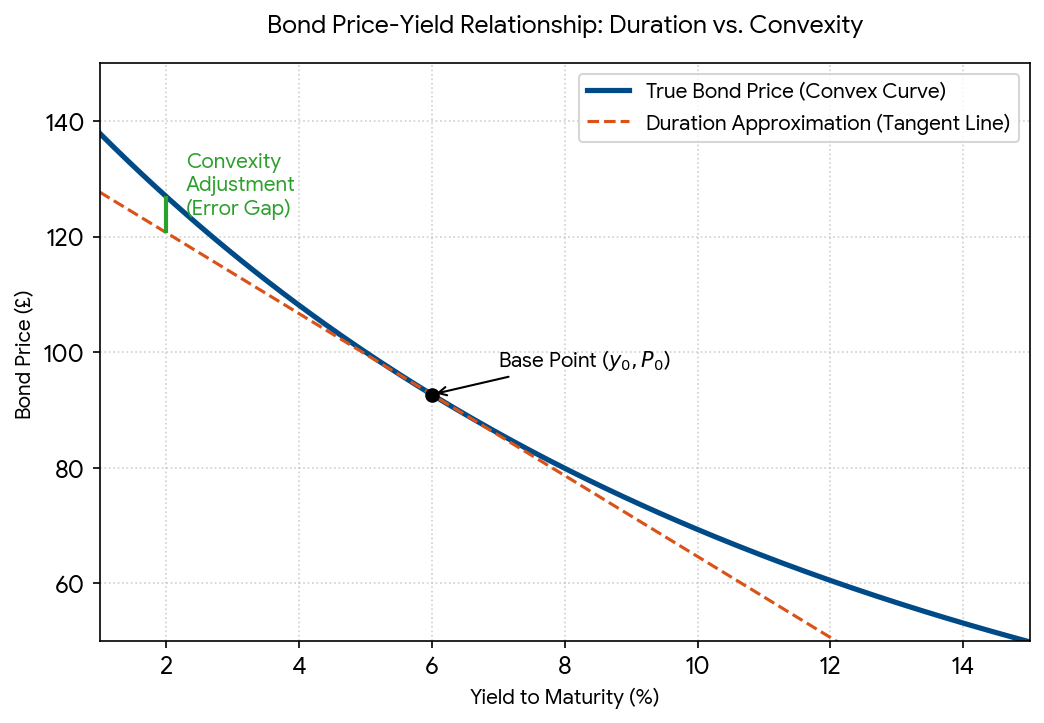
Positive convexity: the price-yield curve bends upward, so duration alone understates the price
The bond's coupon rises
Duration overstates yield
The line shows default risk
Convexity benefits bondholders: for equal yield moves the price rises more when yields fall than it drops when yields rise.
Image: SpookiePuppy, CC0, via Wikimedia Commons.
A callable bond compared with an otherwise identical non-callable bond will have:
A lower yield
An identical yield
A lower coupon only
A higher yield, to compensate investors for the issuer's right to call
The call option favors the issuer, so the buyer demands extra yield.
The yield curve is inverted. This means:
Long-term yields exceed short-term yields
All yields are equal
Short-term yields exceed long-term yields
Yields are negative
Inversions have often preceded slowdowns as markets price in future rate cuts.
Which rating is the lowest investment-grade rating on the S&P scale?
BB+
BBB-
A-
CCC
BBB- is the lowest investment grade. BB+ and below is speculative grade.
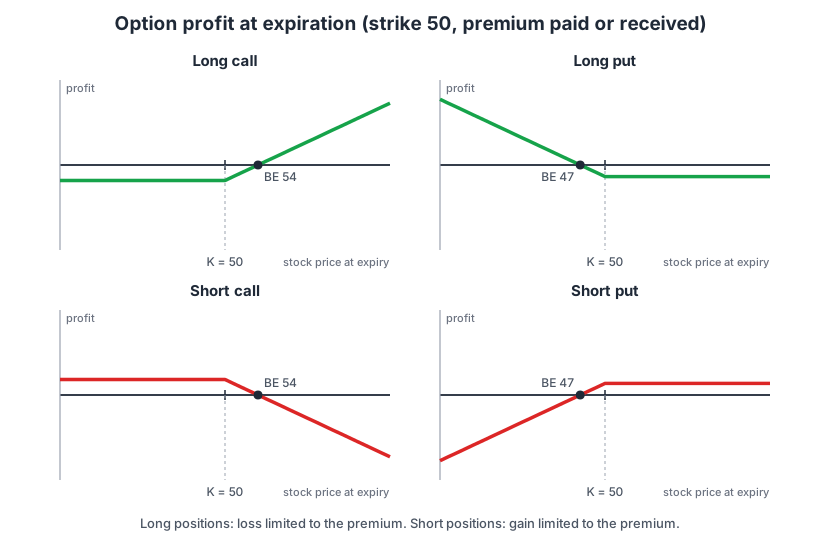
Using the long put in the payoff diagram (strike 50, premium 3), the profit if the stock is $40 at expiry is:
$7
$10
$3
-$3
Payoff = 50 - 40 = 10. Profit = 10 - 3 = 7.
What is the maximum loss on a short (naked) call?
The premium received
The strike price
Zero
Unlimited, as the stock price can rise without limit
The seller must deliver at the strike however high the stock goes. The gain is limited to the premium.
An investor owns shares and sells a call against them. This covered call:
Protects against all losses
Doubles the upside
Earns premium but gives up gains above the strike
Has unlimited risk
The premium cushions small declines, but upside is capped at the strike (plus premium).
Stock $52, strike $50, risk-free rate 5%, one year. A European call costs $8. By put-call parity, the put costs:
$8.00
$3.62
$2.38
$5.62
P = C + K/(1+r) - S = 8 + 47.62 - 52 = 3.62.
The spot price is $80, the risk-free rate is 4% and there are no dividends or storage costs. The one-year forward price is:
$83.20
$80.00
$76.92
$84.00
F = 80 x 1.04 = 83.20.
An investor buys a share at $100 and a put with strike $95 for $3. The most the investor can lose at expiration is:
$3
$5
$100
$8
Loss on shares limited to 100 - 95 = 5, plus the premium 3 = 8.
A straddle buyer pays $4 for a $50 call and $3 for a $50 put. The break-even prices at expiry are:
$47 and $54
$46 and $54
$43 and $57
$50 and $57
Total cost = 7. The stock must move more than 7 above or below the strike: 43 and 57.
A call option has a delta of 0.6. If the stock rises $1, the option price rises about:
$1.60
$0.60
$0.40
$6.00
Delta is the change in option price per $1 change in the underlying.
Futures positions are marked to market daily, which means:
Gains and losses are settled in the margin account each day
Prices never change
Contracts are repaid at maturity only
Positions cannot be closed early
Daily settlement reduces credit risk and is the key difference from a forward.
Which change would raise the price of both a call and a put option?
A rise in the stock price
A fall in time to expiry
A fall in volatility
A rise in the underlying's volatility
Higher volatility increases the chance of large moves, which benefits the option holder on either side.
A muni bond yields 3% and the investor's marginal tax rate is 24%. The tax-equivalent yield is:
2.28%
3.72%
3.95%
4.24%
3 / (1 - 0.24) = 3.95%.
