Quiz · Medium
Texture, voice leading, scores, lead sheets, tone rows and production basics.
Which texture has one melody supported by chords?
Monophony
Heterophony
Homophony
Polyphony
Homophony.
Which texture features several performers playing slightly different versions of the same melody?
Heterophony
Polyphony
Homophony
Monophony
Heterophony.
What is an Alberti bass?
A broken-chord accompaniment figure
A walking jazz bass
A pedal tone
A figured bass
Low-high-middle-high broken chords.
In species counterpoint, the fixed melody is called what?
Cantus firmus
Ostinato
Ground
Motif
The cantus firmus.
Which motion between voices is best for avoiding parallel fifths?
Parallel motion
Contrary motion
Similar motion with leaps
Static motion
Contrary motion keeps voices independent.
In four-part writing, how should the leading tone usually resolve?
Down a step
Up to the tonic
Leap down a fifth
Stay as a pedal
It resolves up to the tonic.
The chords in this progression (C F B° Em Am Dm G C) have roots that move by which interval?

Falling fifths
Rising seconds
Rising thirds
Falling thirds
Falling fifths (or rising fourths).
Image: Spencerpiers, CC BY-SA 4.0, via Wikimedia Commons.
In C major, the progression vi6-ii-V6-I shown here begins on which chord?
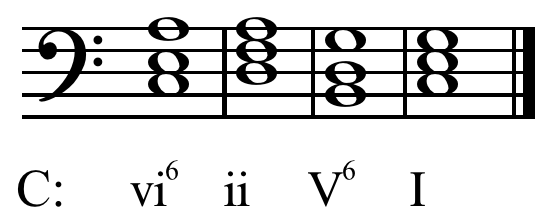
F major
A minor
D minor
G major
vi is A minor.
Image: Hyacinth at English Wikipedia, public domain, via Wikimedia Commons.
Which section of an orchestral score appears at the top?
Strings
Brass
Woodwinds
Percussion
Woodwinds, brass, percussion, then strings.
In this score of an orchestration of Satie's Gymnopédie, which instruments are listed first?
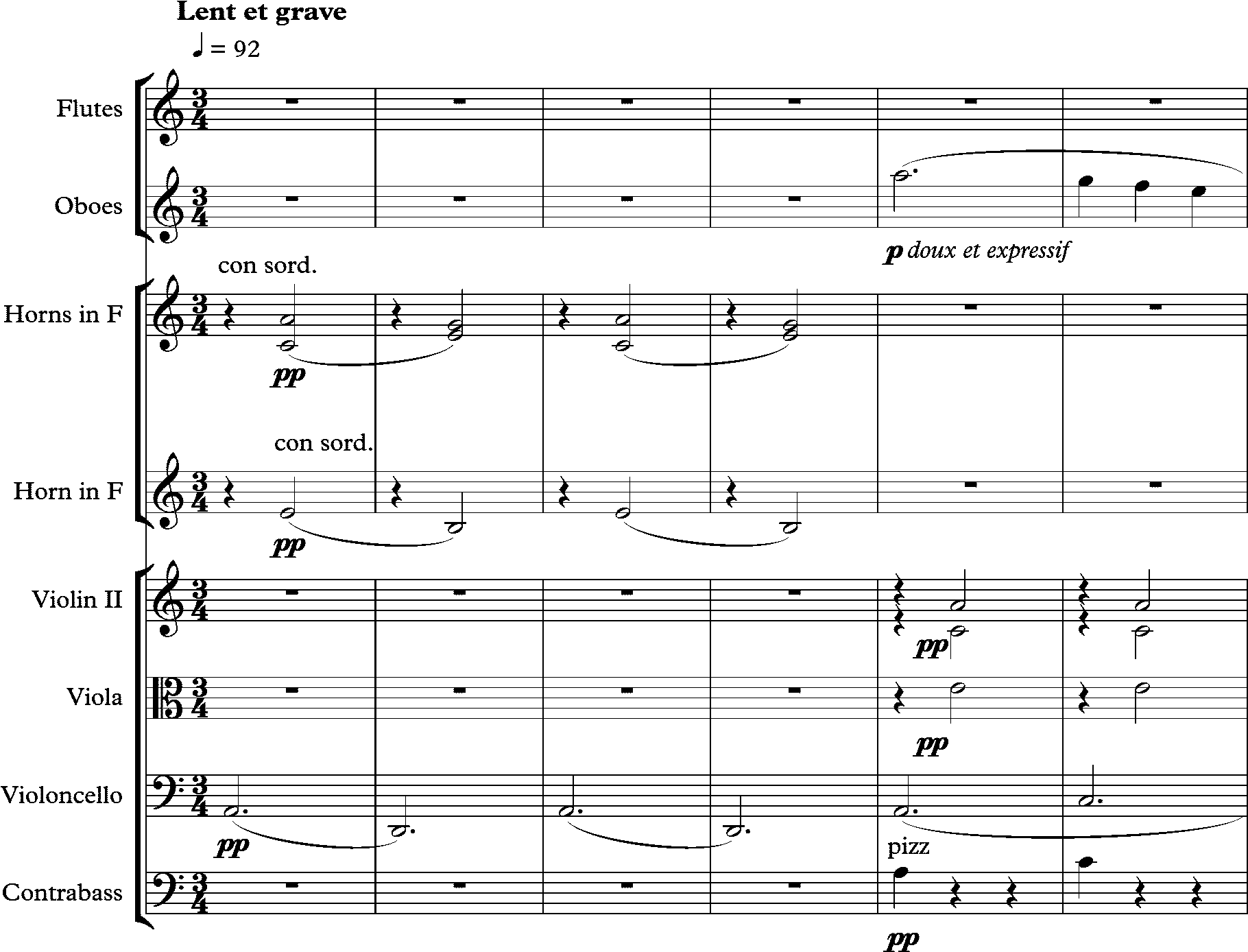
Flutes and oboes
Violins
Timpani
Trumpets
Woodwinds head the page.
Image: Satie, arranged by Debussy, public domain, via Wikimedia Commons.
This handwritten page is a manuscript of which Satie work?
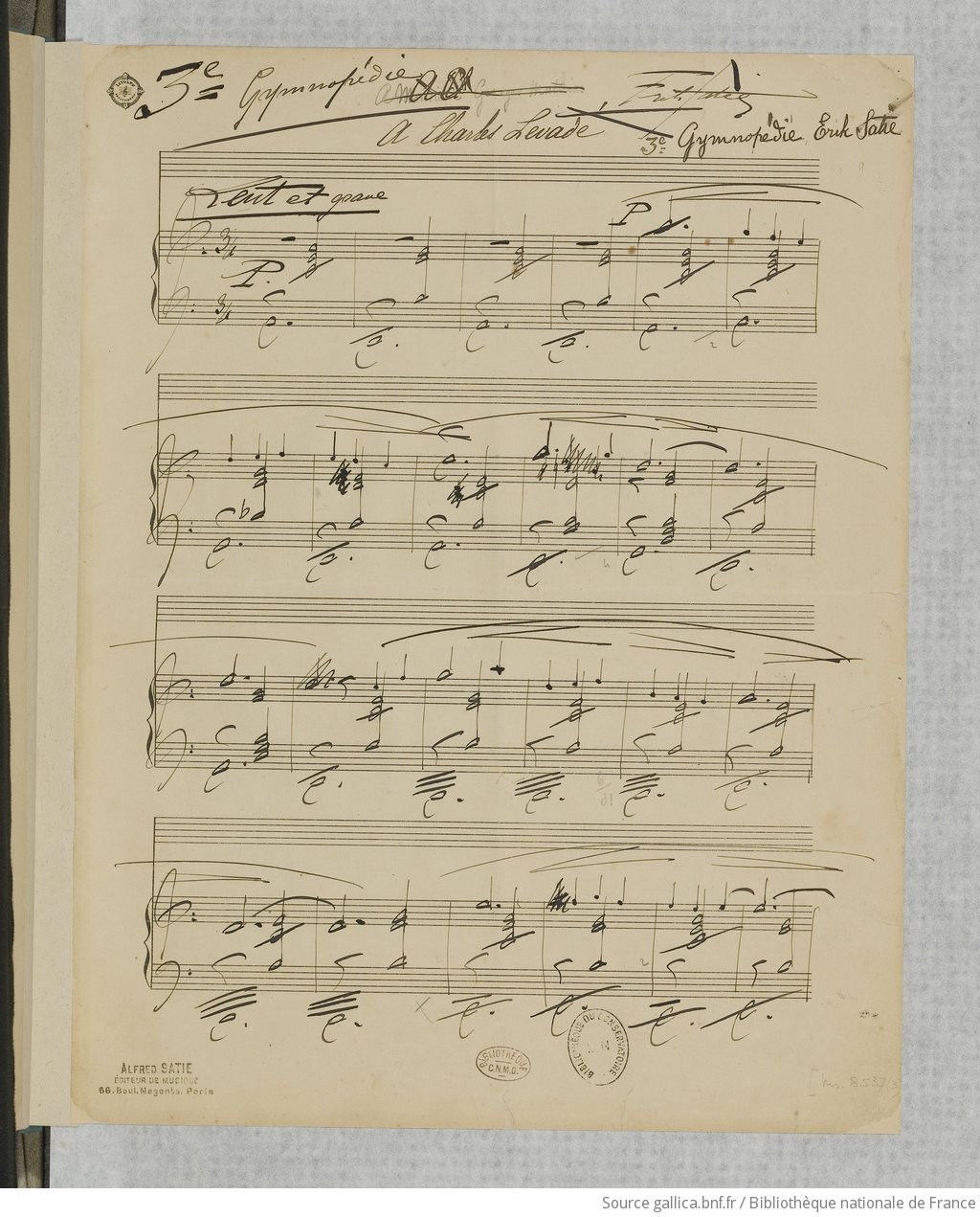
Trois Gymnopédies (No. 3)
Gnossiennes
Vexations
Parade
The Gymnopédie No. 3.
Image: Erik Satie, public domain, via Wikimedia Commons.
What is the lead sheet element labeled 'Emi7, A7, Dmi7'?
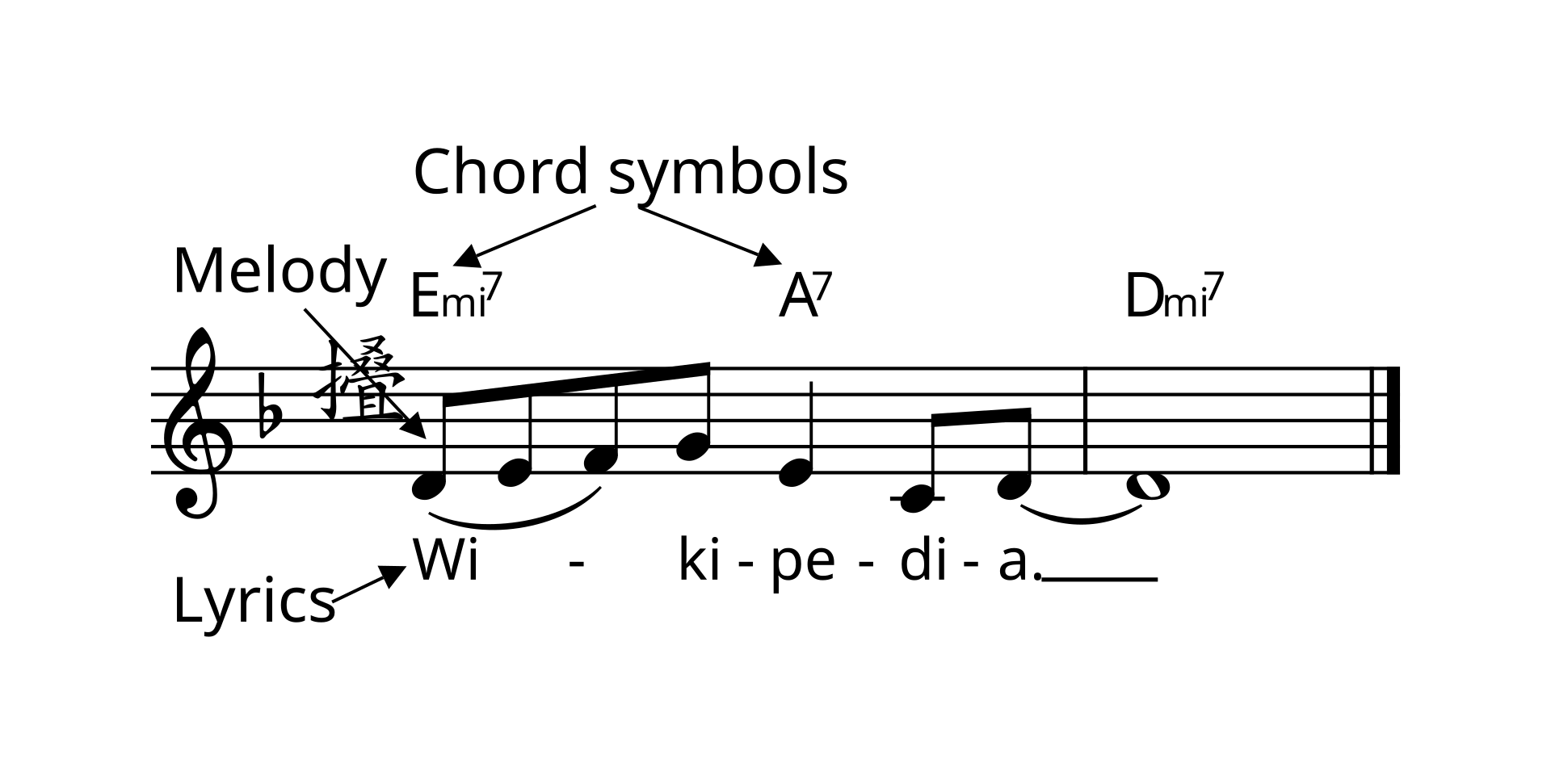
Lyrics
Chord symbols
Melody
Tempo
The chord symbols.
Image: BrandonJCox, CC BY-SA 4.0, via Wikimedia Commons.
In the 32-bar AABA form, what does B represent?
The verse
The bridge
The coda
The chorus
B is the contrasting bridge.
What are the 12-bar blues chords in Roman numerals?
I-IV-V only
I I I I | IV IV I I | V IV I I
ii-V-I
I-vi-ii-V
The standard pattern.
In the tone-row example, the 'RI' form is called what?
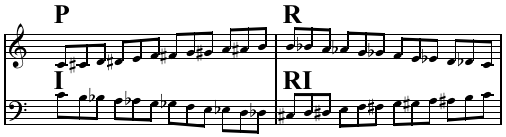
Retrograde inversion
Rhythmic inversion
Root inversion
Reversed interval
Retrograde inversion.
Image: Hyacinth at en.wikipedia, CC BY-SA 3.0, via Wikimedia Commons.
How many distinct row forms exist when P, R, I and RI are each transposed to all 12 pitch levels?
12
24
36
48
4 x 12 = 48.
Which composer used the 'phasing' technique in Piano Phase (1967)?
Steve Reich
John Cage
Philip Glass
Arnold Schoenberg
Steve Reich.
What does a DAW do?
Records, edits and mixes audio and MIDI
Prints sheet music only
Tunes orchestras
Stores notes on paper
Digital audio workstation.
What does MIDI record?
Note data and controls rather than sound
Waveforms only
Lyrics
Video
MIDI sends note-on/off, velocity and controllers.
Which statement about copyright in a song is accurate?
The composition and a particular recording are separate copyrights
Only recordings are protected
Lyrics are not protected
Copyright never expires
Composition and sound-recording rights are distinct.
