Quiz · Medium
Dominant strategies, Nash equilibrium in matrices and trees, mixed strategies, repeated games, backward induction and applications.
The tragedy of the commons is best described as:
A coordination game with a unique equilibrium
A prisoners' dilemma among users of a shared resource
A zero-sum game
A game with a mixed equilibrium only
Each user's dominant strategy is to overuse the resource, since the cost of depletion is shared, so the equilibrium is inefficient.
Which statement about Pareto efficiency and Nash equilibrium is correct?
Every Nash equilibrium is Pareto efficient
A Nash equilibrium can be Pareto inefficient
Pareto-efficient outcomes are always equilibria
The two concepts are the same
The prisoners' dilemma shows that the unique Nash equilibrium (defect, defect) is worse for both than another outcome.
In the matrix, what is the Nash equilibrium?
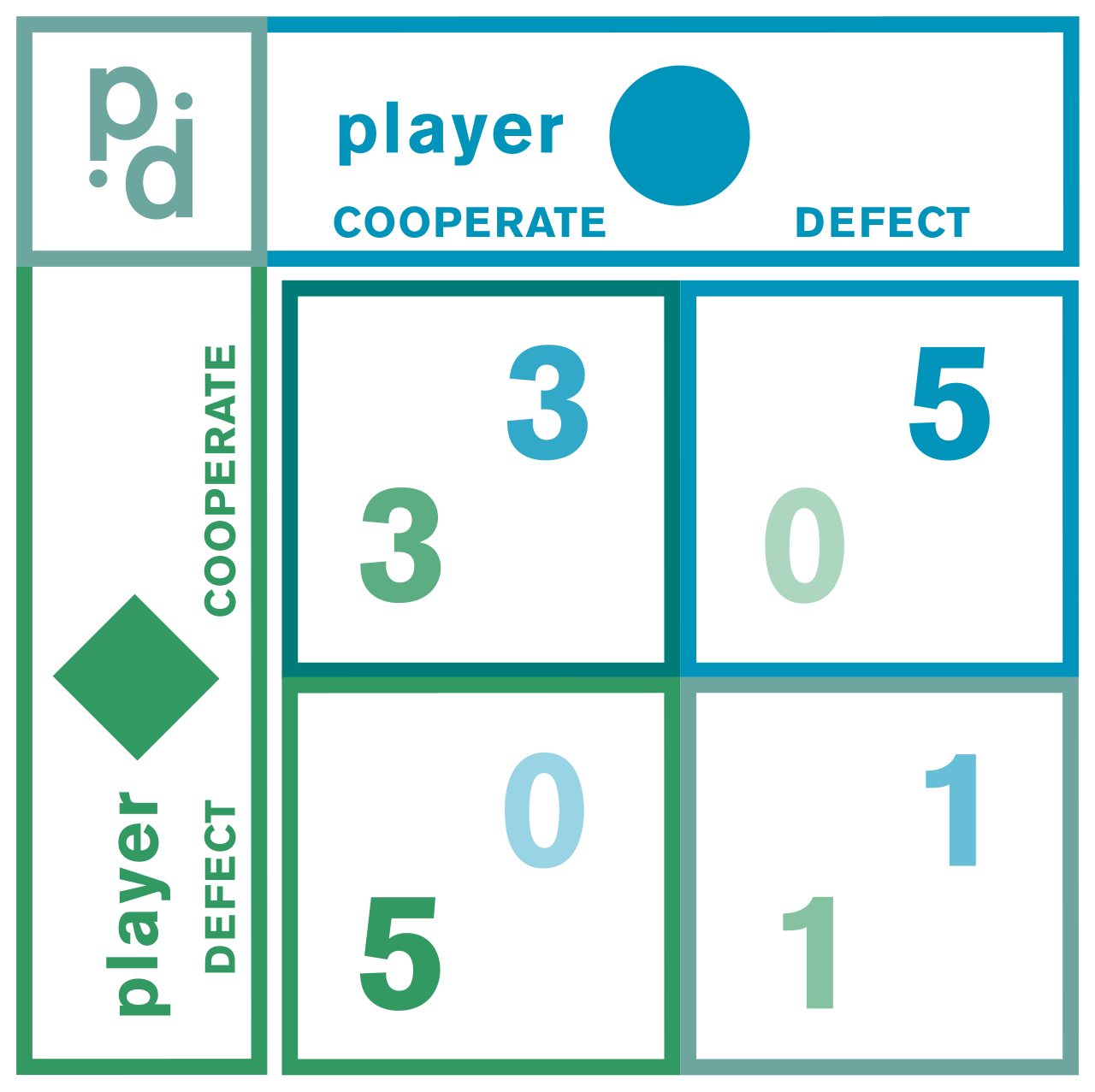
Both cooperate (3, 3)
Row defects, Column cooperates (5, 0)
Both defect (1, 1)
There is no equilibrium
Defect is a dominant strategy for each player (5 > 3 against cooperation, 1 > 0 against defection), so both defect. The result is worse for both than mutual cooperation.
Image: Christopher X Jon Jensen and Greg Riestenberg, CC BY-SA 3.0, via Wikimedia Commons.
A dominant strategy is one that:
Is best whatever the opponent does
Gives the highest payoff only if the opponent plays a particular strategy
Maximizes the sum of payoffs
Is always cooperative
A dominant strategy yields a higher payoff than every alternative against every opponent choice. A strategy that is best only against one choice is merely a best response.
A Nash equilibrium is a set of strategies where:
Each player's total payoff is maximized
Every player has a dominant strategy
The outcome is Pareto efficient
No player can gain by changing strategy alone
It requires only that each strategy is a best response to the others'. Equilibria need not involve dominant strategies and need not be efficient (the prisoners' dilemma).
Payoffs (Row, Column): Up/Left (4, 3), Up/Right (1, 1), Down/Left (2, 2), Down/Right (3, 4). How many pure-strategy Nash equilibria are there?
0
2
1
4
(Up, Left) and (Down, Right) are both mutual best responses. It is a coordination game with two equilibria, so the players must coordinate.
Which game has NO pure-strategy Nash equilibrium?
Prisoners' dilemma
Matching pennies
Stag hunt
Battle of the sexes
In matching pennies one player wants to match and the other to mismatch, so in every cell someone wants to switch. The equilibrium is 50-50 randomization.
In the battle of the sexes, (Opera, Opera) pays (2, 1), (Football, Football) pays (1, 2), and mismatches pay (0, 0). The probability that Row plays Opera in the mixed equilibrium is:
1/3
1/2
2/3
3/4
Row must make Column indifferent: , so p = 2/3. (1/3 is the probability that Column plays Opera.)
In the tree, what does backward induction predict?
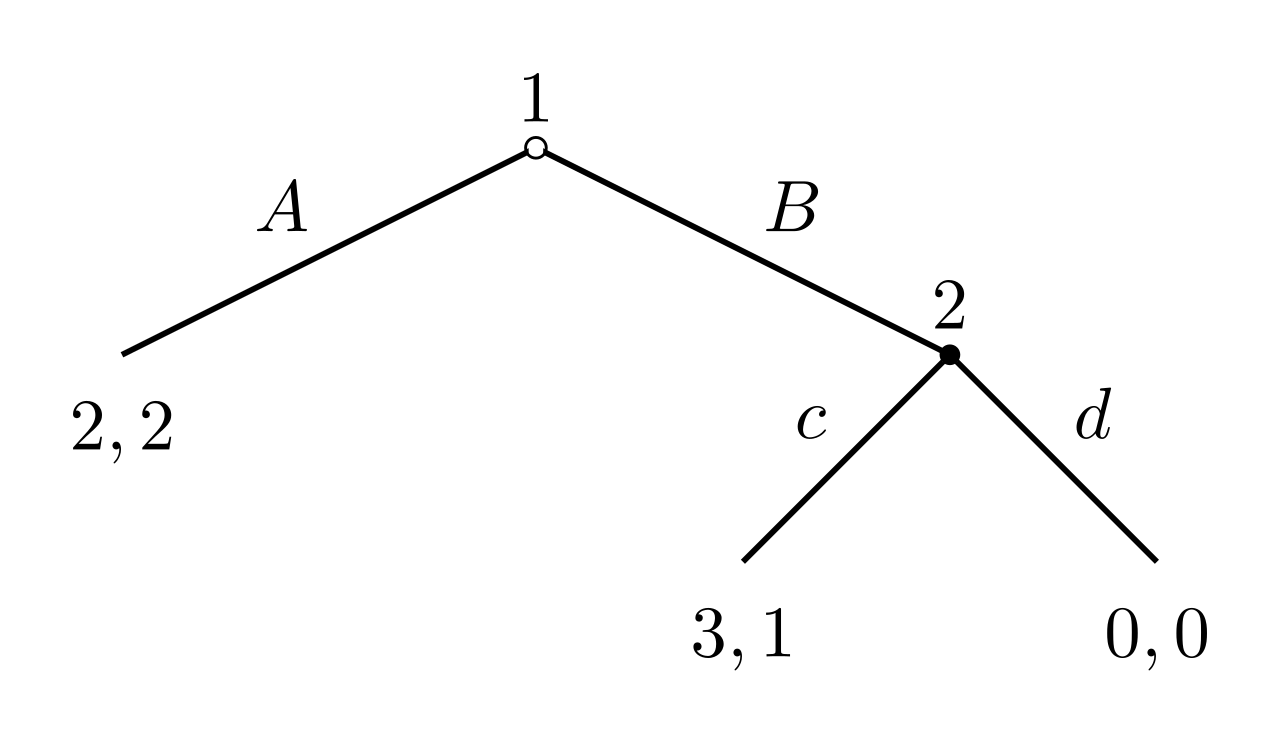
Player 1 chooses B, Player 2 chooses c, outcome (3, 1)
Player 1 chooses A and the outcome is (2, 2)
Player 1 chooses B, Player 2 chooses d, outcome (0, 0)
Player 2 chooses d to punish Player 1
After B, Player 2 gets 1 from c and 0 from d, so she picks c. Player 1 then prefers B (3) to A (2). The threat d is not credible.
In the previous tree, (A, d) is a Nash equilibrium but NOT subgame perfect because:
Player 1 would not choose A
It is not Pareto efficient
Player 2 has a dominant strategy
It relies on a non-credible threat by Player 2
If the game reached Player 2's node she would choose c, not d. Subgame perfection rules out strategies that rely on threats that would not be carried out.
In this ultimatum game tree, which outcome is the subgame-perfect equilibrium?
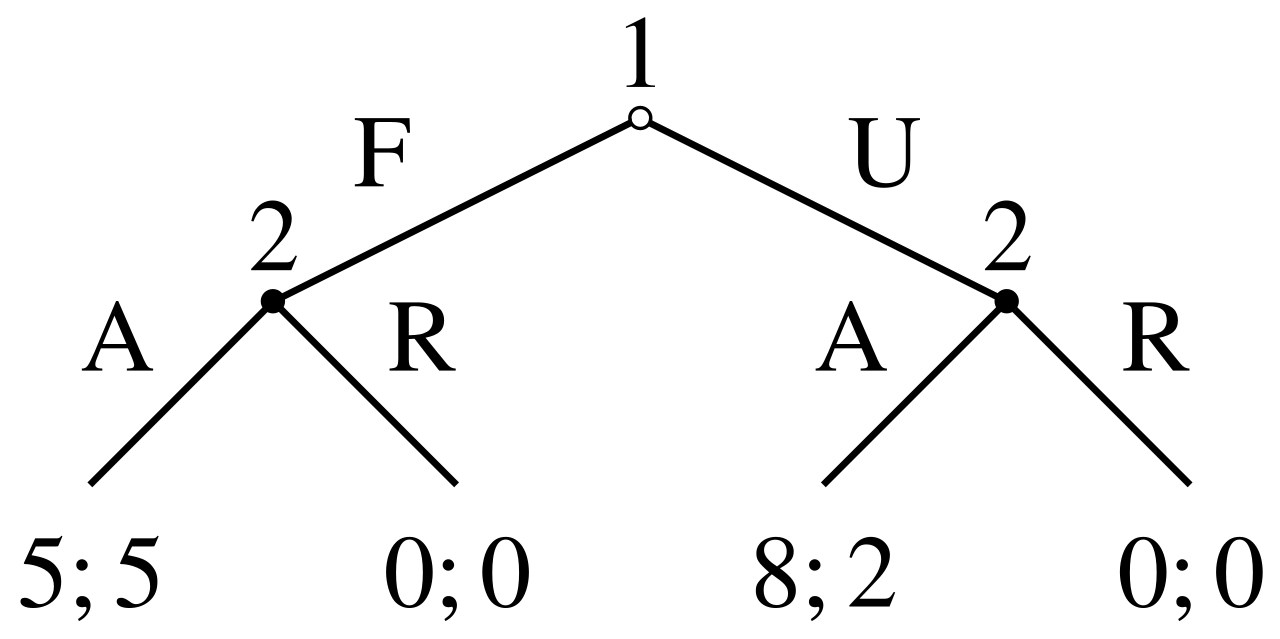
F then accept (5, 5)
U then reject (0, 0)
U then accept (8, 2)
F then reject (0, 0)
Player 2 accepts any positive payoff, so Player 1 offers the unequal split and gets 8. In experiments, real responders often reject such offers.
Image: Kevin Zollman, CC BY-SA 3.0, via Wikimedia Commons.
A game has the payoffs for the row player [[3, 1], [2, 4]] (zero-sum). The row player's maximin value in pure strategies is:
1
3
2
4
Row minimums are 1 and 2. The maximin is the larger, 2. A saddle point would need the column minimax to equal 2, but it is 3, so no pure saddle exists.
In a sequential battle of the sexes where Player 1 moves first and Player 2 observes, the equilibrium shows:
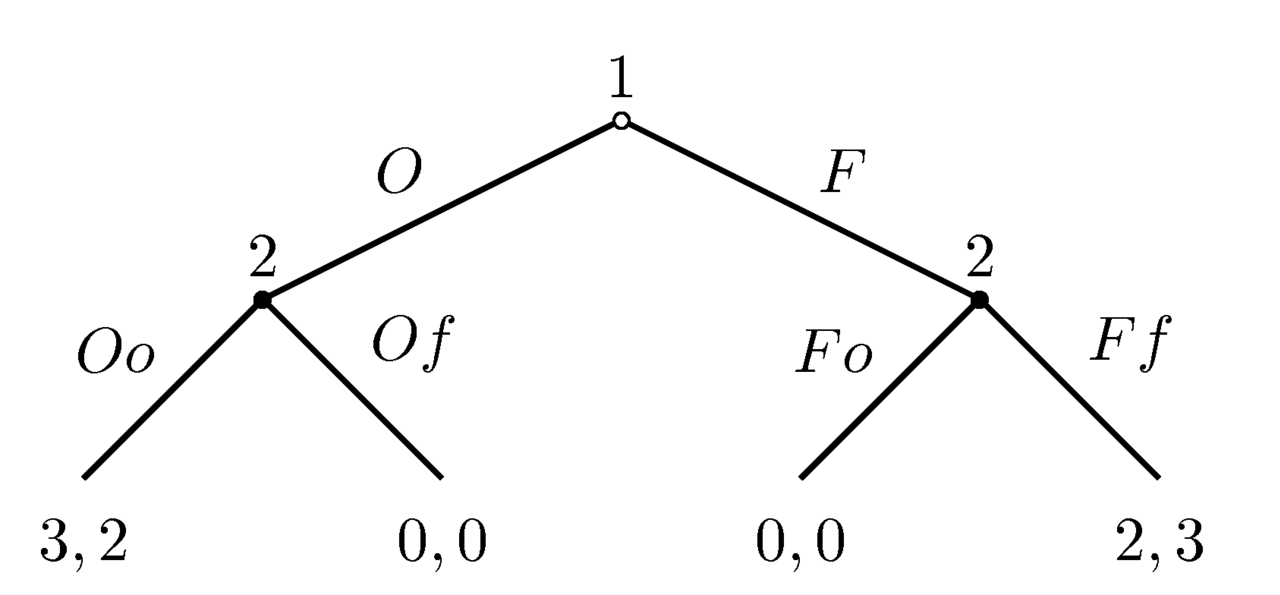
A first-mover advantage: Player 1 gets her preferred outcome
No advantage to moving first
A second-mover advantage
Two equilibria
Player 2 will match whatever Player 1 chooses, so Player 1 picks her preferred option. Here moving first with commitment pays.
Image: Kevin Zollman, CC BY-SA 3.0, via Wikimedia Commons.
A finitely repeated prisoners' dilemma with a known last round. What does backward induction predict?
Cooperation in all rounds
Tit-for-tat
Cooperation until the last round
Defection in all rounds
Defection is dominant in the last round, so there is no reason to cooperate in the second last, and so on back to round 1. Cooperation unravels.
With T = 5, R = 3, P = 1, S = 0, grim-trigger cooperation in an infinitely repeated prisoners' dilemma needs a discount factor of at least:
0.25
0.5
0.67
0.75
. Players must value the future enough that the gain from one-time cheating is outweighed by the loss of cooperation.
Which feature of tit-for-tat contributed to its success in Axelrod's tournaments?
It defects first to exploit
It is nice, retaliatory, forgiving and clear
It is random
It always cooperates
Tit-for-tat never defects first, punishes defection immediately, returns to cooperation after the other player does, and is easy for opponents to understand.
In a Cournot duopoly the Nash equilibrium is:
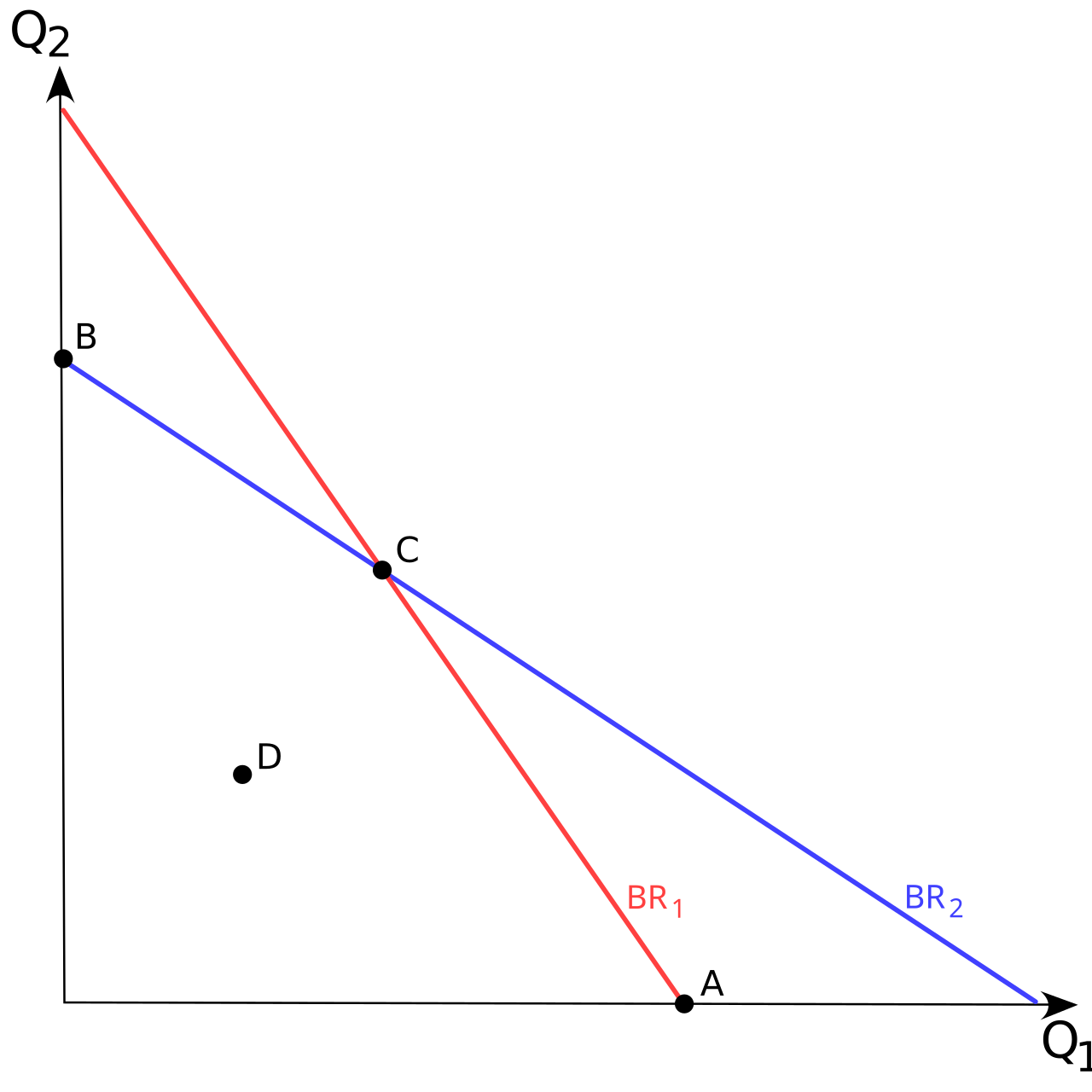
Where marginal revenue equals zero
Where price equals marginal cost
Where each firm's quantity is a best response to the other's
Where the firms collude
Firms choose quantities simultaneously; the equilibrium is where the two best-response curves cross.
Image: Pawel Zdziarski (faxe), Astarot, Everlong and Jarry1250, CC BY-SA 3.0, via Wikimedia Commons.
In a sealed-bid second-price auction with private values, a bidder's weakly dominant strategy is to:
Bid her true value
Bid half her value
Bid above her value
Bid just above her expected competitor's bid
The price paid depends on the second-highest bid, not on her own, so her bid only determines whether she wins. Truthful bidding wins exactly when it is profitable.
In a first-price sealed-bid auction, rational bidders typically:
Bid their true value
Bid above their value
Bid zero
Shade their bids below their value
Winning at your own value gives no surplus, so you bid less than your value, trading off a lower chance of winning against a higher surplus if you win.
The winner's curse arises because:
The auction winner pays the second-highest bid
Bidders collude
The winner is the bidder with the most optimistic estimate of a common value
The seller sets a reserve price
When the item's value is common but uncertain, the highest bid tends to come from the most overoptimistic estimate, so the winner often overpays unless she shades her bid.
In the stag hunt, why might players choose Hare even though (Stag, Stag) pays more?
Hare is the safe choice if you doubt the other will hunt stag
Hare is a dominant strategy
Stag is not a Nash equilibrium
Hare gives higher payoffs
Both (Stag, Stag) and (Hare, Hare) are equilibria. Hunting stag is risky: you get nothing if the other chooses hare, so many players go for the risk-dominant safe option.
Why does Bertrand price competition with two identical firms give P = MC?
Firms collude on marginal cost
Demand is perfectly elastic
Entry is free
Each firm can undercut a higher price and capture the whole market
At any price above MC, a rival can undercut slightly and win all customers, so prices fall to MC. This is the Bertrand paradox.
Which concept did Reinhard Selten introduce to rule out non-credible threats?
Subgame-perfect equilibrium
Dominant strategy
Pareto optimality
Maximin
Selten's subgame-perfect equilibrium requires Nash behavior in every subgame (he shared the 1994 Nobel Prize with Nash and Harsanyi).
