Quiz · Hard
Applied scenarios on functions of behavior, de-escalation, culturally responsive management, FERPA, mandated reporting, discipline of students with IEPs and landmark cases.
A student with an IEP has been suspended for 8 days and a new incident could bring the total beyond 10 school days. What must the school do before the change of placement?
Expel the student automatically
Hold a manifestation determination review
Call the police
Notify only the teacher
Under IDEA, removals beyond 10 school days require a team to decide whether the behavior was a manifestation of the disability.
A student calls out answers to get attention. The teacher gives praise and a point when the student raises a hand. This is mostly a function-based intervention that:
Teaches a replacement behavior that serves the same function
Applies positive punishment
Extinguishes all attention
Is a token economy only
The student still gets attention, but by an acceptable behavior.
A teacher uses a behavior chart only when she is irritated and often forgets to give consequences. Which principle explains why students test limits more?
Continuous reinforcement
Negative reinforcement
Modeling
Intermittent (variable) reinforcement of rule-breaking makes it more persistent
Occasional enforcement means misbehavior sometimes pays off, which strengthens persistence.
A student who escapes writing tasks by going to the nurse is sent home sick each time. What is the likely effect?
Extinction of leaving
Positive punishment
Negative reinforcement: leaving the task becomes more likely
Shaping of writing
Escape from an aversive task reinforces the escape behavior. The function must be addressed (support the writing task).
Which situation best fits a Tier 3 PBIS response?
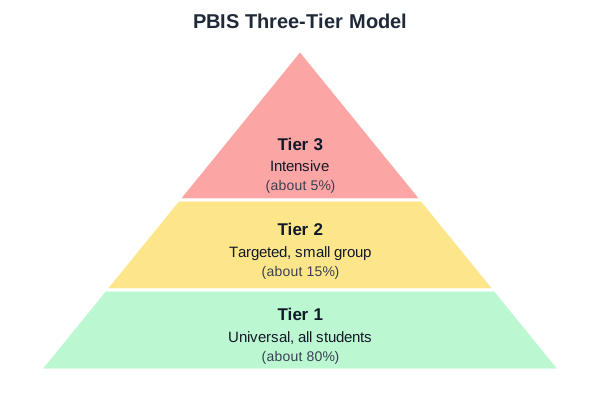
Schoolwide teaching of expectations
A student with intense, frequent aggression receives an FBA and an individual behavior intervention plan
A reminder poster
A class meeting
Tier 3 is individualized and intensive, informed by an FBA.
Which case established that schools need only 'reasonable suspicion' to search a student?
New Jersey v. T.L.O.
Tinker v. Des Moines
Goss v. Lopez
Ingraham v. Wright
T.L.O. (1985). Tinker is about student speech, Goss about due process in suspension, Ingraham about corporal punishment.
Students wear black armbands to protest a war, and no disruption occurs. Which case protects their right?
Hazelwood v. Kuhlmeier
Morse v. Frederick
Goss v. Lopez
Tinker v. Des Moines
Student speech is protected unless it materially and substantially disrupts school activity.
A teacher suspects a student is being abused but wants more proof before calling child protective services. What should she do?
Wait for the student to confirm
Ask the parents first
Report now; reasonable suspicion is the legal standard
Investigate on her own
Mandated reporters must report suspicion without proof and are protected when acting in good faith.
A teacher posts a student's grades on the door. Which law is most likely violated?
IDEA
FERPA
Section 504
Title IX
FERPA protects the privacy of education records, including grades.
Three students lose recess because one student misbehaved. What is the main problem with this approach?
Group punishment is unfair and damages relationships
Response cost is never effective
Recess must always be given
It is positive reinforcement
Address the individual privately instead.
In Colvin's acting-out cycle, a student is shouting and throwing things. In which phase is the student, and what is the best goal?
Calm; teach a skill
Recovery; debrief
Trigger; assign consequences
Peak; ensure safety and give space
At the peak, safety is the priority. Teaching and debriefing wait for the de-escalation and recovery phases.
A teacher in a culturally responsive classroom notices a student avoids eye contact with adults when corrected. What is the best interpretation?
Defiance requiring punishment
Guilt
It may be a sign of respect in the student's culture, not defiance
A sign of low intelligence
Weinstein stresses knowing students' cultural norms to avoid misreading behavior.
A middle school class is loud and off task right after lunch. Which proactive change is likely to help most?
Assign detentions for everyone
Establish and practice an entry routine with a bell-ringer task
Remove all group work
Give a surprise quiz every day
A clear routine and an immediate meaningful task address the problem before it starts.
Which statement best distinguishes accommodations in behavior support for a student with a disability?
A behavior intervention plan can be part of an IEP and must be based on the function of behavior
A BIP replaces the IEP
Only the principal can use BIPs
BIPs are punishments
A BIP is a positive, function-based plan that is often included in the IEP.
A teacher keeps a classroom running 'smoothly' but her lesson jumps between activities and returns to an earlier one multiple times. Which Kounin error is this?
Dangle
Overdwelling
Fragmentation
Flip-flop
A flip-flop is terminating an activity, starting another, and then returning to the first.
