Quiz · Medium
Quiz on Kraljic categories, RFQ vs RFP, three-way matching, make-or-buy break-even, supplier scoring, payment terms and contract types.
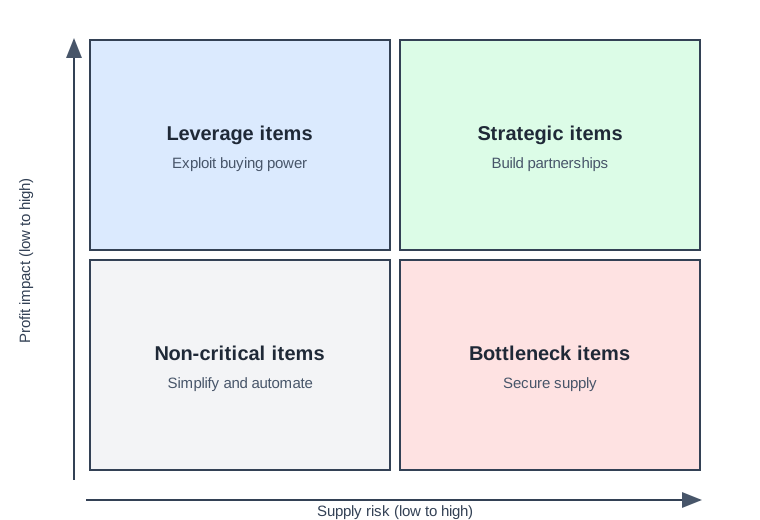
An item has low profit impact but a single supplier and is hard to substitute. On the Kraljic matrix it is a
leverage item
non-critical item
bottleneck item
strategic item
Low profit impact with high supply risk is bottleneck. Strategic items have both high impact and high risk.
Which sourcing strategy best suits a leverage item?
Competitive bidding and volume bundling
Long-term joint development
Hold large safety stock and look for alternatives
Automate with P-cards and catalogs
Leverage items have many suppliers and high spend, so the buyer can exploit its buying power. Partnership suits strategic items; automation suits non-critical.
A buyer asks several suppliers for a price on an exactly specified part. This is an
RFI
RFP
blanket order
RFQ
An RFQ requests prices for a defined spec. An RFI collects information; an RFP asks for proposals on a solution.
In three-way matching, the invoice is compared with the
requisition and contract
purchase order and the goods receipt
packing list and bill of lading
purchase order and payment terms
The three documents are PO, goods receipt and invoice. The check confirms you pay only for what you ordered and received.
A supplier offers terms of 2/10 net 30. Roughly what annualized return do you earn by paying on day 10 instead of day 30?
2%
37%
20%
73%
The 2% discount is earned for paying 20 days early: (2/98) x (365/20) = 37%. The 2% is not annual.
The make-or-buy break-even volume when F = $60,000, variable cost to make = $9 and buying price = $15 is
4,000 units
6,667 units
60,000 units
10,000 units
Q = F / (p - v) = 60,000 / 6 = 10,000. Above that volume making is cheaper.
Which of the following is the definition of total cost of ownership?
Purchase price plus the costs of acquiring, using, maintaining and disposing of the item
The supplier's list price
Purchase price minus any discounts
The cost of transport only
TCO captures the full lifecycle cost. The lowest price is not necessarily the lowest TCO.
A buyer pays $10.40 per unit for 5,000 units. The standard price is $10.00. What is the purchase price variance?
$2,000 favorable
$400 unfavorable
$2,000 unfavorable
$52,000 unfavorable
(10.40 - 10.00) x 5,000 = $2,000. Paying more than standard is unfavorable.
Which describes a sole source?
A buyer who chooses one supplier although others exist
Two suppliers share the volume
The only supplier in the market can provide the item
The supplier owns the stock at the buyer's site
Sole source means no alternative exists. Single source means a deliberate choice; consignment concerns who owns the stock.
In a cost-plus contract, the supplier bears most of the cost risk.
True
False
In cost-plus, the buyer reimburses actual costs plus a fee, so the buyer carries the cost risk. Fixed-price contracts put the cost risk on the supplier.
Supplier X scores Quality 9, Delivery 5, Price 8. The weights are Quality 50%, Delivery 20%, Price 30%. What is the weighted score?
7.9
7.3
7.0
8.5
0.5 x 9 + 0.2 x 5 + 0.3 x 8 = 4.5 + 1.0 + 2.4 = 7.9. An unweighted average (7.3) ignores the priorities.
Which is the best example of maverick spend?
Buying under a framework agreement
Placing a call-off against a blanket PO
Using a P-card for a low-value approved item
A manager buys from a non-approved supplier at a higher price despite an existing contract
Maverick spend bypasses agreed contracts and processes.
A buyer's BATNA is
the best price the supplier will offer
the best alternative if negotiations fail
the buyer's target price
a type of contract clause
A strong BATNA gives more negotiating leverage. The reservation price is the walk-away point; the target is what the buyer hopes to reach.
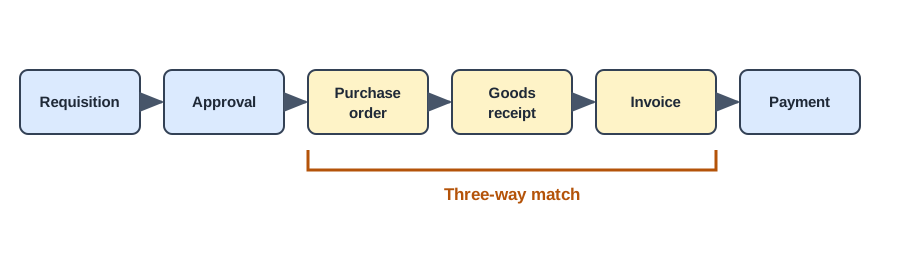
The diagram shows a procure-to-pay flow with a bracket under three steps. What does it represent?
Approval levels for requisitions
Three-way match of purchase order, goods receipt and invoice
Supplier qualification
A blanket PO release
The match is performed before payment to stop paying for items not ordered, not received or wrongly billed.
Which supplier risk is made worse by rationalizing the supply base to one supplier per part?
Currency risk only
Maverick spend
Price variance
Concentration risk
Fewer suppliers give leverage and simplicity but increase dependence; a failure can stop supply.
A company wants to find which categories to focus on first. What should it do?
Run a spend analysis and prioritize large or critical categories
Cut the number of POs to zero
Ask suppliers for discounts on all items equally
Move all purchases to P-cards
Spend analysis shows where the money goes and where consolidation or negotiation pays most.
A supplier shipped 400,000 parts, with 120 defective. The defect rate is
30 ppm
3,000 ppm
300 ppm
0.3%
120 / 400,000 = 0.0003 = 300 ppm (0.03%). 0.3% would be 3,000 ppm.
Which is the main benefit of a punch-out catalog?
It removes the need for contracts
It guarantees the lowest price
Staff shop on the supplier's web store while approvals and ordering stay in the buyer's system
It replaces goods receipts
Punch-out combines current supplier catalog content with the buyer's own controls. It does not by itself fix prices or remove contracts.
Under which condition is a firm fixed-price contract most appropriate?
The scope and specifications are well defined
The scope is uncertain and changing
The supplier cannot estimate costs
The buyer wants to share cost risk
With clear scope the supplier can price accurately and accepts the cost risk. Uncertain scope suits cost-plus or time and materials.
Which is a hard saving?
A price increase that did not happen
Time saved by staff on a simpler process
A supplier who promises future savings
Negotiating a unit price from $12 to $11 on a stable volume
A lower price paid against baseline shows in the P&L. Avoided increases are cost avoidance (soft savings).
