Quiz · Medium
Twenty questions on shifts of demand and supply, equilibrium, shortages and surpluses, and price ceilings and floors, with graph questions.
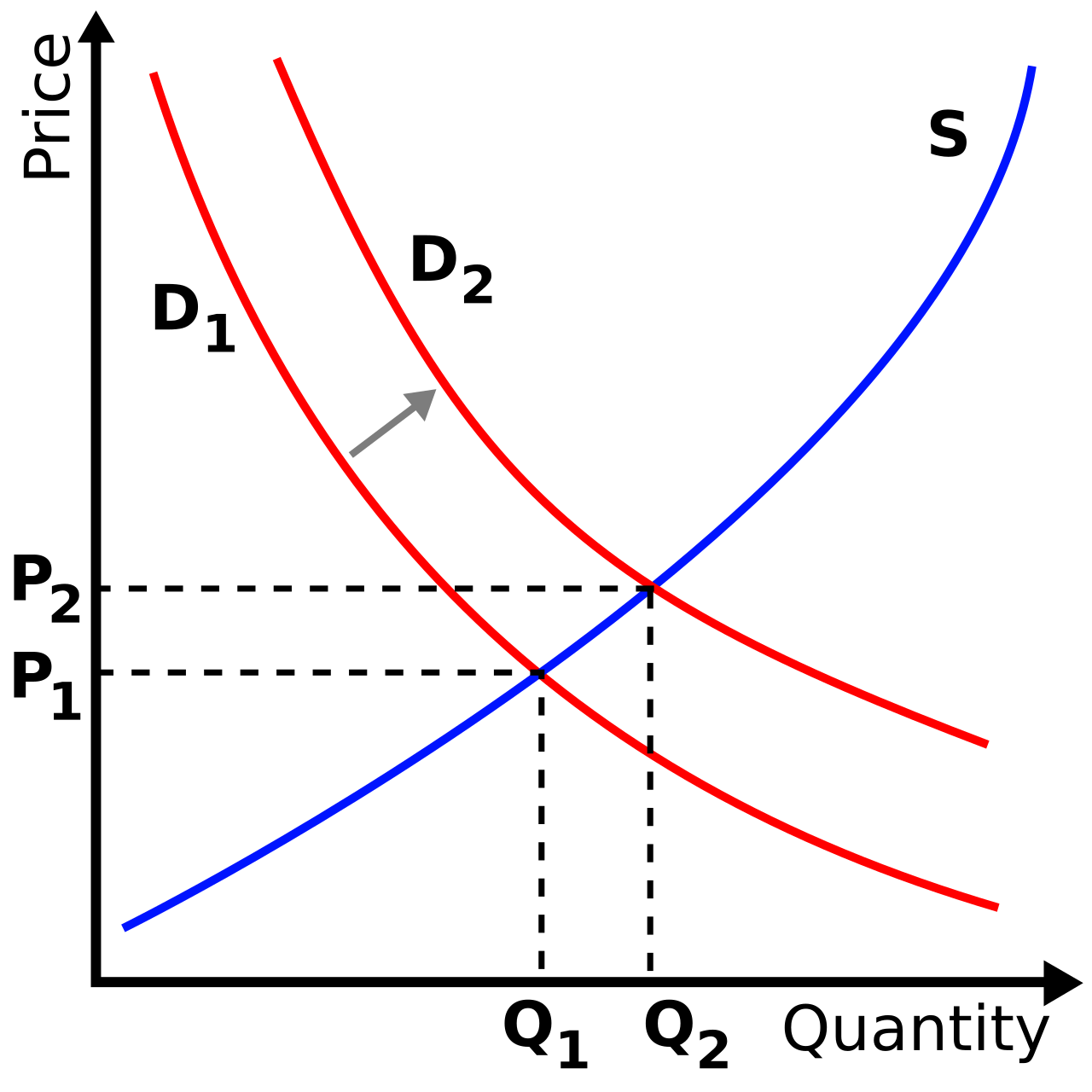
The diagram shows demand shifting from D1 to D2 with supply unchanged. Which event could cause this shift for a normal good?
A fall in the price of the good
A rise in consumers' incomes
A fall in the cost of inputs
An increase in the number of sellers
Higher income raises demand for a normal good at every price. A fall in the good's own price is a movement along the curve, and the other two shift supply.
Image: SilverStar, CC BY 2.5, via Wikimedia Commons.
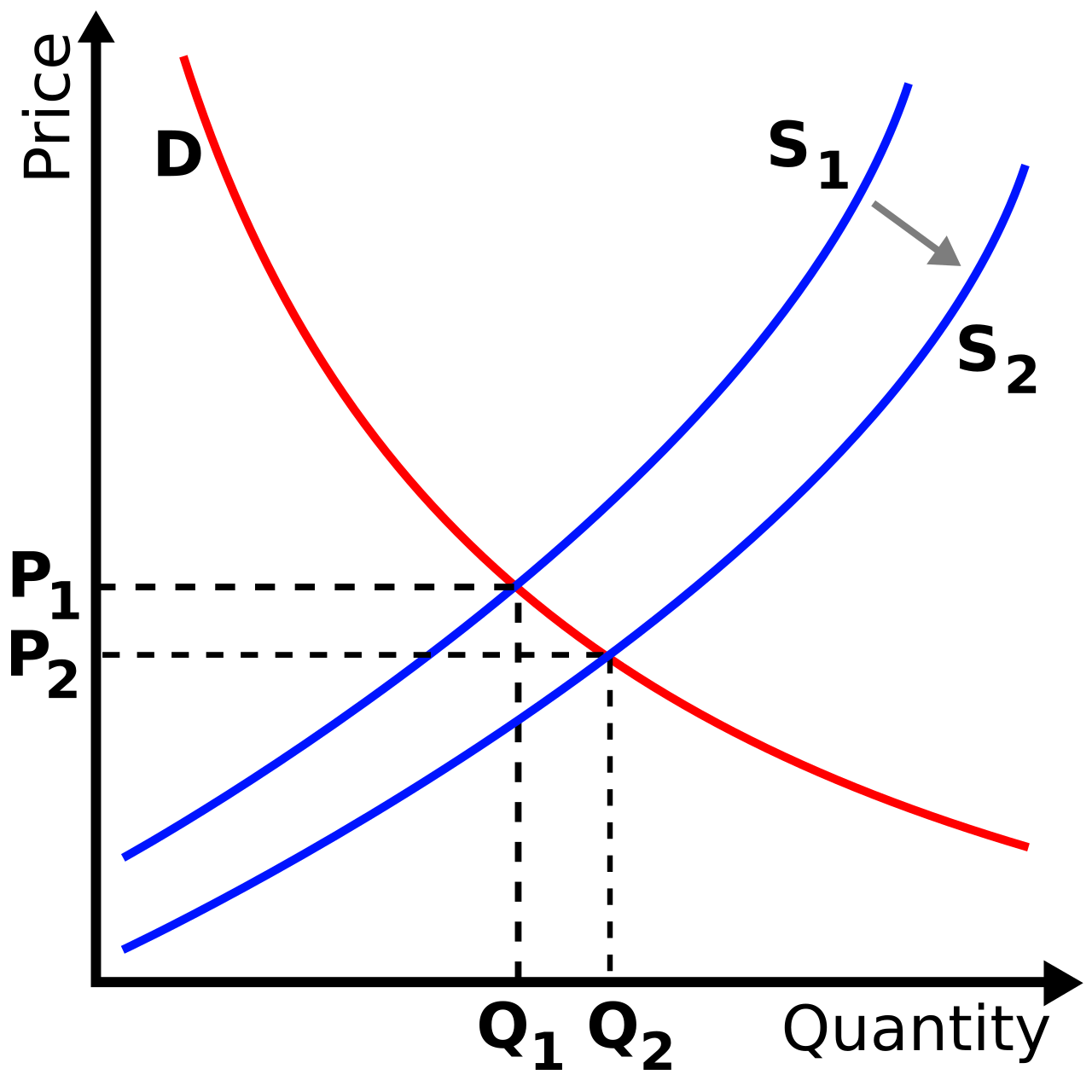
Supply shifts from S1 to S2 while demand is unchanged. What happens to equilibrium price and quantity?
Price falls, quantity rises
Price rises, quantity falls
Price rises, quantity rises
Price falls, quantity falls
The rightward shift creates a surplus at the old price, so price falls and buyers move down along demand to a larger quantity.
Image: SilverStar, CC BY 2.5, via Wikimedia Commons.
Which of these causes a movement along the demand curve rather than a shift?
A change in consumer tastes
A change in consumer income
A change in the price of a substitute
A change in the price of the good itself
Only the good's own price moves you along the curve. Income, related-goods prices and tastes shift it.
Demand is Qd = 80 - 4P and supply is Qs = 20 + 2P. What is the equilibrium price?
15
20
10
6
Set 80 - 4P = 20 + 2P: 60 = 6P, so P = 10 and Q = 40. The tempting 20 is the supply intercept.
A price ceiling is set above the equilibrium price. What is the effect?
A surplus
A rise in the equilibrium price
A shortage
No effect: the ceiling is not binding
The market price is already below the ceiling, so the law doesn't bind. A shortage needs a ceiling below equilibrium.
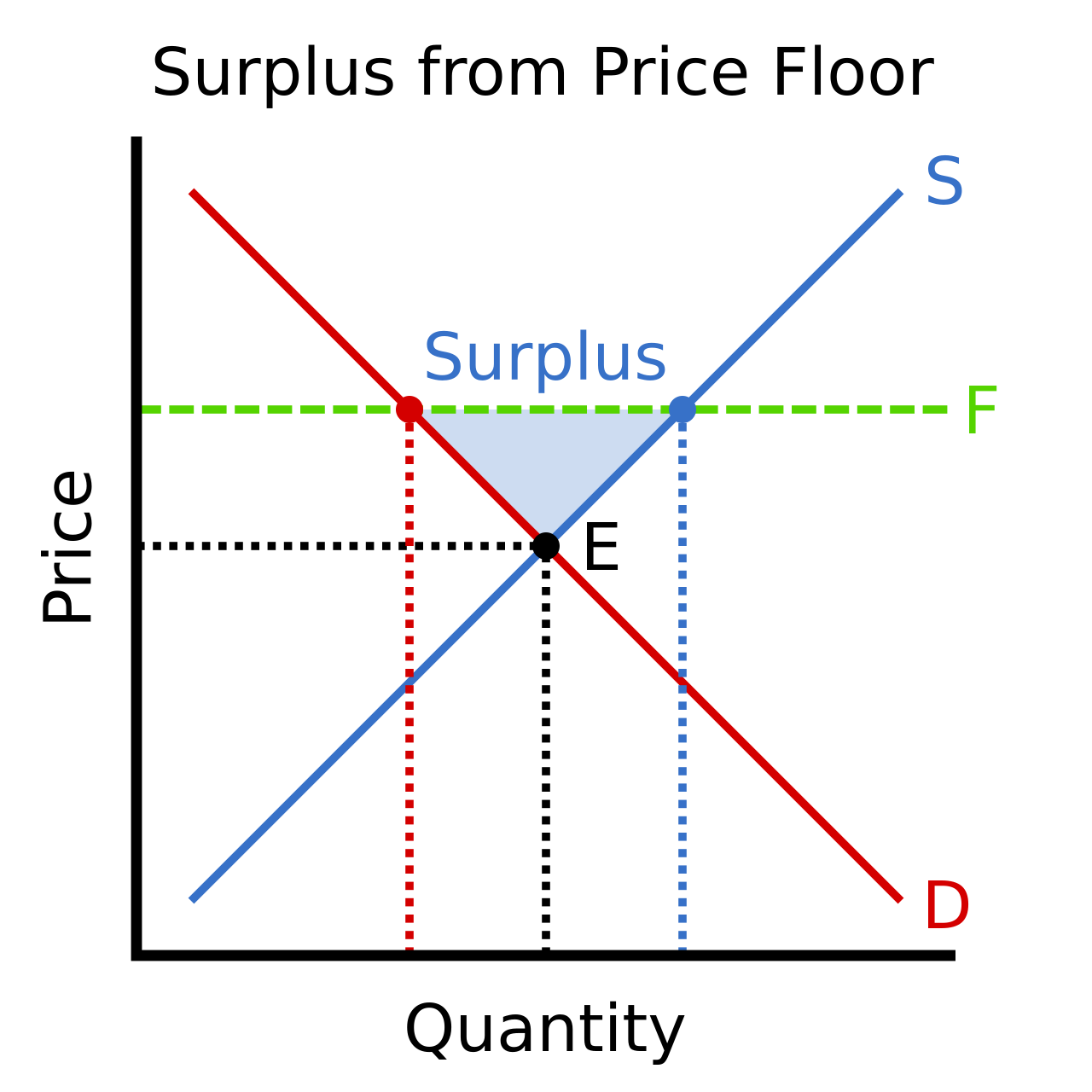
A price floor is set above the equilibrium price. What results?
A surplus
A shortage
No change in quantity demanded
A fall in quantity supplied
At the floor, quantity supplied exceeds quantity demanded. Quantity demanded does fall as price rises, so 'no change' is wrong.
Hot dogs and hot dog buns are complements. The price of buns rises. What happens in the hot dog market?
Demand rises, so price and quantity of hot dogs rise
Quantity demanded rises along a fixed demand curve
Supply falls, so price rises and quantity falls
Demand falls, so price and quantity of hot dogs fall
A higher bun price makes the bundle costlier and shifts hot dog demand left.
A price ceiling set above equilibrium creates a shortage. True or False?
True
False
A ceiling only has an effect when set below equilibrium; a ceiling above it doesn't bind.
Demand and supply both increase. What is certain?
Equilibrium quantity is ambiguous
Equilibrium price rises
Equilibrium quantity rises, and the price change is ambiguous
Equilibrium price falls
Both shifts push quantity up. Demand pushes price up, supply pushes it down, so the net effect depends on which shift is larger.
Demand decreases and supply increases. What is certain?
Equilibrium price falls, and the quantity change is ambiguous
Equilibrium quantity falls
Equilibrium quantity rises
Equilibrium price rises
Both shifts push price down. Demand pushes quantity down and supply pushes it up, so the net effect is unclear.
Incomes rise and demand for bus travel falls. Bus travel is...
a complement to cars
a luxury good
an inferior good
a normal good
A good whose demand falls when income rises is inferior.
Why do scalpers resell tickets above face value for a popular concert?
Demand for tickets is perfectly inelastic
The face value is below the market-clearing price, so there is a shortage
The venue has set a price floor
Supply of tickets is perfectly elastic
The face price creates a shortage, and resale prices reveal the true equilibrium price.
A farmer expects wheat prices to rise sharply next season and stores part of this year's crop. What happens to this season's market?
Supply increases, so the current price falls
Nothing: only current prices matter
Supply decreases, so the current price rises
Demand increases, so quantity rises
Expectations of higher future prices reduce current supply.
The price of cocoa, an input for chocolate, rises. What happens in the chocolate market?
Supply increases, so price falls
Demand decreases, so price falls
Supply decreases, so price rises and quantity falls
Quantity demanded rises along the curve
Higher input costs raise production costs and shift supply left.
Which is NOT a determinant of the demand for a good?
Consumer income
Consumer tastes
Prices of related goods
The cost of the inputs used to make it
Input costs shift supply, not demand.
At a price above the equilibrium price, what is true?
Quantity supplied equals quantity demanded
Quantity demanded exceeds quantity supplied and price tends to rise
The market is stuck there permanently
Quantity supplied exceeds quantity demanded and price tends to fall
A surplus pushes sellers to cut prices until the market clears.
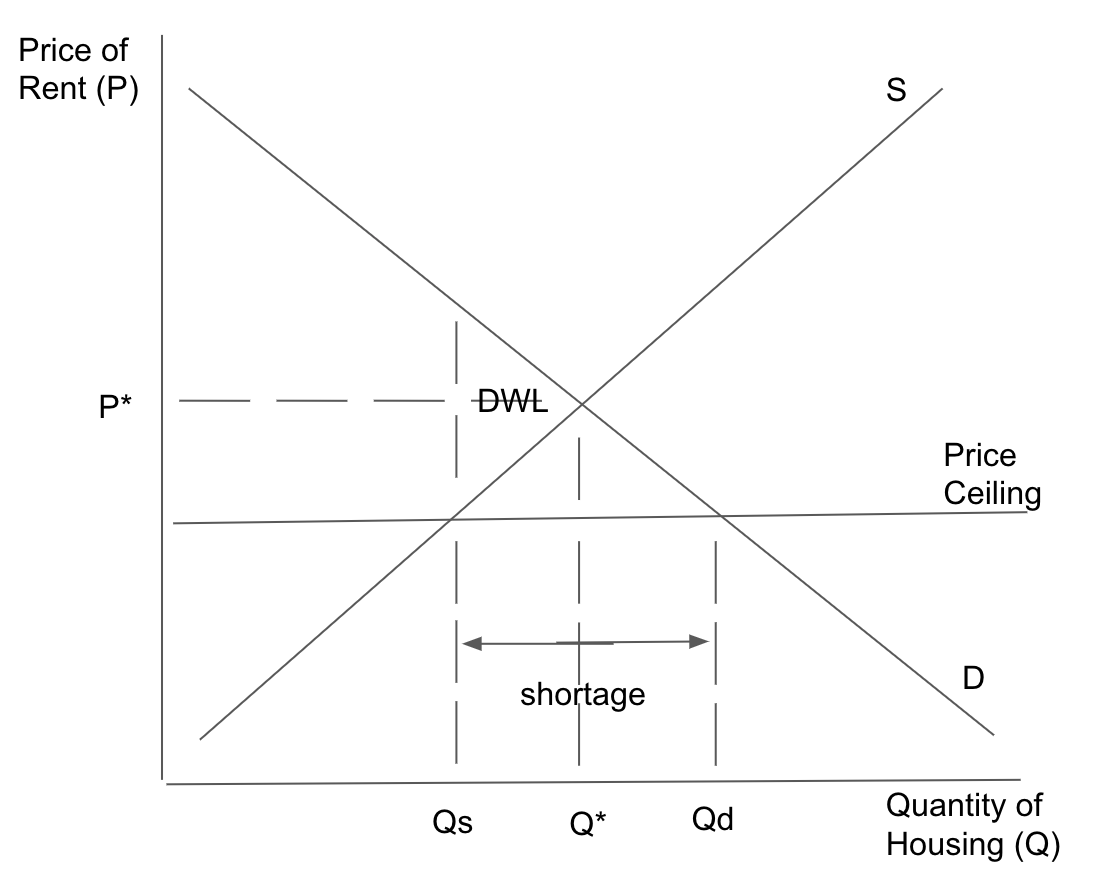
This rent ceiling is below equilibrium. What does the horizontal gap between Qs and Qd represent?
The equilibrium quantity
A surplus
The deadweight loss
A shortage
Qd exceeds Qs at the controlled rent, so renters can't all find a home.
Image: Karinnna13, CC BY-SA 4.0, via Wikimedia Commons.
How is a market demand curve derived from individual demand curves?
By adding prices vertically at each quantity
By averaging each person's quantity
By adding quantities demanded horizontally at each price
By taking the highest individual demand curve
Market demand sums quantity across all buyers at each price.
A new technology cuts production costs, and a health scare also reduces demand. What happens to price?
Price falls
Price is ambiguous
Price rises
Price doesn't change
Both effects push price down: supply shifts right (price down) and demand shifts left (price down). Quantity is the ambiguous variable.
Which statement about the demand curve is correct?
It shifts when the good's price changes
It shows how supply responds to price
It shows the quantity demanded at each price, holding other factors constant
It shows total spending at each price
The demand curve holds income, tastes, related prices and expectations fixed.
