Quiz · Medium
Check your grasp of dharma, karma, moksha, the Vedas and epics, the Trimurti, the Vedanta schools and major festivals.
True or false: Hinduism was founded by a single person.
True
False
It has no single founder; it developed over millennia.
What is the correct meaning of moksha?
Reward in heaven after death
Liberation from the cycle of rebirth
The duty of each social class
Devotional singing
Moksha is release from samsara. Heaven stays within the cycle; the other options describe dharma and bhakti.
Which pair is correctly matched?
Atman - ultimate reality
Brahman - the individual self
Atman - the individual self
Maya - the creator god
Atman is the self; Brahman is ultimate reality (Advaita identifies them). Maya is illusion, and Brahma, not Maya, is the creator.
Which are the four purusharthas?
Dharma, artha, kama, moksha
Karma, jnana, bhakti, raja
Sattva, rajas, tamas, moksha
Brahmin, Kshatriya, Vaishya, Shudra
The four goals are dharma, artha, kama and moksha. The second option lists yogas, the third mixes gunas and the fourth lists varnas.
In order, the four ashramas are:
Householder, student, renunciate, forest dweller
Student, householder, forest dweller, renunciate
Student, forest dweller, householder, renunciate
Householder, forest dweller, student, renunciate
Brahmacharya, grihastha, vanaprastha, sannyasa.
Which Veda is mainly a collection of hymns and is considered the oldest?
Atharvaveda
Samaveda
Rigveda
Yajurveda
The Rigveda has over a thousand hymns. Samaveda is chants, Yajurveda ritual formulas, and Atharvaveda spells and healing.
In this diagram, the Epics belong to which category?
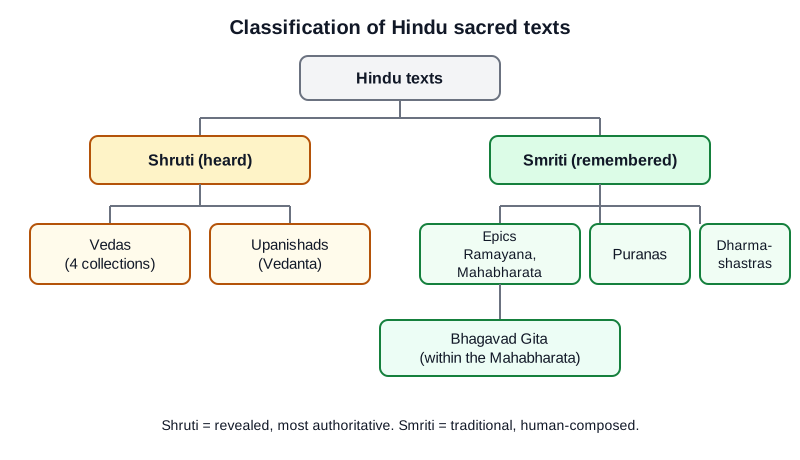
Shruti
Smriti
Vedanta
Upanishad
The Ramayana and Mahabharata are smriti (remembered), not revealed shruti.
Who is the consort of Vishnu in the Trimurti diagram?
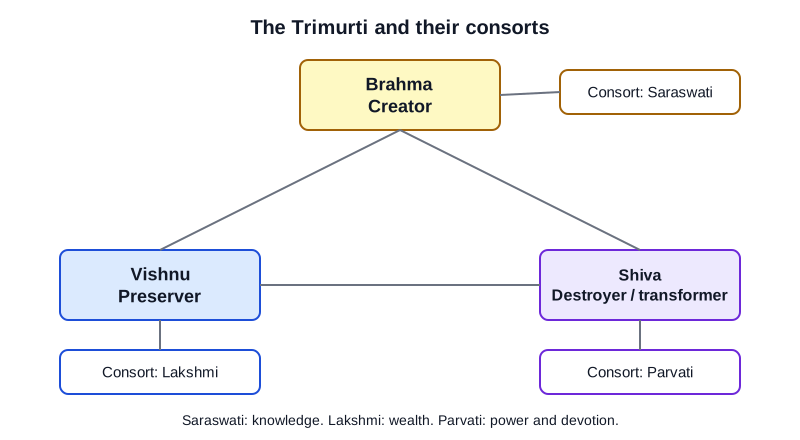
Saraswati
Parvati
Lakshmi
Durga
Lakshmi is Vishnu's consort; Saraswati is Brahma's, Parvati is Shiva's.
The Bhagavad Gita is a dialogue between:
Rama and Hanuman
Krishna and Arjuna
Shiva and Parvati
Vyasa and Valmiki
It records Krishna's teaching to Arjuna before the Kurukshetra war; Rama and Hanuman belong to the Ramayana.
Which teacher founded Advaita Vedanta's classic form?
Ramanuja
Madhva
Shankara
Patanjali
Shankara taught non-dualism. Ramanuja taught qualified non-dualism, Madhva dualism, and Patanjali wrote the Yoga Sutras.
Which path of yoga stresses loving devotion to a personal God?
Jnana
Bhakti
Karma
Raja
Bhakti. Jnana is knowledge, karma is action without attachment, raja is meditation.
Hindus generally avoid beef mainly because:
Cows are worshipped as the supreme God
Cows are revered as symbols of nonviolence and motherly care
The Vedas forbid all meat
It is forbidden for all Hindus by law everywhere
Reverence for the cow is linked to ahimsa. Cows are not considered the supreme deity, and diet practice varies.
Which festival celebrates the victory of Rama over Ravana?
Holi
Dussehra
Raksha Bandhan
Maha Shivaratri
Dussehra (the tenth day after Navaratri). Holi marks spring and Prahlada's story.
Which statement about the Upanishads is correct?
They are smriti law codes
They are the philosophical end of the Vedas
They are part of the Ramayana
They were written by Patanjali
Upanishads are Vedanta, 'the end of the Vedas'; they are shruti.
Which group is NOT one of the four varnas?
Kshatriya
Vaishya
Dalit
Shudra
Dalits were historically outside the varna system. The other three are varnas.
What does 'tat tvam asi' teach?
God is only transcendent
The self is identical with Brahman
Karma is an illusion
Worship requires an image
'That thou art' from the Chandogya Upanishad states the identity of atman and Brahman.
What is darshan?
Fasting during festivals
Seeing and being seen by a deity or holy person
A priest's training
A sacred thread ceremony
Darshan is sacred viewing; the thread ceremony is upanayana.
The Kumbh Mela is held in rotation at which set of cities?
Varanasi, Delhi, Mumbai, Chennai
Haridwar, Prayagraj, Ujjain, Nashik
Pushkar, Puri, Dwarka, Badrinath
Kolkata, Agra, Jaipur, Mysore
These four sites each host it every twelve years in turn.
Which reformer founded the Brahmo Samaj in 1828?
Dayananda Saraswati
Swami Vivekananda
Ram Mohan Roy
Mahatma Gandhi
Ram Mohan Roy. Dayananda founded the Arya Samaj in 1875.
Which of the following best describes the gunas?
Three qualities of nature: sattva, rajas, tamas
Three Vedas
Three main gods
Three paths to liberation
Sattva (harmony), rajas (energy), tamas (inertia) make up material nature; the Trimurti are the three main gods.
