Quiz · Medium
Check your grip on the most tested teaching strategies, assessment terms and lesson-planning models.
A teacher states the objective, models a skill step by step, has students practice with feedback, then assigns independent practice. Which approach is this?
Inquiry-based learning
Direct (explicit) instruction
Problem-based learning
Discovery learning
This is the classic explicit-instruction sequence. Inquiry and discovery begin with student investigation, not teacher modeling.
In a jigsaw activity, what does each student do in the expert group?
Master one part of the material so they can teach it to their home group
Complete the whole assignment alone
Debate the topic with the class
Take the final test for the group
Every student becomes the only source of one piece for their home group, which creates positive interdependence.
Which question best describes the 'flipped classroom'?
Students teach the whole lesson to the class
Class time is used for lectures and homework is skipped
Students choose any topic they like
Students first meet new content at home, then practice in class with teacher help
The flip moves content delivery out of class and uses class time for application. Lectures in class are the opposite.
Which of these is NOT one of Johnson and Johnson's five elements of cooperative learning?
Individual accountability
Positive interdependence
Competition between members
Group processing
Competition among members undermines cooperation. The five elements are positive interdependence, individual accountability, promotive interaction, social skills and group processing.
What is scaffolding?
Giving students easier tasks all year
Temporary support that is gradually removed as the learner becomes more capable
A permanent accommodation for a disability
Teaching only students at the same level
Scaffolds support learners through a task just beyond their ability and fade over time. Permanent simplification does not.
Which sequence matches the gradual release of responsibility model?
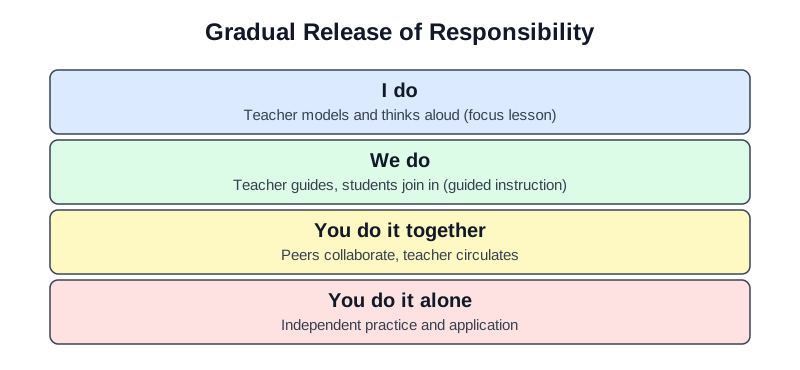
I do, we do, you do it together, you do it alone
You do, we do, I do
We do, I do, you do
I do, you do, we do
Responsibility moves from teacher to student.
Which phase of the 5E model comes right after Engage?
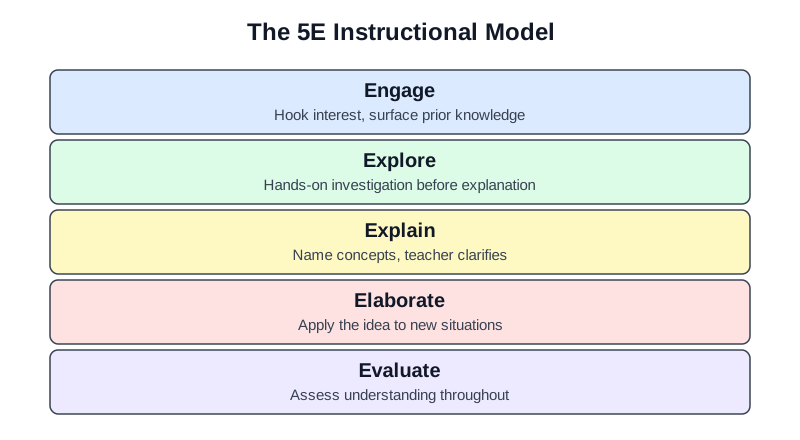
Explain
Elaborate
Evaluate
Explore
Students explore the phenomenon first, then the teacher helps them explain with formal terms.
In Bloom's Revised Taxonomy (2001), which level is at the top?
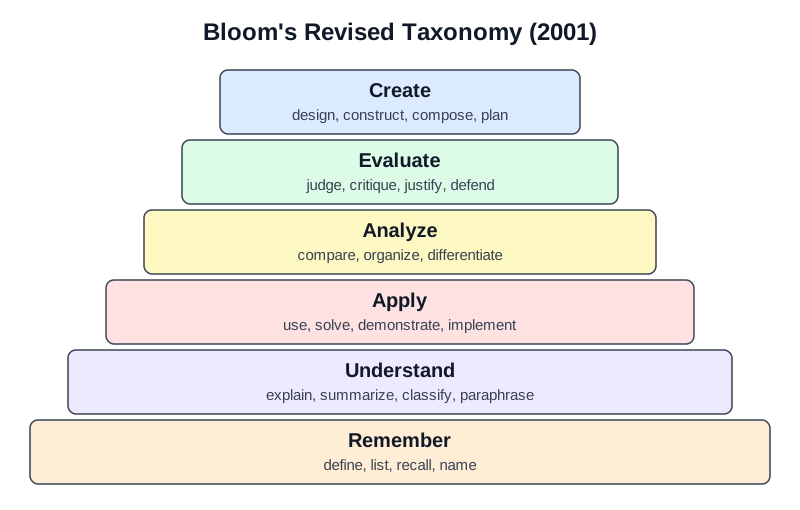
Evaluate
Analyze
Create
Synthesize
The revision moved Create above Evaluate. 'Synthesis' was the 1956 name for a level that became Create.
Which verb is best for a measurable learning objective?
Understand
Compare
Appreciate
Know
Compare is observable. 'Understand', 'know' and 'appreciate' cannot be directly observed or measured.
What is the main purpose of formative assessment?
To monitor learning and adjust teaching while instruction is in progress
To assign final grades
To rank students against each other
To satisfy accreditation reports
Formative = assessment FOR learning. Final grades and ranking are summative or norm-referenced uses.
An exam gives very consistent results, but it tests vocabulary when the goal is to measure reading comprehension. What is its problem?
It is valid but not reliable
It is neither reliable nor valid
It is norm-referenced
It is reliable but not valid
Consistency is reliability. Measuring the wrong thing is a validity problem.
A driver's license written test where everyone who scores 80 percent passes is which kind of assessment?
Norm-referenced
Diagnostic
Criterion-referenced
Portfolio
It compares each person to a fixed standard, not to other test takers.
Which statement about learning styles (visual, auditory, kinesthetic) is best supported by research?
Visual learners learn best from images only
Matching instruction to a student's preferred style has not been shown to improve learning
Students perform better when taught in their favorite modality
Learning styles should guide all lesson plans
Reviews (e.g., Pashler et al., 2008) found no evidence for the meshing hypothesis. Match the method to the content, not the preference.
What are the three tiers in RTI/MTSS?
Universal instruction, targeted small-group support, intensive individual support
Elementary, middle, high school
Remedial, average, gifted
Teacher, parent, administrator
Tier 1 serves everyone, Tier 2 targets groups needing more, Tier 3 is intensive.
Which law governs IEPs?
Section 504 of the Rehabilitation Act
The Every Student Succeeds Act (ESSA)
The Americans with Disabilities Act (ADA)
The Individuals with Disabilities Education Act (IDEA)
IEPs come from IDEA. Section 504 governs 504 plans, a separate plan for accommodations.
What is the first stage of backward design?
Plan learning activities
Write the final exam
Identify the desired results
Choose the textbook
Backward design: results, then assessment evidence, then the learning plan.
Which strategy is a retrieval practice activity?
Re-reading the chapter twice
Taking a short low-stakes quiz without notes
Highlighting key sentences
Copying the notes neatly
Retrieving from memory strengthens it. Re-reading, highlighting and copying are passive.
Think-pair-share is best described as:
Think alone, discuss with a partner, share with the class
Pair first, then think, then write
Share with the class, then pair up
Group debate followed by a vote
The solo thinking time comes first so everyone has something to say.
Which model gives each student a different part of a text that they must teach to others?
Four corners
Gallery walk
KWL
Jigsaw
Jigsaw builds interdependence because each expert holds unique information.
A KWL chart asks students what they Know, what they Want to know and:
What they Like
Which words they Wrote
What they Learned
What the Lesson was
KWL = Know, Want to know, Learned.
