Quiz · Medium
Intro-level archaeology questions on context, superposition, dating techniques, CRM and key sites.
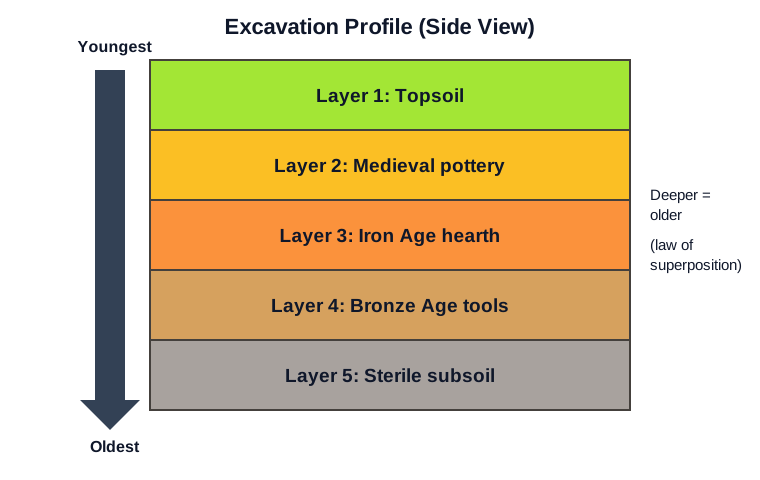
According to the law of superposition, in an undisturbed sequence:
Lower layers are younger
Lower layers are older
Layers with pottery are oldest
All layers are the same age
Deeper deposits were laid down first. Disturbance (pits, burrows) can break the rule, which is why context matters.
In the profile shown, which layer with human material is the oldest?
Layer 2: Medieval pottery
Layer 4: Bronze Age tools
Layer 1: Topsoil
Layer 5: Sterile subsoil
Layer 4 is deepest among layers with human material. Layer 5 is deeper but sterile (no cultural remains), so it is the natural base, not an occupation.
A hearth, a post hole and a stone wall are examples of:
Ecofacts
Features
Middens
Artifacts
Features cannot be removed from the site without destroying them. Artifacts are portable.
Seeds and animal bones that show no human modification are called:
Ecofacts
Proveniences
Artifacts
Features
Ecofacts are natural remains that still carry information about past human life.
Provenience refers to:
The material an object is made of
The exact location where an item was found
The ownership history of an object
The age of an object
Provenience = findspot; provenance = ownership history, which is the common confusion.
The half-life of carbon-14 is about:
5,730 years
57,300 years
573 years
5.73 million years
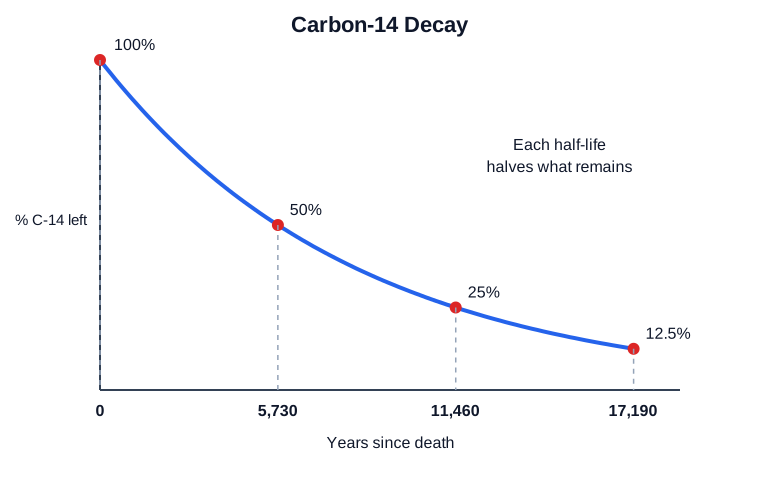
After about 5,730 years half remains.
A bone has 25% of its original C-14. About how old is it (using the 5,730-year half-life)?
11,460 years
5,730 years
22,920 years
17,190 years
25% is two half-lives, so 2 x 5,730 = 11,460 years.
Why is radiocarbon dating unsuitable for a 2-million-year-old fossil?
Fossils contain no carbon
Carbon-14 is stable
Only metals can be dated
Too little C-14 remains after about 50,000 years
Beyond about 50,000 years nearly all C-14 is gone. Methods such as K-Ar are used for older volcanic contexts.
Which method matches tree-ring patterns to give exact calendar dates?
Seriation
Dendrochronology
Obsidian hydration
Thermoluminescence
Dendrochronology also provides the calibration curve for radiocarbon.
Which dating technique is most suitable for volcanic ash layers at early hominin sites in East Africa?
Radiocarbon
Potassium-argon
Dendrochronology
Pollen analysis
K-Ar dates volcanic rock and covers very long time spans.
Ordering artifact styles by their rising and falling popularity is called:
Calibration
Flotation
Stratigraphy
Seriation
Seriation is a relative dating method.
Which procedure recovers charred seeds from excavated soil?
LiDAR
Seriation
Screening
Flotation
Flotation uses water so light plant remains rise to the surface; screening catches larger items.
Processual archaeology (the 'New Archaeology') emphasized:
Subjective interpretation and symbolism
Art-historical classification
Treasure hunting
Hypothesis testing and scientific explanation
Lewis Binford led the processual movement in the 1960s. Post-processualism emphasized interpretation.
Which law provides for the return of Native American human remains and sacred objects?
Antiquities Act (1906)
Clean Water Act
NHPA (1966)
NAGPRA (1990)
NAGPRA covers repatriation; the Antiquities Act protects sites on federal land.
Most archaeology in the US today is done in the context of:
Museum collections only
Private treasure hunting
Universities only
Cultural Resource Management
CRM firms do surveys and excavations required before construction on federal land or with federal funds.
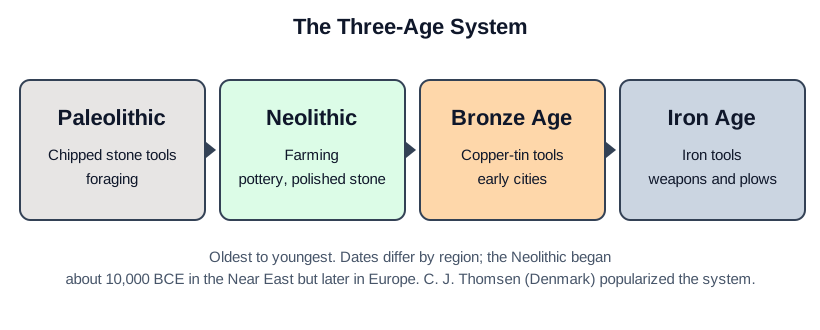
This diagram shows four stages. They are the:
Hominin species in order
Three-Age System divided into Paleolithic, Neolithic, Bronze Age and Iron Age
Four fields of anthropology
Stages of state formation
The system orders technology: stone, bronze, iron.
The Neolithic Revolution is best described as:
The invention of writing
The first use of fire
The rise of iron tools
The shift to farming and herding
Settled farming began around 10,000 BCE in the Near East. Writing came later.
Which site in Turkey has monumental pillars built by hunter-gatherers around 9500 BCE?
Çatalhöyük
Troy
Jericho
Göbekli Tepe
Göbekli Tepe predates farming; Çatalhöyük is a later Neolithic town.
Which tool tradition is associated with Homo erectus and bifacial hand axes?
Mousterian
Acheulean
Oldowan
Aurignacian
Acheulean (from 1.7 mya). Oldowan is the earlier simple chopper tradition; Mousterian is Neanderthal.
Which individual is the naturally mummified Copper Age man found in the Alps in 1991?
Tollund Man
Lucy
Kennewick Man
Ötzi
Ötzi lived about 3300 BCE. Tollund Man is an Iron Age bog body from Denmark.
Stable isotope analysis of bone collagen mainly helps archaeologists learn about:
Tool type
Exact calendar year of death
Language spoken
Diet
Carbon and nitrogen isotopes reflect diet; strontium and oxygen reflect geographic origin.
The Rosetta Stone was crucial because it:
Gave the same text in three scripts, allowing hieroglyphs to be deciphered
Gave the date of the pyramids
Described Troy
Was the earliest known writing
Champollion used the Greek text to decipher hieroglyphs in 1822.
Which is the best example of a feature?
A pottery sherd
A projectile point
A buried storage pit
A charred seed
Pits cannot be removed intact from the ground; the others are portable (artifacts) or natural (ecofact).
Which statement about looting is most accurate?
It is legal on all land
It destroys context, which is the main source of information
It helps archaeologists find sites
It is harmless if objects end up in museums
Context is lost the moment an object is dug up without recording.
