Quiz · Medium
Twenty-one questions on classifying estates and future interests, concurrent ownership, landlord-tenant law, deeds, recording, adverse possession, easements and covenants.
O conveys Blackacre "to A so long as the premises are used for church purposes." What interest does O hold?
A right of entry
A possibility of reverter
A reversion
A shifting executory interest
"So long as" is durational language that creates a fee simple determinable, and the grantor keeps a possibility of reverter. A right of entry follows a fee simple subject to condition subsequent ("but if"), and a reversion follows an estate of lesser duration, like a life estate.
O conveys "to A for life, then to B and her heirs." What interest does B hold?
An indefeasibly vested remainder in fee simple
A contingent remainder
An executory interest
A reversion
B is ascertained and there is no condition precedent other than the natural end of A's life estate, so the remainder is vested. Nothing can divest it, so it is indefeasibly vested. O has no reversion, since the whole fee was given away.
O conveys "to A for life, then to B if B survives A." During A's life, who holds a reversion?
B
A
No one
O, because B's remainder is contingent
B's remainder is subject to the condition precedent of surviving A, so it is contingent. When the remainder is contingent, the grantor keeps a reversion in case it never vests.
Which of the following is NOT subject to the Rule Against Perpetuities?
A contingent remainder
An executory interest
A reversion
A vested remainder subject to open
The Rule applies to contingent remainders, executory interests, vested remainders subject to open, and options in gross. Interests retained by the grantor (reversion, possibility of reverter, right of entry) are not subject to the Rule.
A, B and C own land as joint tenants with right of survivorship. A conveys her interest to D by deed. Who owns what?
B, C and D own as joint tenants
B and C own two-thirds as joint tenants, and D owns one-third as a tenant in common
D owns the whole
B and C own the whole as joint tenants and D owns nothing
A's inter vivos conveyance severs the joint tenancy as to her share, and D takes as a tenant in common. The joint tenancy between B and C continues as to their two-thirds.
Two co-tenants own land as tenants in common. One co-tenant lives on the land and does not exclude the other. Must the occupying co-tenant pay rent to the other?
No, absent an ouster or an agreement
Yes, fair rental value
Yes, if the occupant makes a profit
No, but only if the land is a residence
Each co-tenant has the right to possess the whole. A co-tenant in sole possession owes no rent unless there is an ouster, though rent collected from third parties must be shared.
In which situation does a tenant have a periodic tenancy?
A lease for exactly two years
A tenant continues to stay after the lease ends without the landlord's consent and the landlord has not decided what to do
A lease that says the tenant may stay until the landlord asks them to leave
A tenant pays rent monthly under an oral lease, and the term is not stated
A periodic tenancy renews automatically for successive periods and arises when rent is paid per period without a fixed term. A fixed two-year lease is a term of years, and a holdover who stays without consent is a tenant at sufferance until the landlord elects.
A landlord leased an apartment. The heating system fails in January and the landlord refuses to repair it for months. The tenant gives notice and moves out within a reasonable time. What is the likely result?
The tenant is liable for rent through the end of the lease
The tenant has only a claim for damages and must continue paying rent
The tenant has been constructively evicted and is excused from further rent
The tenant has abandoned the lease and owes the landlord damages
Constructive eviction requires substantial interference caused by the landlord, notice, and the tenant vacating within a reasonable time. The tenant is then released from further rent.
What is the main difference between a general warranty deed and a quitclaim deed?
A quitclaim deed does not transfer title
A quitclaim deed contains no covenants of title
A general warranty deed need not be signed
A quitclaim deed must be recorded to be valid
A quitclaim deed conveys whatever interest the grantor has, if any, with no covenants of title. It is still a valid conveyance. Both require a signed writing, and recording is not required for validity.
Owner O sells land to A, who does not record. O later sells the same land to B, who gives value and has no notice of the earlier sale, and B records. In a notice jurisdiction, who wins?
B, because B is a bona fide purchaser without notice
A, because A bought first
Neither; the sale to B was void
A, because B recorded after A's possession began
In a notice jurisdiction, a subsequent BFP without notice prevails over a prior unrecorded interest. B paid value and had no notice. A's possession could give inquiry notice, but nothing says A took possession.
O sells land to A. A does not record. O then sells to B, who records, but B knew about the sale to A. In a race-notice jurisdiction, who wins?
B, because B recorded first
B, because B paid value
Neither, until a court decides
A, because B had notice
Race-notice requires a subsequent purchaser to take without notice and to record first. B had actual notice, so B is not a BFP and cannot win even though B recorded first.
Which of the following is generally NOT required for adverse possession?
Open and notorious possession
Continuous possession for the statutory period
Payment of property taxes
Actual possession
Actual, open and notorious, exclusive, hostile, and continuous possession are required. Payment of property taxes is an additional element in only a minority of states.
An easement is created when a landowner who owns two lots sells one, and the buyer has been using a path across the retained lot to reach the street. What kind of easement is likely?
An easement by prescription
An easement implied from prior use
An easement by estoppel
A profit
The common ownership before severance, an apparent and continuous prior use, and reasonable necessity create an implied easement. Prescription requires adverse use for the statutory period by someone other than the owner.
When does an easement by necessity end?
When the necessity ends
When the dominant owner sells the land
After 20 years
Only by a written release
An easement by necessity lasts only as long as the necessity does. If the dominant owner gets another access, the easement is extinguished.
Which requirement applies to a real covenant but NOT to an equitable servitude?
Intent to bind successors
Touch and concern
Notice
Privity of estate (horizontal privity)
Real covenants (damages at law) require horizontal and vertical privity. Equitable servitudes (injunction) do not, but need a writing, intent, touch and concern, and notice.
Which of the following is a correct statement about private nuisance?
It requires a physical invasion of land
It requires intent to harm
It requires a substantial and unreasonable interference with the use and enjoyment of land
It cannot be remedied by an injunction
Private nuisance is about substantial, unreasonable interference with use and enjoyment, and can be remedied by damages or an injunction. Physical invasion is trespass.
Under the majority rule, who bears the risk of loss if a house burns down after the sales contract is signed but before closing, and the contract is silent?
The seller
The buyer
Both equally
Neither; the contract is void
Under equitable conversion, the buyer is the equitable owner from the time of the contract and bears the risk of loss. A minority of states and statutes place the risk on the seller until closing.
A township in the U.S. Public Land Survey System contains how many sections?
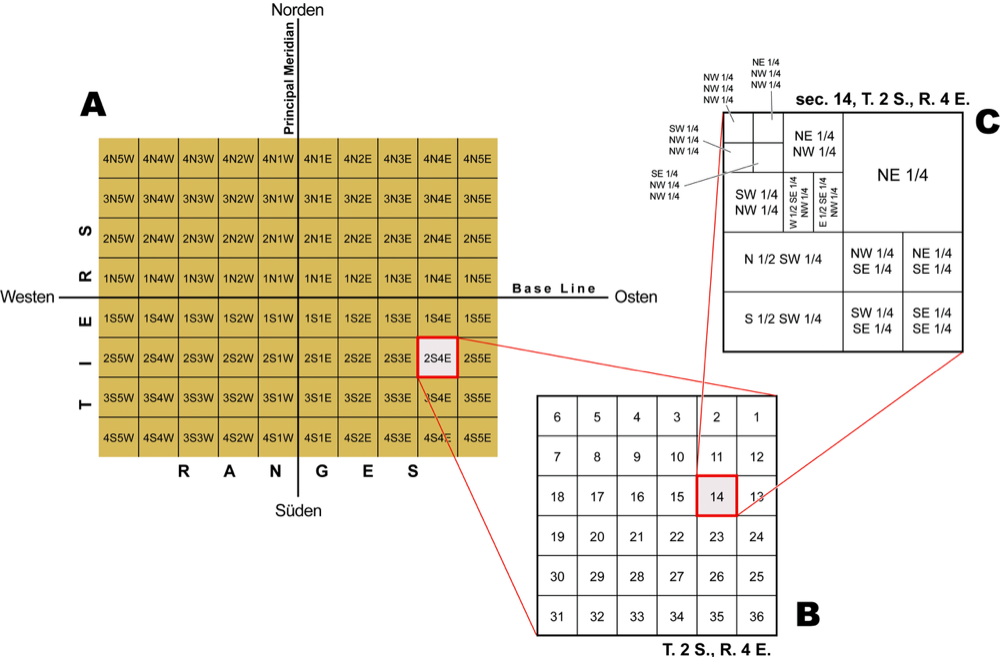
36
16
25
64
A township is six miles by six miles, divided into 36 sections of one square mile (640 acres) each. Image: Gretarsson, CC BY-SA 3.0, via Wikimedia Commons.
What did Pierson v. Post decide about the wild fox?

Post owned the fox because he was the first to pursue it with hounds
The fox belonged to the landowner
Neither man could own a wild animal
Pursuit alone does not give ownership. The person who captures the animal owns it
The court held that occupancy by capture, mortal wounding, or entrapment is required to establish ownership of a wild animal. Mere pursuit gives no property right. Image: Larry Lamsa, CC BY 2.0, via Wikimedia Commons.
A landowner posts a sign stating that the public may cross the land by revocable license only. What does the sign most likely accomplish?
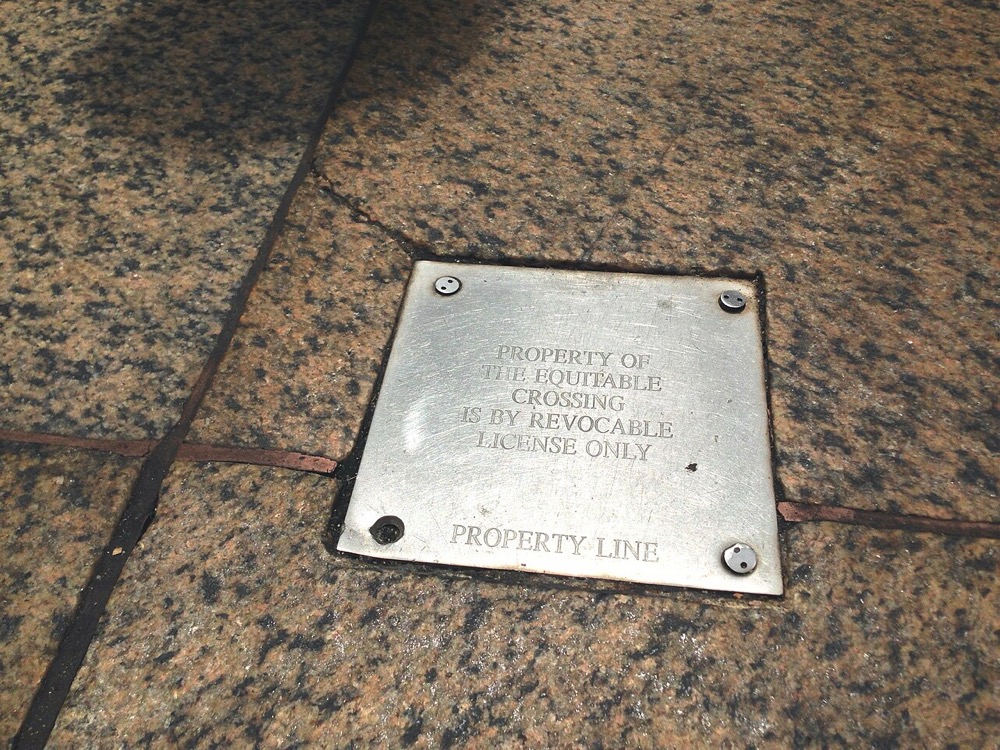
It creates an easement appurtenant
It gives the public a permanent right of way
It prevents members of the public from acquiring a prescriptive easement
It transfers title to the government
A license is permission, and permissive use is not hostile or adverse. The posted notice defeats the hostility needed for a prescriptive easement. It also shows the owner can revoke the license at any time. Image: Z22, CC BY-SA 4.0, via Wikimedia Commons.
