Quiz · Medium
Dramatic terms, Greek tragedy, staging and major plays from Sophocles to Hansberry, with image questions.
In Greek theatre, the orchestra was:
The circular area where the chorus danced and sang
The raised stage for the actors
The seating area
The building behind the actors
The skene was the building behind; the theatron was the seating.
In Greek tragedy, the term for a hero's error or flaw that leads to downfall is:
Hamartia
Anagnorisis
Hubris
Catharsis
Hamartia is the error. Catharsis is the audience's emotional release, anagnorisis is recognition, and hubris is arrogant pride (often the cause of the error).
Who wrote Oedipus Rex?
Sophocles
Euripides
Aristophanes
Aeschylus
Sophocles (c. 429 BC). Aeschylus wrote the Oresteia, Euripides wrote Medea and Aristophanes wrote comedies.
Which element does Aristotle rank most important in tragedy?
Melody
Plot
Character
Spectacle
Aristotle calls plot the "soul" of tragedy, ahead of character, thought, diction, melody and spectacle.
Which of the three unities was actually stressed by Aristotle?
Unity of place
Unity of action
Unity of time
All three equally
Aristotle stressed a single, coherent action and only mentioned time loosely. The unities of time and place were codified by Renaissance critics.
Which dramatist wrote Tartuffe?
Racine
Moliere
Corneille
Beaumarchais
Moliere's 1664 comedy satirizes religious hypocrisy. Racine and Corneille wrote tragedies.
A "deus ex machina" is:
An unexpected, contrived solution that resolves a plot at the last minute
The final catastrophe of a tragedy
A speech by the chorus
An actor's hidden aside to the audience
It literally means "god from the machine": a god lowered onto the stage by a crane to settle matters.
Which statement about Lysistrata is correct?
It is a morality play
It is a tragedy by Sophocles about the Trojan War
It is an Aristophanes comedy in which women withhold sex to end a war
It is a Roman comedy by Plautus
Aristophanes' Lysistrata (411 BC) is an anti-war comedy about the Peloponnesian War.
A soliloquy is:
A long speech to another character
A short remark the other characters on stage cannot hear
A speech in which a character alone on stage voices inner thoughts to the audience
A song by the chorus
The second option describes an aside. A monologue is a speech to others on stage.
Dramatic irony occurs when:
The audience knows something a character does not
An actor forgets a line
A character addresses the audience directly
A character says the opposite of what they mean
The second option is verbal irony. The third is breaking the fourth wall.
Nora leaves her family at the end of which play?
Miss Julie
Hedda Gabler
A Doll's House
The Seagull
Ibsen's A Doll's House (1879) ends with Nora leaving Torvald and slamming the door. Hedda Gabler ends in Hedda's suicide.
Which playwright is associated with the Moscow Art Theatre and plays such as The Cherry Orchard?
Bertolt Brecht
George Bernard Shaw
Henrik Ibsen
Anton Chekhov
Chekhov's plays were staged by Stanislavski at the Moscow Art Theatre. Brecht worked in Germany and Shaw in Britain.
The Importance of Being Earnest is a play by:
Noel Coward
Oscar Wilde
George Bernard Shaw
Richard Brinsley Sheridan
Wilde's "trivial comedy for serious people" (1895) features Lady Bracknell and Bunburying.
In Death of a Salesman, who is Willy Loman?
A lawyer who defends his sons
A farmer losing his land
An aging salesman clinging to the American Dream
A detective investigating a murder
Willy's sense of success is built on being "well liked", but his career and family collapse.
Arthur Miller's The Crucible uses the Salem witch trials to criticize:
Prohibition
The Great Depression
The Vietnam War
McCarthyism and the Red Scare
Miller wrote it in 1953 as an allegory of the House Un-American Activities Committee investigations.
Which play contains the characters Vladimir and Estragon?
Waiting for Godot
No Exit
Rosencrantz and Guildenstern Are Dead
Rhinoceros
Beckett's tramps wait for a Godot who never comes. Stoppard's play follows two minor Hamlet characters.
Brecht's Verfremdungseffekt is intended to:
Make the audience cry
Help the audience forget the play is a play
Hide the stage machinery
Distance the audience so they think critically rather than lose themselves in emotion
Brecht used placards, songs and visible lights so audiences would question social conditions.
Which term describes Beckett, Ionesco and Pinter?
Restoration comedy
Kitchen sink realism
Naturalism
Theatre of the Absurd
The Absurdists dramatized human life as meaningless, often with circular plots and broken communication.
What is the stage area closest to the audience called?
Upstage
Downstage
Backstage
Stage left
Upstage is away from the audience. Stage left is from the actor's point of view.
A thrust stage has the audience on all four sides.
True
False
A thrust stage projects into the audience on three sides. Theatre in the round (arena) has audience on all four.
Which play was inspired by a line of poetry by Langston Hughes?
Fences
A Raisin in the Sun
The Glass Menagerie
Death of a Salesman
Hansberry took her title from "Harlem" ("What happens to a dream deferred?").
Who is shown in this image?
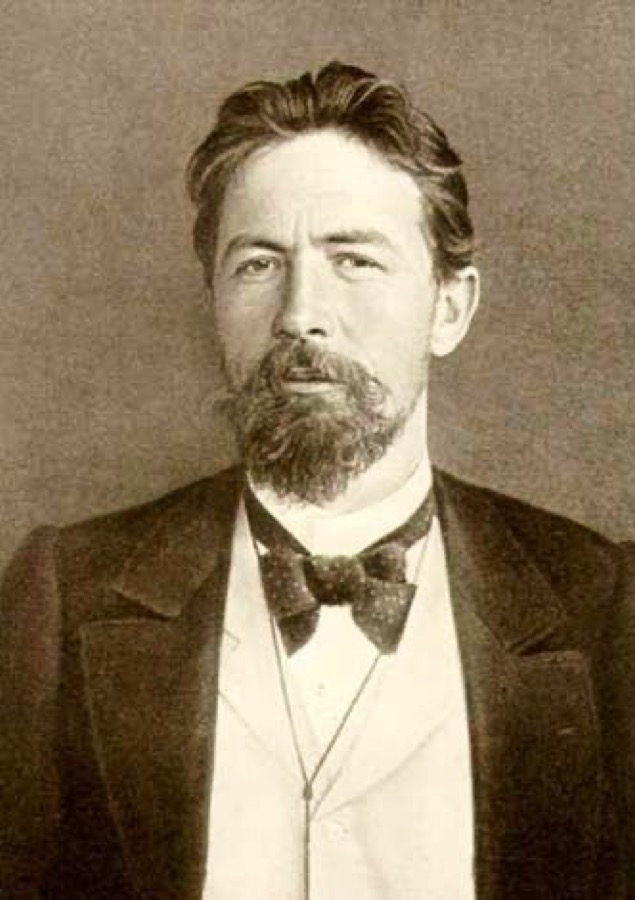
Anton Chekhov
August Strindberg
Leo Tolstoy
Henrik Ibsen
Anton Chekhov (1860-1904), physician and author of The Cherry Orchard. Image: public domain, via Wikimedia Commons.
These two masks, from a Roman mosaic, symbolize:
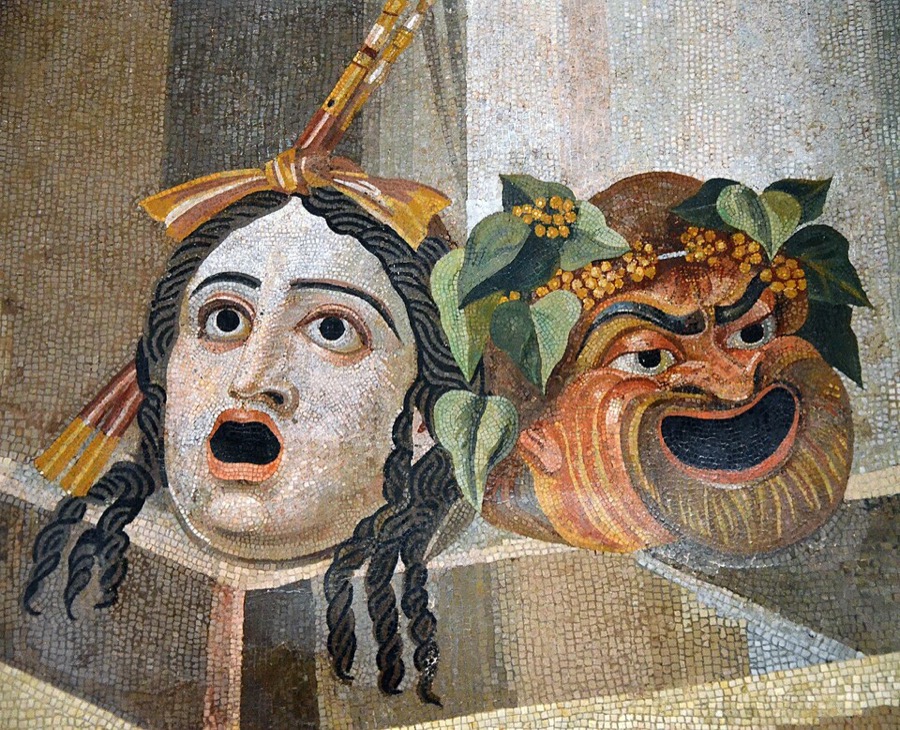
Day and night
Good and evil in morality plays
Tragedy and comedy
Chorus and actor
The paired masks are the traditional emblem of theatre. Image: Carole Raddato, public domain, via Wikimedia Commons.
Which of the following is a Japanese form with masks and a bare wooden stage?
Bunraku
Peking opera
Noh
Kabuki
Noh has masks and minimalist staging. Kabuki is flamboyant and unmasked; Bunraku uses puppets; Peking opera is Chinese.
